







-

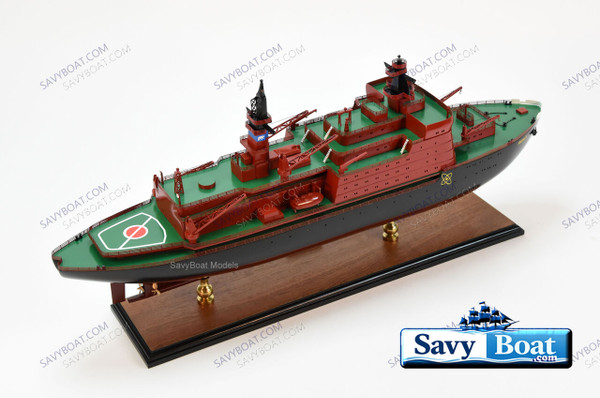
YAMAL YAMEL ICE BREAKER
SAVY DIRECT PRICE $729.96MSRP: $799.99YAMAL ICEBREAKER FULLY BUILT AND READY TO DISPLAY MUSEUM QUALITY SHIP MODEL Dimension approx.: 29″ L x 6″ W x 12.5″H The model is 100% hand built by artisans from scratch Handcrafted from... -


KAPITAN KHLEBNIKOV ICE BREAKER
SAVY DIRECT PRICE $689.96MSRP: $729.99KAPITAN KHLEBNIKOV ICE BREAKER FULLY BUILT AND READY TO DISPLAY, QUALITY SHIP MODEL Dimension approx.: 32″L x 7″W x 13″H The model is already built. THIS IS NOT A MODEL SHIP KIT Wh
Description

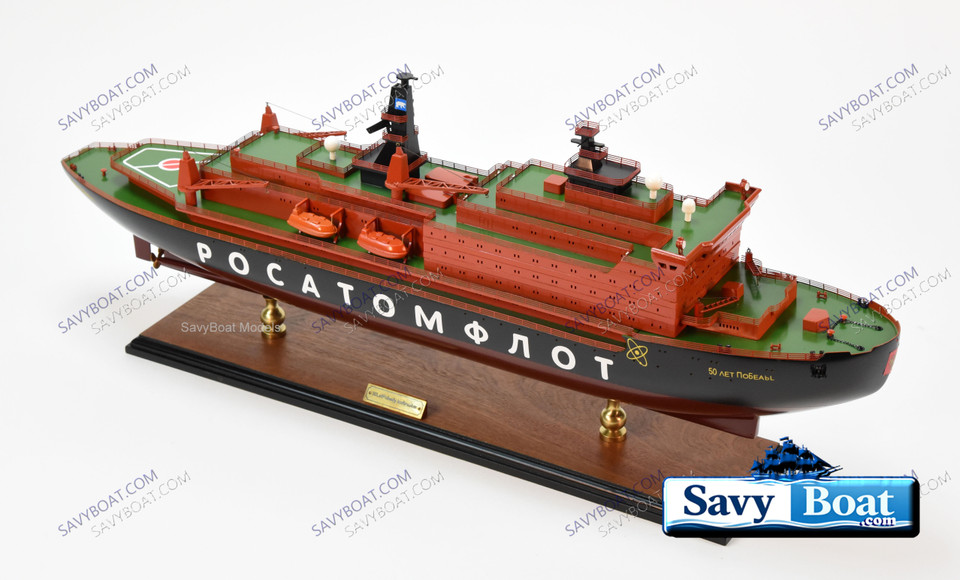
50 LET POBEDY RUSSIAN ARKTIKA-CLASS NUCLEAR POWERED ICEBREAKER
FULLY BUILT AND READY TO DISPLAY, QUALITY SHIP MODEL
- Dimension approx.: 32″L x 5.5″W x 12″H
- Scale 1:200
- The model is already built, NOT a model ship kit
When the 50 Let Pobedy finally entered service in 2007, she was already a legend in the making — a ship born in the last years of the Soviet Union, abandoned in the chaos that followed, and resurrected to become one of the most powerful icebreakers ever built. Her name means “50 Years of Victory,” commemorating the Soviet triumph in the Second World War, but it also reflects her own improbable survival.
Construction began on 4 October 1989 at the Baltic Shipyard in Leningrad, when the Soviet Union still envisioned a vast nuclear icebreaker fleet to dominate the Northern Sea Route. She was originally named NS Ural, the newest member of the Arktika‑class, a line of nuclear giants built to smash through the Arctic’s hardest pack ice.
But the world shifted beneath her keel. The Soviet Union dissolved, funding evaporated, and by 1994 the half‑finished ship sat silent in the yard — a 25,000‑ton monument to a vanished era. For nearly a decade she remained frozen in time, her hull complete but her future uncertain.
In 1995, during preparations for the 50th anniversary of Victory Day, she was renamed 50 Let Pobedy, but the gesture was symbolic; real work would not resume until 2003, when Russia recommitted to rebuilding its Arctic infrastructure.
Just as momentum returned, disaster struck. On 30 November 2004, a fire broke out aboard the unfinished ship, burning for nearly 20 hours before firefighters subdued it. One worker was hospitalized, and the incident threatened to derail the project once again.
But the shipyard pressed on. The vessel was rebuilt, modernized, and finally completed in early 2007, nearly 18 years after her keel was laid.
In February 2007, 50 Let Pobedy sailed into the Gulf of Finland for sea trials. Her twin OK‑900A nuclear reactors, generating 342 MW of thermal power, drove her to 21.4 knots — remarkable for a ship with a reinforced double hull and a displacement exceeding 25,000 tons.
She was the first Arktika‑class icebreaker with a spoon‑shaped bow, a design that allowed her to ride up onto thick ice and crush it under her weight. With 75,000 horsepower driving three massive propellers, she could break through 2.5 meters of ice continuously, and far thicker ridges by ramming.
On 11 April 2007, she arrived at her homeport of Murmansk, ready for service.
In operation, 50 Let Pobedy became a workhorse of Russia’s Arctic ambitions. She escorted convoys through the Kara and Laptev Seas, supported scientific missions, and maintained the Northern Sea Route in some of the harshest ice conditions on Earth.
But she also became a vessel of adventure. During summer months, she carried tourists to the North Pole, offering helicopter flights, ice landings, and the surreal experience of standing at 90° N. Her accommodations — cabins, lounges, a pool, a sauna — made her a rare blend of brute force and unexpected comfort.
On 26 January 2025, she collided with the cargo ship Yamal Krechet in the Kara Sea, damaging her port bow plating. No injuries occurred, and the nuclear icebreaker continued operating — a reminder of her rugged construction and the unforgiving environment she inhabits.
Today, 50 Let Pobedy stands as a symbol of Russia’s Arctic presence: a nuclear‑powered leviathan capable of operating for 7.5 months without refueling, carrying a crew of up to 189, and navigating ice fields that would stop almost any other ship on Earth.
Her long, troubled construction mirrors the upheavals of the nation that built her. Yet she endures — powerful, purposeful, and still carving a path through the frozen crown of the world.