







-


EDMUND FITZGERALD GREAT LAKES FREIGHTER 40"
SAVY DIRECT PRICE $729.96MSRP: $799.99EDMUND FITZGERALD GREAT LAKES FREIGHTER Dimension Approx.: 40″ (long) x 4.5″ (wide) x 9″ (high) The model is 100% hand built by artisans from scratch Base and name plate included. The model is... -


EDWARD L RYERSONGREAT LAKES FREIGHTER
SAVY DIRECT PRICE $719.96MSRP: $749.99EDWARD L RYERSON GREAT LAKES FREIGHTER FULLY BUILT AND READY TO DISPLAY HIGH QUALITY SHIP MODEL ARGE MUSEUM QUALITY MODEL Dimension Approx.: 32″ (long) x 3.25″ (wide) x 7″... -
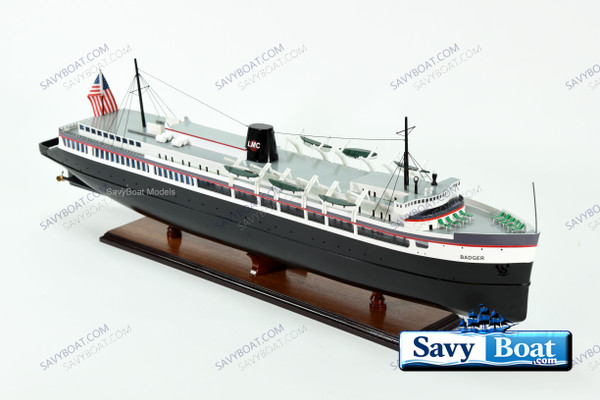
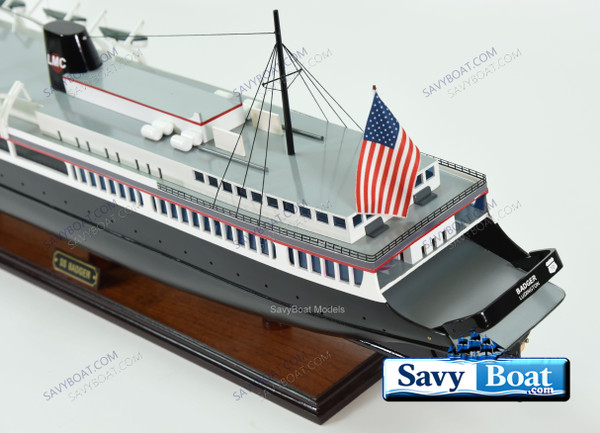
SS BADGER GREAT LAKE FERRY
SAVY DIRECT PRICE $699.96MSRP: $749.99SS BADGER GREAT LAKE FERRY FULLY BUILT AND READY TO DISPLAY SHIP MODEL Dimension approx.: 36″ L x 7″ W x 11″ H The model is already built. THIS IS NOT A MODEL SHIP KIT When the
Description

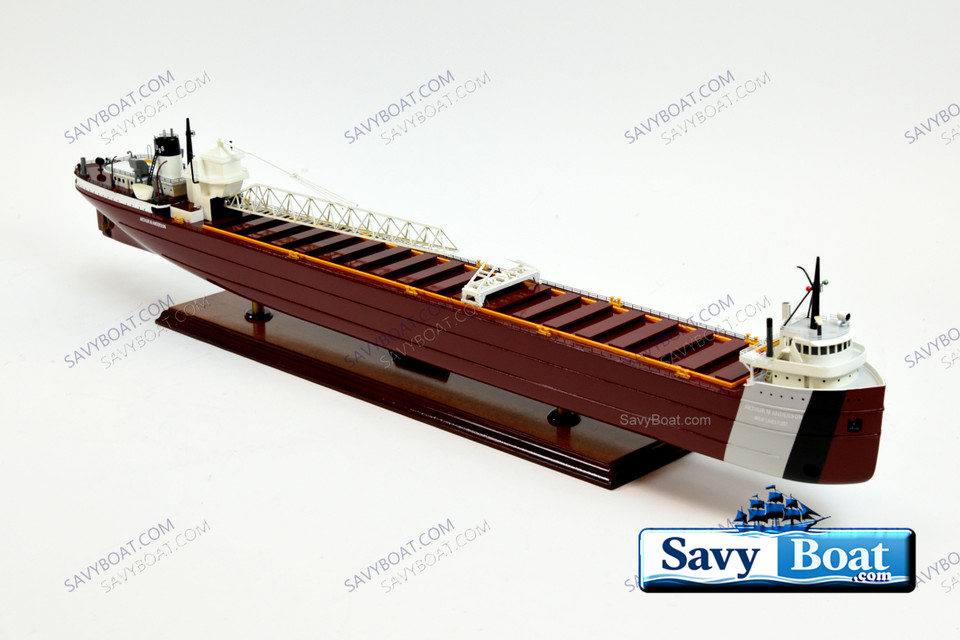
SS ARTHUR M ANDERSON GREAT LAKE FREIGHTER SHIP
FULLY BUILT AND READY TO DISPLAY HIGH QUALITY SHIP MODEL
- This beautiful model is already built, NOT a kit.
- approx 36″ (high) x 4″ (wide) x 7″ (high)
Launched on 16 February 1952 at the American Shipbuilding Company yard in Lorain, Ohio, the SS Arthur M. Anderson entered service as one of U.S. Steel’s proud AAA‑class freighters—big, rugged, and built for the relentless demands of Great Lakes ore transport. Named for Arthur Marvin Anderson, a senior U.S. Steel executive and J.P. Morgan & Co. vice chairman, she embodied the industrial might of mid‑century America: 647 feet long, 70 feet abeam, and powered by a 7,700‑shp Westinghouse steam turbine that pushed her to a respectable 15 knots. Her hull, designed with a slightly softer midsection, limited her cargo capacity compared to her sisters, but she quickly proved herself a dependable workhorse on the ore routes between Minnesota, Michigan, and Ohio.
Through the decades, the Anderson evolved with the industry. In 1975, she was lengthened by 120 feet, boosting her tonnage to over 26,500 GT and extending her usefulness in an era of ever‑larger lakers. A self‑unloading boom was added in 1981, transforming her into a more efficient, versatile carrier capable of faster turnarounds at ports across the lakes. She also took part in U.S. government winter navigation trials in the mid‑1970s, testing the limits of year‑round shipping on ice‑choked waters.
But it was the night of 10 November 1975 that forever etched the Arthur M. Anderson into Great Lakes history. Battling a brutal Lake Superior storm with hurricane‑force gusts and towering seas, she sailed in close company with the SS Edmund Fitzgerald. The Anderson was the last vessel to maintain visual, radar, and radio contact with the Fitzgerald before the giant ore carrier vanished from the screens—lost with all 29 men aboard. When the call came to search for survivors, the Anderson turned back into the storm, becoming the first rescue vessel on the scene, her crew risking their own safety in the desperate hope of finding life amid the wreckage. Their courage remains one of the most respected chapters in Great Lakes maritime lore.
In the decades that followed, the Arthur M. Anderson continued her steady service, enduring harsh winters, heavy cargoes, and the slow attrition of time. In February 2015, she made headlines again when she became trapped in deep ice near Conneaut Harbor, Ohio—an incident that underscored both the challenges of winter navigation and the ship’s enduring presence on the lakes. In recent years, she has been laid up in Toledo, Ohio, awaiting future decisions about her operational fate.
Today, the Arthur M. Anderson stands as one of the most storied vessels still afloat on the Great Lakes. She is remembered not only for her long and hardworking career, but for her role on that fateful November night—an enduring symbol of seamanship, resilience, and the quiet heroism that defines life on the inland seas.