








-

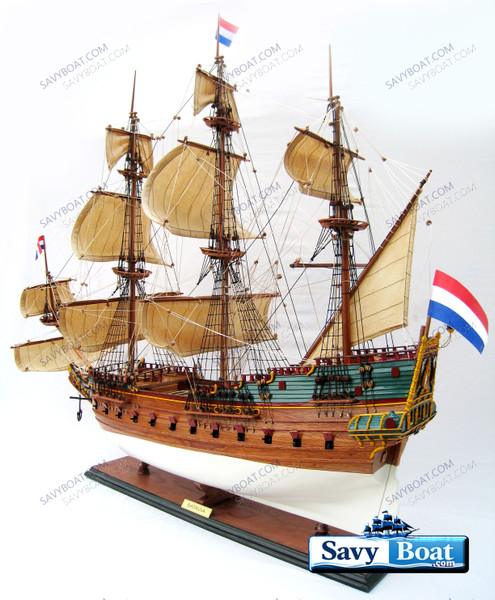
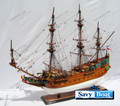
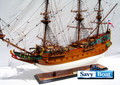
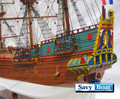
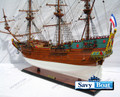
BATAVIA MERCHANT TALL SHIP W/ SAILS
SAVY DIRECT PRICE $1,099.96MSRP: $1,199.99BATAVIA MERCHANT TALL SHIP (WITH SAILS) FULLY BUILT AND READY TO DISPLAY MUSEUM QUALITY SHIP MODEL Dimension approx.: 32.6L x 7.4W x 29.5H The model is already built. THIS IS... -


USS RATTLESNAKE TALL SHIP (NO SAILS)
SAVY DIRECT PRICE $579.96MSRP: $629.99USS RATTLESNAKE TALL SHIP (NO SAILS) FULLY BUILT AND READY TO DISPLAY, QUALITY SHIP MODEL Dimension approx.: 28″ (long) x 9″ (wide) x 20″ (high) The model is already built. THIS IS... -


USS OHIO TALL SHIP W/ SAILS
SAVY DIRECT PRICE $799.96MSRP: $799.99USS OHIO TALL SHIP WITH SAILS FULLY BUILT AND READY TO DISPLAY QUALITY SHIP MODEL Dimension Approx.: 32″ (high) x 7″ (wide) x 28″ (high) The model is already built, NOT a model shi
Description

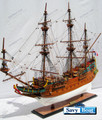
BATAVIA MERCHANT TALL SHIP (NO SAILS)
FULLY BUILT AND READY TO DISPLAY MUSEUM QUALITY SHIP MODEL
- Dimension approx.: 32.6L x 7.4W x 29.5H
- The model is already built. THIS IS NOT A MODEL SHIP KIT
-
In the autumn of 1628, as the Dutch Republic stood at the height of its maritime power, a new East Indiaman waited at anchor off Texel. She was the Batavia, a 600‑ton, full‑rigged merchantman built in Amsterdam for the Dutch East India Company (VOC)—a ship meant to carry silver, trade goods, and the ambitions of an empire stretching from Europe to Asia. At 45 meters long, richly carved and heavily armed, she was the pride of an eight‑ship fleet departing for the East Indies.
Her maiden voyage, however, would become one of the most infamous in maritime history.
On 4 June 1629, after months at sea, Batavia struck a reef in the Houtman Abrolhos off the coast of Western Australia. The wreck itself was catastrophic—of the 341 people aboard, only about 122 survived the initial disaster. But what followed was far worse. With the ship’s officers away seeking help, a VOC under‑merchant named Jeronimus Cornelisz seized control of the survivors. Over the next several weeks he orchestrated a brutal mutiny, murdering roughly 125 men, women, and children. It was, as your summary notes, “one of the most infamous maritime tragedies,” ending only when rescuers returned, captured Cornelisz, and carried out the first legal executions in Australian history. Two mutineers were marooned on the mainland—unwilling pioneers who became Australia’s first European settlers.
For centuries, Batavia’s story lived on in VOC records, archaeological remains, and the grim legends of the Abrolhos. Then, in the late 20th century, the ship was reborn.
In 1985, Dutch shipwrights began constructing a full‑scale replica at the Batavia‑Werft in Lelystad. The project became a national undertaking: hundreds of young people, artisans, and historians worked together using 17th‑century tools, archival plans, and authentic VOC techniques. The result was extraordinary—a 56‑meter, three‑masted East Indiaman with a sail area of nearly 1,200 square meters, built exactly as her 1628 predecessor had been.
Launched in 1995 and christened by Queen Beatrix, the modern Batavia quickly became a cultural ambassador. In 1999 she was transported to Australia, where she served as the Dutch flagship during the Sydney 2000 Olympic Games, a symbolic return to the continent where the original ship had met its fate. She returned to Lelystad in 2001 and today serves as a museum ship at Bataviawerf and Museum Batavialand, where visitors can walk her decks, explore her gunports, and experience the world of the VOC firsthand.
The Batavia’s dual legacy—tragedy and craftsmanship—makes her one of the most compelling ships in maritime history. The original vessel represents the peril, ambition, and human darkness of the Age of Exploration. The replica, by contrast, stands as a celebration of Dutch shipbuilding, cultural memory, and the enduring fascination with the great wooden ships that once connected the world.
Together, they ensure that the name Batavia remains etched into both the maritime past and the living present.