








-


SHAMROCK SAIL BOAT
SAVY DIRECT PRICE $429.96MSRP: $449.99SHAMROCK SAIL BOAT FULLY BUILT AND READY TO DISPLAY BOAT MODEL Dimension approx.: 23.5"L x 4.5"W x 30"H The model is already built. THIS IS NOT A MODEL SHIP KIT The story... -


ENDEAVOUR SAIL BOAT 24"
SAVY DIRECT PRICE $289.96MSRP: $339.99ENDEAVOUR SAIL BOAT 24" FULLY BUILT AND READY TO DISPLAY MODEL Dimension approx.: 24″ L x 4″ W x 33″ H The model is already built. THIS IS NOT A MODEL SHIP KIT The story of... -


ENDEAVOUR SAIL BOAT 20"
SAVY DIRECT PRICE $249.00ENDEAVOUR SAIL BOAT 20" FULLY BUILT AND READY TO DISPLAY MODEL Dimension approx.: 20L x 4W x 26H The model is already built. THIS IS NOT A MODEL SHIP KIT The story of Endeavour...
Description

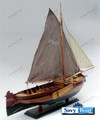
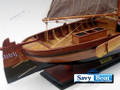
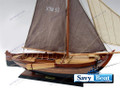
BOTTER SAIL BOAT
FULLY BUILT AND READY TO DISPLAY MUSEUM QUALITY SHIP MODEL
- Dimension approx.: 31″ (long) x 7″ (wide) x 6″ (high)
- The model is already built. THIS IS NOT A MODEL SHIP KIT
For centuries, the shallow inland sea of the Zuiderzee shaped the lives of the Dutch fishing communities that bordered it. Out of this landscape of shifting sandbanks, tidal flats, and narrow harbors emerged one of the Netherlands’ most distinctive working boats: the botter. Flat‑bottomed, broad‑sided, and unmistakably Dutch, the botter was built not for the open ocean but for the quiet, treacherous shallows where only local knowledge—and the right kind of hull—could survive.
The botter’s origins reach back to at least the 17th century, though towns like Elburg were building them in large numbers by the 18th. Their design was a direct response to the Zuiderzee’s geography. A flat bottom allowed them to settle upright on mudflats at low tide. Angular bilges flaring into rounded topsides gave them stability without deep draft. And at the heart of the boat lay the bun, a wooden, slatted well that allowed fresh water to circulate around the day’s catch—keeping fish alive until the crew returned to port. It was a simple, ingenious solution that made the botter one of the most efficient small fishing craft in Europe.
Rigged with a gaff mainsail, a powerful jib, and often a small mizzen—the “breadwinner”—the botter could ghost across calm water or drive hard before a stiff breeze. Its low, open stern made it easy for a crew of two to four men to haul nets, though it also meant the boat was never meant for rough seas. The botter belonged to the shallows, to the quiet mornings of the Zuiderzee, to the rhythm of tides and the smell of eel, herring, and flounder.
For generations, these boats were the backbone of the region’s fishing economy. But in 1956, everything changed. The great land‑reclamation projects that transformed the Zuiderzee into the freshwater IJsselmeer ended the traditional fishery almost overnight. Harbors silted up, fishing rights vanished, and the botter—so perfectly adapted to a world that no longer existed—fell into decline. Many were scrapped. Others were sold cheaply and converted into yachts, their buns removed, their working rigs replaced with modern sail plans.
Yet the botter refused to disappear.
In towns like Elburg, Huizen, and Bunschoten‑Spakenburg, enthusiasts and preservation groups stepped in to save the last survivors. The Foundation for Restoration of the Elburger Botters began rebuilding boats plank by plank, preserving not just the vessels but the craftsmanship and maritime culture they represented. Today, a small but vibrant fleet of restored botters still sails—some in regattas, some as museum pieces, others offering visitors a taste of traditional Dutch seamanship.
One of the most unusual examples is the Groote Beer, a 52‑foot botter‑inspired vessel built during World War II in Huizen. Rumored to have been commissioned for a German industrialist with ties to Göring, she later crossed the Atlantic, sailed American waters, and eventually became part of the Boy Scouts’ maritime program in Seattle. Her journey reflects the botter’s surprising adaptability and enduring charm.
Today, the botter stands as a symbol of the Netherlands’ maritime past—a reminder of the communities that lived by the tides, the ingenuity of shallow‑water boatbuilding, and the quiet beauty of a working craft shaped entirely by its environment. Though the Zuiderzee is gone, the botter endures, carrying its history on every curved plank and weathered sail.