










-

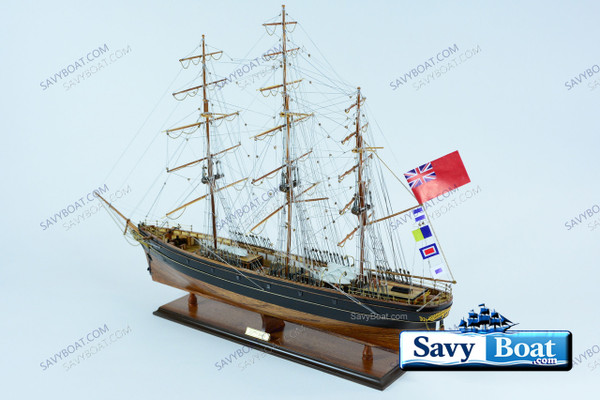
CUTTY SARK 40" NO SAILS / PAINTED
SAVY DIRECT PRICE $769.96MSRP: $819.99CUTTY SARK 40" TALL SHIP NO SAILS/PAINTED FULLY BUILT AND READY TO DISPLAY, QUALITY SHIP MODEL Dimension Approx.: 40″ (long) x 12″ (wide) x 27″ (high). This beauti -


CUTTY SARK 34" FURLED SAILS/PAINTED
SAVY DIRECT PRICE $649.96MSRP: $699.99CUTTY SARK 34" TALL SHIP FOLDED SAILS/PAINTED FULLY BUILT AND READY TO DISPLAY, QUALITY SHIP MODEL Dimension Approx.: 34″L x 9.0″W x 26″H This beautiful model is already -

 img:low-bottom-with-special-offer.pngimg:low-bottom-with-special-offer.png
CUTTY SARK 34" FURLED SAIL
SAVY DIRECT PRICE $100.00 - $649.96CUTTY SARK 34" TALL SHIP FOLDED SAILS FULLY BUILT AND READY TO DISPLAY, QUALITY SHIP MODEL Dimension Approx.: 34″L x 9.0″W x 26″H This beautiful model is already built, N
Description

CUTTY SARK 40" TALL SHIP WITH SAILS & PAINTED HULL
FULLY BUILT AND READY TO DISPLAY, QUALITY SHIP MODEL
- Dimension Approx.: 40″ (long) x 12″ (wide) x 27″ (high).
- This beautiful model is already built, NOT a kit.
When Cutty Sark slid into the River Leven on 22 November 1869, she represented the final, brilliant flourish of the great age of sailing clippers. Built for the Jock Willis Shipping Line, she was designed to be fast — fast enough to outrun rivals across half the world, fast enough to carry the first tea of the season from China to London, and fast enough to justify her name, taken from the fleet‑footed witch in Robert Burns’s Tam o’ Shanter. As the document notes, she was “one of the last tea clippers to be built and one of the fastest,” a ship born at the very moment steam power was beginning to eclipse sail.
Her hull was a masterpiece of composite construction: a wooden skin over an iron frame, one of only three such ships still surviving today. Hercules Linton designed her with a razor‑sharp bow inspired by Willis’s earlier ship The Tweed, while giving her a squarer, more buoyant stern to lift her in heavy seas. She was built to Lloyd’s A1 standard, though construction was fraught — Scott & Linton, the firm contracted to build her, ran out of money mid‑project, forcing Denny’s to take over and finish the ship.
When she finally set sail under Captain George Moodie, she lived up to her promise. In her first eight tea seasons, she raced from London to Shanghai and back, logging passages as fast as 107–122 days. Her rivalry with the clipper Thermopylae became legend. In 1872, the two ships left Shanghai together; Cutty Sark built a 400‑mile lead before losing her rudder in a gale. Rather than put into Cape Town, the crew built a new rudder at sea — a feat of seamanship that earned them admiration even though Thermopylae reached London a week earlier.
But the world was changing. The opening of the Suez Canal in 1869 gave steamships a shorter route to China, and by the mid‑1870s the tea trade was slipping from the hands of the great clippers. Cutty Sark shifted to carrying Australian wool, and here she found her true glory. Under Captain Richard Woodget, she became the fastest ship on the wool run for a decade, making passages of 73, 70, even 69 days from Sydney to Britain — astonishing speeds for a sailing vessel. One steamship recorded being overtaken at night by a sailing ship doing 17 knots; it was Cutty Sark.
By the 1890s, even the wool trade had succumbed to steam. In 1895, she was sold to a Portuguese firm and renamed Ferreira, continuing as a hardworking cargo ship for nearly three decades. She was dismasted in 1916, rerigged as a barquentine, and renamed Maria do Amparo before fate brought her back to Britain. In 1922, caught in a storm in the English Channel, she put into Falmouth — where retired captain Wilfred Dowman recognized her and resolved to save her. He bought the ship, restored her rig, and turned her into a cadet training vessel.
After Dowman’s death, Cutty Sark passed to the Thames Nautical Training College in 1938, serving alongside HMS Worcester. By the early 1950s she was obsolete as a training ship, but not forgotten. In 1954 she was moved to a permanent dry dock at Greenwich, where she became a museum ship — a monument to the age of sail.
Her later years were not without drama. She suffered two major fires, one in 2007 during conservation work and another in 2014, but each time she was restored. Today she stands in Greenwich, suspended above her dry dock, her hull gleaming and her masts towering over the Thames. She is listed as part of the National Historic Fleet, a Grade I historic monument, and one of the last surviving examples of the great composite clippers.
Cutty Sark’s story is one of endurance — a ship built for speed that outlived the very trade she was designed for, survived storms, neglect, fire, and obsolescence, and remains one of the most beloved maritime icons in the world.