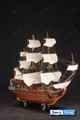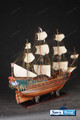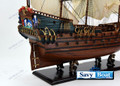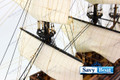

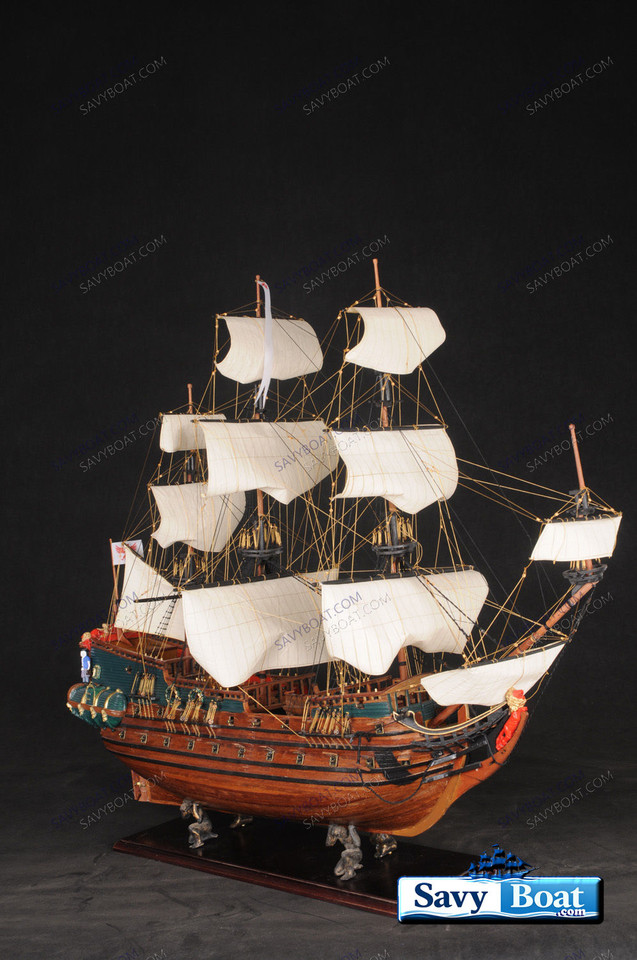
The GERMAN FRIGATE "FRIEDRICH WILHELM ZU PFERDE" 1661 - 1692
FULLY BUILT AND READY TO DISPLAY MUSEUM QUALITY SHIP MODEL
- Dimension approx.: 35″ L x 12″ W x 28″ H.
- This beautiful model is already built, NOT a kit.
The "FRIEDRICH WILHELM ZU PFERDE", a German frigate, was built between 1660 and 1661 in the shipyard of Pillau Princpaute by Mr. G.C. Peckelhering. She was named after Frederick William (a German: 16 February 1620 – 29 April 1688). He was an Elector of Brandenburg and Duke of Prussia, thus ruler of Brandenburg-Prussia, wwhere he ruled from 1640 until his death in 1688. A member of the House of Hohenzollern, he is popularly known as "the Great Elector" (der Große Kurfürst) because of his military and political achievements. Frederick William was a staunch pillar of the Calvinist faith, associated with the rising commercial class. He saw the importance of trade and promoted it vigorously. His shrewd domestic reforms gave Prussia a strong position in the post-Westphalian political order of Northern-Central Europe, setting up Prussia for elevation from duchy to kingdom, achieved under his son and successor.
In the late 17th century, when the great naval powers of Europe were carving their influence across the seas, Brandenburg‑Prussia — a rising but still modest state — sought a fleet worthy of its ambitions. At the center of that effort stood a single ship: the Friedrich Wilhelm zu Pferde, a two‑deck frigate built between 1680 and 1681 at Pillau by master shipwright G.C. Peckelhering. She was named for the “Great Elector,” Friedrich Wilhelm, whose horse‑emblem adorned her stern and symbolized the authority of a ruler determined to give his state a maritime voice.
She was built in the Dutch style — a 900‑ton, 37‑meter, two‑decker with the clean, purposeful lines of the late 17th‑century frigate. With 54–60 guns, including 20 twelve‑pounders, she was powerful enough to serve as a flagship yet nimble enough for escort and patrol duties. Her crew of 160–250 sailors and soldiers made her one of the most formidable vessels in the young Kurbrandenburgische Marine.
By 1684, she became the fleet’s flagship, the pride of Brandenburg’s naval aspirations. Her early years were spent moving between key ports — from Pillau to Emden — as the Elector’s navy expanded its reach. But her most dramatic service came during the Nine Years’ War (1688–1697), when Brandenburg joined the coalition against France.
In 1691, she escorted the Derfflinger toward the Shetland Islands. A year later, under Captain Jean le Sage, she sailed from Emden toward West Africa and the West Indies, engaging and defeating French ships in a series of sharp encounters that proved the Brandenburg fleet could punch above its weight. In October 1692, she set course for Guinea — a long, dangerous voyage into contested waters.
Her end came in November 1693, near Cape Spartel, where she was attacked by French warships and a Brandish vessel. Outnumbered and outgunned, the Friedrich Wilhelm zu Pferde fought until she could fight no more. She burned to the waterline and sank — a dramatic loss that echoed across Brandenburg’s naval circles. Her destruction marked not just the end of a ship, but the fading of the Elector’s early maritime ambitions.
Yet her name endured. In Brandenburg‑Prussian memory, the Friedrich Wilhelm zu Pferde became a symbol of the state’s brief but determined push onto the world’s oceans — a reminder of a time when even smaller powers dared to build great ships and send them into the storm.
The FRIEDRICH WILHELM ZU PFERDE belonged to the Brandenburg fleet of the Grosse Kurfuerst Frederick William in the years 1685 - 1693. The ship had typical Dutch construction features. As "two-decker", she carried 54 cannons and had a crew of 200-250 men. The overall length was 37 m (125 feet) with a tonnage of about 900 tons.
The "Friedrich Wilhelm zu Pferde" made several trips ... in 1685 from Pillau to Emden, in September 1691 from Emden to Shetland Islands under the guide of Captain Jean Le Sage as an escort for the " Derfflinger". On July 25 1692, along with a large fleet, the "Friedrich Wilhelm zu Pferde" sailed from Emden, heading towards Guinea. During the trip it and the "Salamander" won a victory over a French ship. At this time in history, Brandeburg was at war France.
In the night of October 30/31 1692. three French ships fought the "Friedrich Wilhelm zu Pferede" With the first cannonades, Captain Jean Le Sage was killed and the ship was captured and was set on fire.