








-
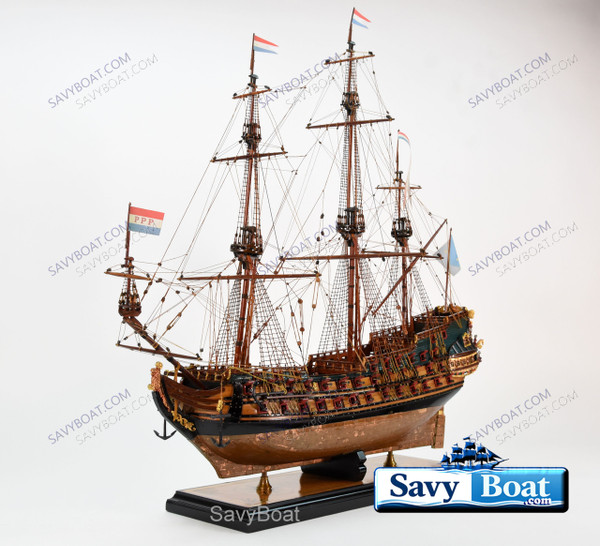

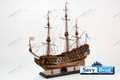
FRIESLAND DUTCH 80 GUN 1663 WITH SAILS
SAVY DIRECT PRICE $1,299.99MSRP: $1,499.991663 FRIESLAND - DUTCH 80 GUN SHIP WITH SAILS FULLY BUILT AND READY TO DISPLAY MUSEUM QUALITY SHIP MODEL Dimension approx.: 30″ L x13.5″ W x 32″ H Copper cladded colored hull In the early 166 -
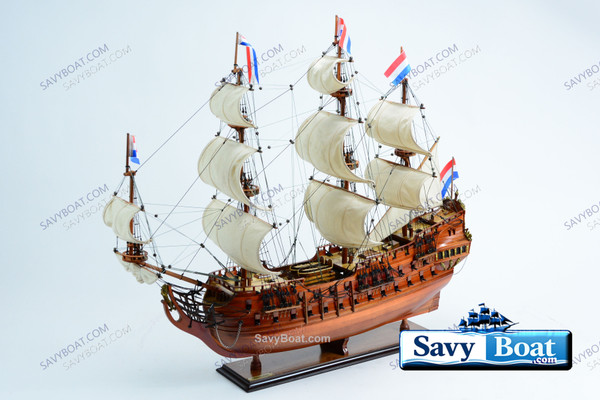

FRIESLAND WOOD DUTCH 80 GUN SHIP (WOOD HULL)
SAVY DIRECT PRICE $1,299.96MSRP: $1,399.991663 FRIESLAND - DUTCH 80 GUN SHIP FULLY BUILT AND READY TO DISPLAY MUSEUM QUALITY SHIP MODEL Dimension approx.: 30″ L x13.5″ W x 32″ H Cloth sails Unpanted white hull < -


FRIESLAND DUTCH 80 GUN SHIP (WHITE)
SAVY DIRECT PRICE $1,199.96MSRP: $1,399.991663 FRIESLAND - DUTCH 80 GUN SHIP FULLY BUILT AND READY TO DISPLAY MUSEUM QUALITY SHIP MODEL Dimension approx.: 30″ L x13.5″ W x 32″ H Cloth sails Panted white hull
Description

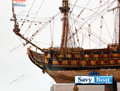
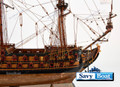
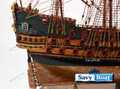
1663 FRIESLAND - DUTCH 80 GUN SHIP
FULLY BUILT AND READY TO DISPLAY MUSEUM QUALITY SHIP MODEL
- Dimension approx.: 30″ L x13.5″ W x 32″ H
- Copper cladded colored hull
In the early 1660s, when the Dutch Republic stood at the height of its maritime power, a new warship took shape in the shipyards of the Admiralty of Friesland. Craftsmen moved with practiced rhythm along her rising hull, laying plank upon plank in the efficient Dutch style that had built a commercial empire. When she finally slid into the water around 1663, the ship was christened Friesland—an 80‑gun second‑rank ship of the line, broad‑shouldered, heavily armed, and ready for the battles that defined the age.
The Republic did not rely on a handful of massive warships like its rivals. Instead, it fielded a vast, disciplined fleet—nearly 1,700 vessels in all—each one a piece of a larger strategy. The Friesland fit perfectly into this doctrine. She was not the largest ship afloat, but she was powerful, maneuverable, and built to fight in the line, where discipline and numbers mattered as much as brute size.
For nearly a decade she served the Admiralty of Friesland, patrolling the waters of a nation whose wealth and survival depended on the sea. But her moment of greatest consequence came in 1672, the “Disaster Year,” when the Dutch Republic faced invasion on nearly every front. At sea, the threat came from the combined might of England and France.
In early June, the Friesland joined the fleet assembling under Admiral Michiel de Ruyter, the Republic’s greatest naval commander. Seventy‑seven Dutch ships gathered off the coast, their hulls rising and falling in the gray swell as crews prepared for the coming storm. Among them, the Friesland took her place in the line, her 80 guns run out, her decks crowded with sailors ready for battle.
On the morning of 7 June 1672, the Anglo‑French fleet appeared off Solebay. The sea erupted into chaos—cannon smoke rolling across the waves, masts splintering, ships grinding past one another in the crush of battle. The Friesland fought alongside De Ruyter’s flagship, the Zeven Provinciën, trading broadsides with larger English ships and holding her place in the line as the Dutch fought to prevent a blockade that could strangle their nation.
The battle ended without a clear victor, but the Dutch achieved what mattered most: the enemy fleet withdrew, and the Republic lived to fight another day. In the smoke and confusion of Solebay, the Friesland had done her duty—steadfast, disciplined, and unbroken.
Though the ship herself has long since vanished into history, her legacy endures. She remains a symbol of the Dutch Golden Age at sea: a vessel built not for spectacle, but for purpose; not to stand alone, but to stand as part of a fleet that shaped the fate of a nation. Today, model builders and maritime historians still recreate her lines, preserving the memory of a ship that once held her place in the thunderous heart of battle.