






-


HMS VICTORY 44" TALL SHIP
SAVY DIRECT PRICE $1,749.96MSRP: $1,999.9944" HMS VICTORY TALL SHIP FULLY BUILT AND READY TO DISPLAY MUSEUM QUALITY SHIP MODEL Dimension Approx.: 44″L x 12"W x 33″H Highly complex rigging with varied thread gauge, hundreds o -


HMS VICTORY 60 TALL SHIP
SAVY DIRECT PRICE $2,999.95MSRP: $3,199.99LARGE HMS VICTORY TALL SHIP FULLY BUILT AND READY TO DISPLAY MUSEUM QUALITY SHIP MODEL LARGE HIGH QUALITY MODEL Dimension Approx.: 60L x 19W x 55H (inch) The model is alrea -
 img:low-bottom-with-special-offer.pngimg:low-bottom-with-special-offer.png
HMS VICTORY 24'' TALL SHIP
SAVY DIRECT PRICE $379.96MSRP: $399.99HMS VICTORY Sailing Ship FULLY BUILT AND READY TO DISPLAY MUSEUM QUALITY SHIP MODEL Dimension Approx.: 24L x 7W x 21H (inch) The model is 100% hand built by artisans from scratch us
Description

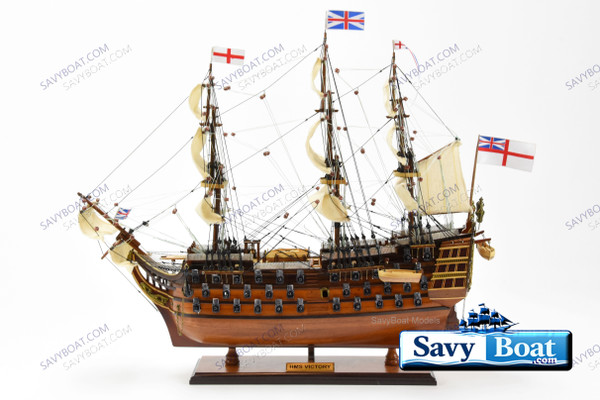
HMS VICTORY Sailing Ship
FULLY BUILT AND READY TO DISPLAY MUSEUM QUALITY SHIP MODEL
- Dimension Approx.: 34L x 9W x 27H (inch)
- The model is 100% hand built by artisans from scratch using “plank on bulkhead” construction method
- The model is already built, NOT a model ship kit
When HMS Victory was laid down at Chatham Dockyard in 1759, Britain was in the midst of the Seven Years’ War, and the Royal Navy needed ships that could dominate the world’s oceans. Designed by the brilliant naval architect Sir Thomas Slade, Victory was conceived as a first‑rate ship of the line — the largest and most powerful class afloat. Her construction consumed the timber of nearly 6,000 oak and elm trees, shaped by more than 150 shipwrights into a hull over 227 feet long, carrying 104 guns across three decks.
Launched in 1765, she was the seventh Royal Navy vessel to bear the name Victory, chosen to celebrate Britain’s triumphs in the global conflict. Yet after her launch, she spent years in ordinary, waiting for a moment worthy of her size and strength.
That moment arrived in 1778, when she was commissioned during the American Revolutionary War. Under various admirals, she fought in the First and Second Battles of Ushant, helped escort convoys, and took part in the relief of Gibraltar in 1782. In the turbulent years of the French Revolutionary Wars, she served in the Mediterranean, supporting the occupation of Toulon, the Invasion of Corsica, and fighting at the Battle of the Hyères Islands in 1795. Two years later, she played a key role at the Battle of Cape St Vincent, helping Admiral Jervis defeat a larger Spanish fleet.
But her greatest chapter began in 1803, when Admiral Horatio Nelson hoisted his flag aboard her. Under Nelson, Victory became more than a warship — she became a symbol of British naval supremacy. On 21 October 1805, at the Battle of Trafalgar, she led the weather column straight into the combined French and Spanish line. As she advanced, her signal flags spelled out Nelson’s immortal message: “England expects that every man will do his duty.”
The battle was ferocious. Victory endured heavy fire as she broke the enemy line, her decks shrouded in smoke and splinters. Nelson was mortally wounded by a French marksman, dying below decks as the battle raged on. But Victory remained at the heart of the fight, helping secure one of the most decisive naval victories in history. Afterward, she carried Nelson’s body home to England, her timbers still scarred from the battle.
In the decades that followed, Victory continued to serve — blockading ports, acting as a flagship, and later becoming a stationary command ship at Portsmouth. By the 1830s she was dismasted and permanently moored, but the Royal Navy never struck her from the lists. Instead, she became a living monument to Britain’s maritime past.
Today, HMS Victory is the world’s oldest naval vessel still in commission, preserved at Portsmouth Historic Dockyard. Extensive restorations have kept her close to her 1805 appearance, from her copper‑plated hull to her towering masts and gun decks. Visitors walk the same planks where Nelson fell, surrounded by the craftsmanship and power of an 18th‑century first‑rate ship of the line.
HMS Victory is more than a museum ship — she is a national icon. She embodies the age of sail, the rise of British sea power, and the legacy of Nelson himself. From the American Revolution to Trafalgar, she has witnessed the defining moments of Britain’s naval history. And as she remains in commission, she continues to serve — not in battle, but as a guardian of memory, tradition, and maritime heritage.