









-
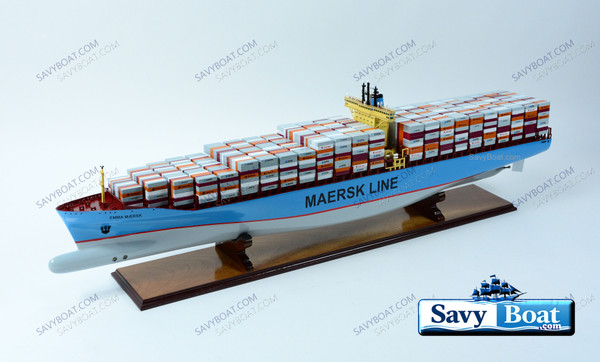

MAERSK EMMA CONTAINER 48” RC READY SHIP
SAVY DIRECT PRICE $1,299.96MSRP: $1,499.99Mærsk EMMA CONTAINER CARGO SHIP READY TO DISPLAY MUSEUM QUALITY SHIP MODEL Dimension Approx.: 48″L x 6.5"W x 13″H The model is already built, NOT a model ship kit -

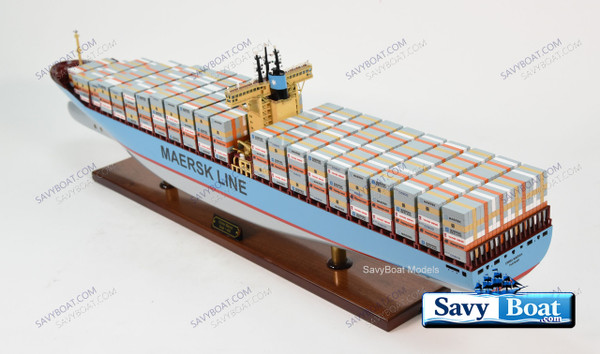
MAERSK Mærsk EMMA 40" CONTAINER CARGO SHIP
SAVY DIRECT PRICE $889.96MSRP: $899.99Mærsk EMMA 40" CONTAINER CARGO SHIP READY TO DISPLAY HIGH QUALITY SHIP MODEL Dimension Approx.: -


Mærsk EMMA CONTAINER 36" CARGO SHIP MAERSK
SAVY DIRECT PRICE $749.96MSRP: $799.99Mærsk EMMA CONTAINER 36" CARGO SHIP READY TO DISPLAY MUSEUM QUALITY SHIP MODEL Dimension Approx.: 36″L x 5"W x 10″H The model is already built, NOT a model ship k
Description

Mærsk EMMA CONTAINER CARGO SHIP
READY TO DISPLAY MUSEUM QUALITY SHIP MODEL
- Dimension Approx.: 48″L x 6.5"W x 13″H
- The model is already built, NOT a model ship kit
When the Emma Mærsk emerged from the Odense Steel Shipyard in 2006, she represented a seismic shift in global shipping. Built for A.P. Møller – Mærsk A/S, she was the first of the company’s new E‑class — a fleet of ultra‑large container ships designed to dominate the world’s busiest trade routes. At nearly 400 meters long and capable of carrying between 11,000 and 15,000 TEU depending on calculation method, she instantly became the largest container ship in the world, a floating symbol of the scale and ambition of 21st‑century logistics.
Her construction was not without drama. In June 2006, a welding fire broke out in her superstructure, spreading into the accommodation block and bridge. The damage delayed her completion by nearly two months, but the shipyard pressed on. On 16 August 2006, five tugboats eased the massive vessel backward from the yard into open water — a delicate maneuver for a ship of unprecedented size.
Emma Mærsk began her maiden voyage on 8 September 2006, departing Aarhus and calling at Gothenburg, Bremerhaven, Rotterdam, Algeciras, and the Suez Canal before reaching Singapore on 1 October. From there she continued to Yantian, Kobe, Nagoya, and Yokohama, completing her first round‑the‑world loop when she returned to Aarhus on 11 November 2006. Her arrival signaled a new era: the age of the ultra‑large container vessel, where economies of scale reshaped global trade.
Her technical profile was as impressive as her size. Powered by a Wärtsilä 14RT‑Flex96C — one of the largest diesel engines ever built — supplemented by Caterpillar generators, she could reach 25.5 knots, remarkable for a ship of her displacement. With a 56‑meter beam, 16‑meter draft, and accommodations for a crew of just 13, she embodied the efficiency and automation that define modern shipping.
Emma Mærsk’s career has not been without incident. On 1 February 2013, while transiting the Suez Canal, a damaged stern thruster caused flooding in her engine room, leaving her unmaneuverable. Tugs, anchors, and even favorable winds helped guide her to Port Said, where 13,500 containers were offloaded — one of the largest such operations ever undertaken. She was then towed to Palermo for repairs costing around DKK 250 million, returning to service in August of the same year.
Her prominence extended beyond the shipping industry. She was featured in the 2008 documentary Mighty Ships, and in 2011, the National Bank of Denmark issued a 20‑kroner commemorative coin in her honor — a rare tribute for a working commercial vessel.
Today, the Emma Mærsk remains in active service, a cornerstone of Maersk’s global fleet. Though newer ships have surpassed her in size, she retains her status as a pioneer — the vessel that ushered in the era of mega‑container ships and redefined what was possible in maritime transport. Her legacy is one of scale, innovation, and the relentless evolution of global trade.