










-


MISS SEVERN RACING BOAT
SAVY DIRECT PRICE $599.96MSRP: $649.99MISS SEVERN RACING BOAT FULLY BUILT AND READY TO DISPLAY HIGH QUALITY SHIP MODEL Dimension Approx.: 31.5″L x 8″W x 7″H -

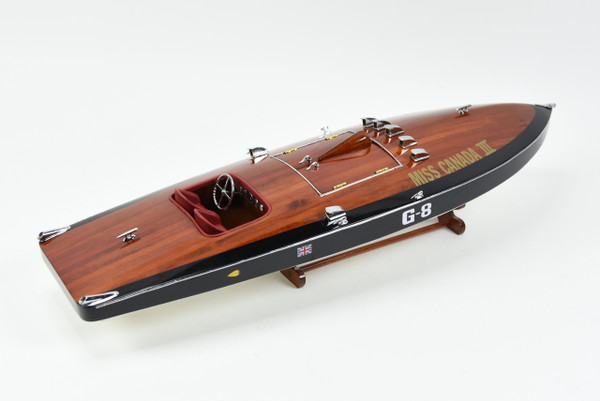
MISS CANADA III RACE BOAT
SAVY DIRECT PRICE $689.96MSRP: $699.99MISS CANADA III RACE BOAT FULLY BUILT AND READY TO DISPLAY HIGH QUALITY SHIP MODEL Dimension Approx.: 33.5″L x 9.5″W x 7″H -

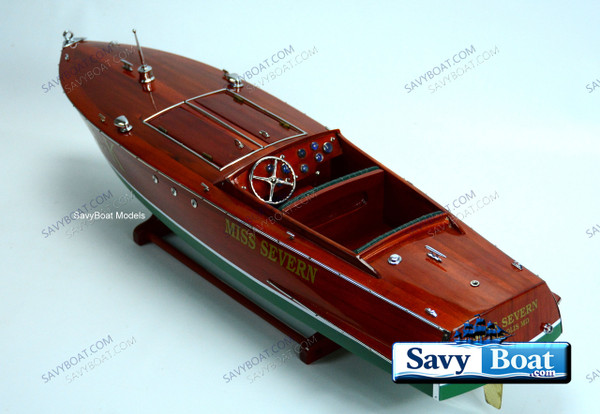
MISS SEVERN RACING BOAT RC READY
SAVY DIRECT PRICE $679.96MSRP: $699.99MISS SEVERN RACING BOAT RC READY FULLY BUILT AND READY TO DISPLAY HIGH QUALITY SHIP MODEL Dimension Approx.: 31.5″L x 8″W x 7″H
Description

MISS COLUMBIA G-1 RACE BOAT
FULLY BUILT AND READY TO DISPLAY HIGH QUALITY SHIP MODEL
- Dimension Approx.: 34.5″L x 7″W x 8″H
- The model is already built, NOT a model ship kit
In the early 1920s, as American powerboat racing transitioned from the wild excess of unlimited hydroplanes to the refined discipline of displacement craft, Miss Columbia emerged as one of the most distinguished representatives of the new Gold Cup Class. She was the realization of a long‑held ambition within the Columbia Yacht Club of New York, whose members had dreamed of fielding a premier racing boat worthy of national competition.
That dream took shape in 1924, when Miss Columbia was unveiled at the Hudson Boat Show in Detroit. The christening, performed by Miss Emily Smith, daughter of the New York Governor, underscored the prestige surrounding the project. Her pedigree was impeccable: designed by the brilliant George F. Crouch, built by master craftsman Henry B. Nevins of City Island, and powered by a 624‑cu‑in Wright eight‑cylinder engine — a powerplant chosen specifically to meet the APBA’s newly imposed displacement limit.
These rule changes, enacted in 1921, had reshaped the Gold Cup into a class emphasizing efficiency, hull refinement, and reliability. Gone were the roaring, unlimited hydroplanes; in their place came a fleet of long, elegant runabouts, each striving to extract maximum performance from a tightly restricted engine size. Miss Columbia entered this arena in 1922, joining thirteen other “gentlemen’s runabouts” in what became the defining era of displacement racing.
For nearly two decades, from 1922 to 1941, the Gold Cup Class represented the pinnacle of American powerboat competition, and Miss Columbia stood firmly within that tradition. She embodied the East Coast school of design — “eastern designed, eastern built, and eastern powered” — a philosophy that prized craftsmanship and hydrodynamic purity over brute force. Her long, narrow hull and balanced proportions were hallmarks of Crouch’s design language, built to endure the Gold Cup’s grueling 90‑mile format, run in three demanding 30‑mile heats.
After her racing career, Miss Columbia avoided the fate that befell many early competitors. She survived into the modern era and was restored in the 1980s by New England Boat & Motor, Inc. for collector Philip Sharples, ensuring that her lines and character remained intact. Today, she lives on not only as a preserved vessel but also through museum‑quality scale models crafted from original drawings — a rare and tangible link to the formative years of American powerboat racing.
Miss Columbia’s legacy rests in her role as one of the earliest and finest examples of the Gold Cup displacement era. She represents a moment when craftsmanship, engineering discipline, and yacht‑club ambition converged to create a class of boats that shaped the future of the sport. Sleek, dignified, and unmistakably of her time, Miss Columbia remains a testament to the artistry and innovation that defined the golden age of American racing craft.