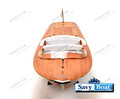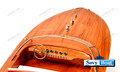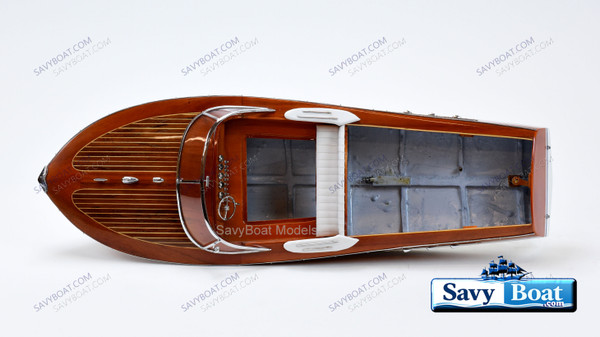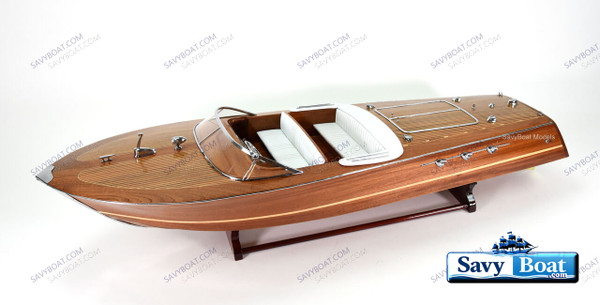
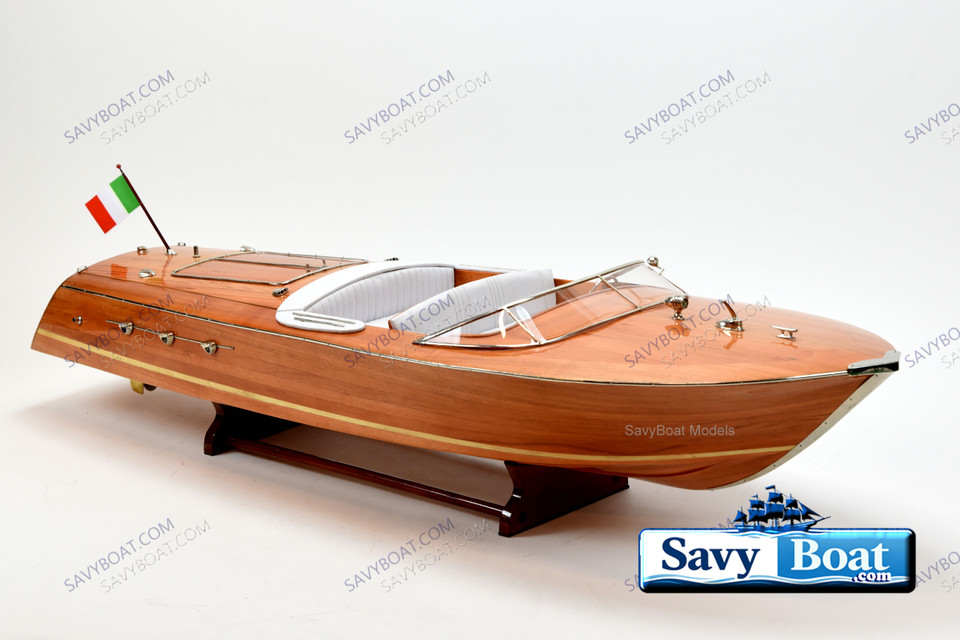
When the Riva Ariston debuted in 1953, it marked a turning point for Carlo Riva and for postwar Italian boatbuilding. Its name — Ariston, meaning “the very best” — was not a boast but a mission statement. Carlo envisioned a boat that would embody the essence of Riva: speed, beauty, craftsmanship, and a sense of effortless glamour. Over the next 21 years, more than 1,000 Aristons would be built, making it one of the most iconic wooden runabouts ever launched.
The Ariston’s lineage began with the experimental BF and BM prototypes of the early 1950s, boats that helped Carlo refine the hull form and construction techniques that would define the Riva style. Developed alongside the Florida — a model used as a rolling testbed for innovations — the Ariston emerged as the purest expression of Riva’s design philosophy: long, low, elegant, and impeccably balanced.
Early Aristons featured traditional planked hulls, but by 1957, Riva transitioned to waterproof plywood, a major step forward in strength and longevity. The boat’s distinctive panoramic windscreen, inspired by automotive design, gave it a cinematic presence on the water. Inside, the Ariston offered a surprising level of luxury for its size: six seats, folding front loungers that converted into a sunbed, and upholstery that evolved from yellow Vipla and checked Saran to the later, famously bold zebra‑pattern interiors.
Under the engine hatch, the Ariston carried the heart of American power. From 1952 onward, Riva used exclusively U.S. engines — Chrysler Sea V8s, Chris‑Craft 283s, and in rare cases, even Cadillac V8s. The Cadillac‑powered Aristons, built between 1956 and 1958, numbered only 19 units and are now among the most coveted wooden boats in the world.
Evolution of a Classic
The Ariston was never static. Carlo Riva refined it constantly:
-
1956–1958: Length increased from 6.25 m to 6.95 m; hull lines sharpened.
-
1957: Introduction of the deep‑V hull and stainless steel fuel tanks.
-
1960: Arrival of the Super Ariston, with more power and a slightly longer hull.
-
1964: Updated instruments, upholstery, and technical improvements.
-
1967: Standard and Super models unified in length and hull form.
-
1971: Standard Ariston discontinued; the Super Ariston carried the torch until 1974.
This continuous evolution kept the Ariston competitive and desirable for more than two decades — a remarkable lifespan in the fast‑changing world of luxury runabouts.
The Ariston became known as the “Rolls‑Royce of the sea”, a boat whose craftsmanship rivaled fine furniture and whose performance matched the best of its era. Its varnished mahogany hull, chrome hardware, and sculpted lines made it a favorite of the international jet set. Celebrities such as Brigitte Bardot, Elizabeth Taylor, and countless Riviera socialites were photographed aboard Aristons, helping cement the boat’s association with Mediterranean glamour.
More than any other model, the Ariston represented Carlo Riva’s personal vision. It remained in the Riva catalog throughout his entire tenure, evolving with him, reflecting his obsession with perfection, and becoming the spiritual predecessor to the legendary Aquarama.
Today, the Riva Ariston is one of the most collectible wooden boats in the world. Restored examples command high prices, and original Super Aristons — especially the Cadillac‑powered variants — are prized by enthusiasts who appreciate the blend of Italian artistry and American muscle.
More than a boat, the Ariston is a symbol of an era: the optimism of the 1950s, the glamour of the Riviera, and the craftsmanship of a man who believed that beauty and engineering should always move in harmony. It remains, as Carlo intended, the very best.