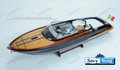


When the Riva Aquarama first appeared on the water in 1962, it didn’t just launch a new model — it launched an era. Carlo Riva had already transformed his family’s boatyard into a symbol of Italian elegance, but with the Aquarama he created something transcendent: a mahogany runabout so beautiful, so perfectly proportioned, that it became an icon the moment it touched the water.
Its origins lay in the earlier Riva Tritone, itself inspired by American Chris‑Craft runabouts. But the Aquarama was more refined, more sculptural, more cinematic. Its name came from the Cinerama widescreen film format, and the boat lived up to it — a sweeping wraparound windshield, a panoramic cockpit, and a hull that seemed to glide rather than cut through the water.
The first prototype, affectionately nicknamed Lipicar after Carlo’s daughters, was tested in Monte Carlo in 1962. There, industrial titan Gianni Agnelli challenged Carlo to “capsize it.” Carlo obliged — and the boat refused to flip. The Aquarama had passed its first trial by fire, and its legend began.
The Aquarama’s beauty was more than skin‑deep. Beneath its varnished mahogany — polished through 24 coats until it glowed like liquid amber — lay a hull between 8.02 and 8.78 meters long, engineered for speed and stability. The cockpit seated up to eight passengers, with separate front seats for easy movement and a rear sundeck that lifted to reveal a convertible top.
Its engines were pure American muscle: twin V8s from Chrysler, Cadillac, or Riva‑tuned powerplants producing between 185 and 400 horsepower. With the right setup, an Aquarama could reach 45–50 knots, its exhaust note a deep, confident growl that echoed across the Riviera.
Every detail mattered. Chrome hardware gleamed like jewelry. The swim ladder folded neatly into the stern. The gangway was non‑slip, the upholstery hand‑stitched, the deck planking aligned with obsessive precision. Carlo Riva believed a boat should be both a machine and a work of art — and the Aquarama proved him right.
Evolution of a Legend
The Aquarama evolved over three decades, each version refining the last:
-
Aquarama (1962–1972): The original, 281 built.
-
Super Aquarama (1963–1971): Longer at 8.45 m, with 320 hp engines and higher speeds.
-
Aquarama Lungo (1972): Only 7 built — a rare transitional model.
-
Aquarama Special (1972–1996): The final and most advanced version, with a length of 8.75 m and a redesigned stern corridor for easier water access.
By the time production ended in 1996, only 761 Aquaramas had ever been built — each one handcrafted, each one slightly different, each one a masterpiece.
The Aquarama became the Ferrari of the boat world, a symbol of Mediterranean glamour. It appeared in films like GoldenEye and Ocean’s Twelve, graced the pages of fashion magazines, and carried celebrities including Brigitte Bardot, Sophia Loren, Jude Law, Charlize Theron, and countless Riviera aristocrats.
Jeremy Clarkson once called it “the most beautiful thing ever made.” For many, that wasn’t hyperbole — it was simple truth.
The Aquarama represents the pinnacle of wooden boatbuilding. It is the culmination of Riva’s history, which began in 1842 with Pietro Riva and reached its artistic zenith under Carlo. When the last Aquarama Special left the yard in 1996, it marked the end of Riva’s wooden era — and the beginning of its myth.
Today, restored Aquaramas command extraordinary prices. They are cherished by collectors, displayed in museums, and still turn heads in harbors from Portofino to St. Tropez. More than a boat, the Aquarama is a symbol of timeless Italian design — a floating sculpture that captures the sun, the sea, and the spirit of la dolce vita.
It remains, without question, the most celebrated wooden runabout ever built.