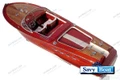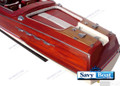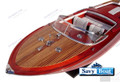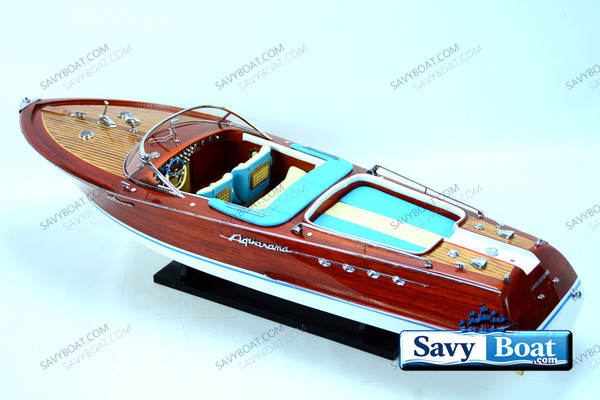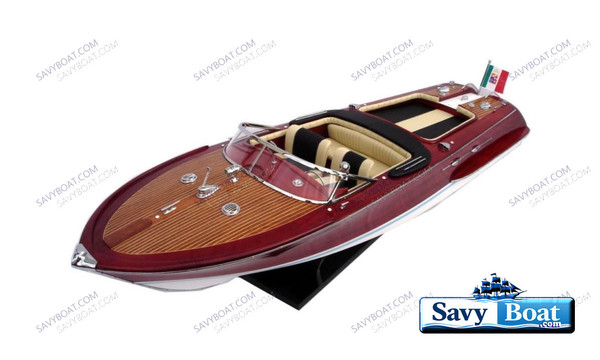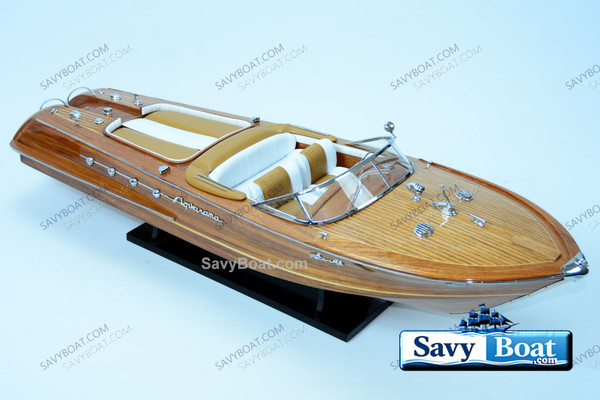


When the Riva Super Aquarama debuted in 1963, it represented the moment when Carlo Riva’s wooden‑boat artistry reached full maturity. The original Aquarama had already captivated the Riviera with its sweeping lines and wraparound Cinerama‑inspired windshield, but the Super Aquarama elevated the concept into something faster, longer, and even more luxurious — a runabout that blended Italian glamour with the power and presence of an American muscle car.
Its roots lay in the 1962 prototype Lipicar, a boat that Carlo tested relentlessly in Monte Carlo. Lipicar introduced the innovations that would define the Aquarama family: separate front seats for easier movement, a non‑slip gangway for water access, and a redesigned stern passage that made swimming and sunbathing part of the experience. The Super Aquarama refined these ideas and wrapped them in a hull of Honduras mahogany, varnished through dozens of coats until it glowed like amber under the Mediterranean sun.
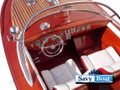
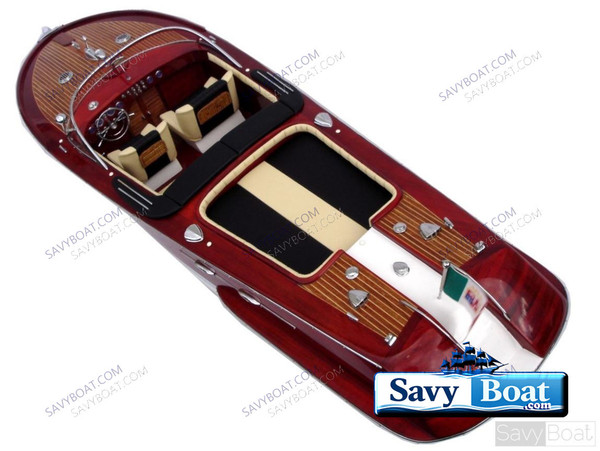
At 8.45 meters long with a beam of about 2.62 meters, the Super Aquarama offered space for eight passengers, a generous sundeck over the engine compartment, and a convertible roof that tucked neatly behind the cockpit. Inside, the upholstery evolved with the decade — from bold white ribs with black borders and orange trim to the later turquoise‑and‑ivory or lobster‑and‑ivory combinations that became synonymous with 1960s Italian style.
The Super Aquarama was built for speed. Beneath the sundeck lay twin V8 engines, often Riva‑tuned Cadillacs or Chryslers, producing between 185 and 320 horsepower per engine. With the right setup, the boat could reach 45–50 knots — roughly 90 km/h — while maintaining the smooth, confident ride that made Rivas famous.
Carlo Riva believed a boat should feel alive, and the Super Aquarama delivered: the deep, throaty rumble of its twin V8s, the way the bow lifted as it accelerated, the sensation of skimming across the water with nothing but varnished mahogany and chrome between you and the sea. It was not just a boat — it was a performance.
Between 1963 and 1971, Riva built 203 Super Aquaramas, each one handcrafted and subtly unique. Over the years, the model gained refinements such as Laminated hull sides from hull #4 onward, Improved instrumentation and comfort features, An icebox beneath the cockpit sole, A marine WC tucked beneath the forward bunk, and Updated upholstery and trim as fashions changed.
In 1972, the Super Aquarama gave way to the Aquarama Special, which extended the hull to 8.75 meters and added the now‑famous stern corridor for easier ladder access. But the Super Aquarama remained the purest expression of the original design — the perfect balance of size, power, and elegance.
The Super Aquarama became a symbol of Mediterranean luxury. It appeared in films like GoldenEye and Ocean’s Twelve, graced fashion campaigns such as Jude Law’s Dior commercial, and was praised by Jeremy Clarkson as “the most beautiful thing ever made.”
It was the boat of choice for aristocrats, actors, industrialists, and anyone who wanted to embody the spirit of la dolce vita. On the Riviera, a Super Aquarama at the dock said everything without a word.
Today, the Riva Super Aquarama is one of the most collectible wooden boats in the world. Restored examples command extraordinary prices, and their presence at classic‑boat gatherings draws crowds like few other vessels. They represent the pinnacle of Carlo Riva’s wooden‑boat era — a fusion of Italian design, American horsepower, and artisanal craftsmanship that has never been replicated.
More than a runabout, the Super Aquarama is a floating sculpture, a cultural icon, and a timeless expression of elegance on the water.