













-
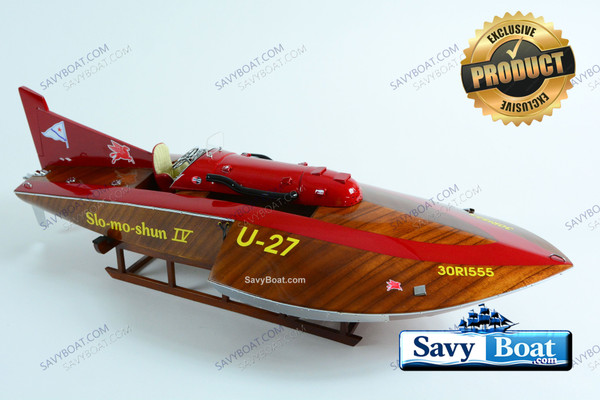

SLO-MO IV (U-27) UNLIMITED HYDROPLANE W/ COWL
SAVY DIRECT PRICE $699.96MSRP: $759.99SLO-MO IV (U-27) UNLIMITED HYDROPLANE FULLY BUILT AND READY TO DISPLAY MUSEUM QUALITY SHIP MODEL Dimension approx.: 30″ L x 12.5″ W x 8.5″ H – Scale 1:12 The model is already built. THIS... -


SLO-MO IV (U-27) UNLIMITED 36" RC READY HYDROPLANE
SAVY DIRECT PRICE $829.96MSRP: $899.99SLO-MO IV (U-27) 36" UNLIMITED HYDROPLANE FULLY BUILT AND READY TO DISPLAY MUSEUM QUALITY SHIP MODEL Dimension approx.: 36″ L x 15″ W. The model is already built. THIS IS NOT A MODEL... -

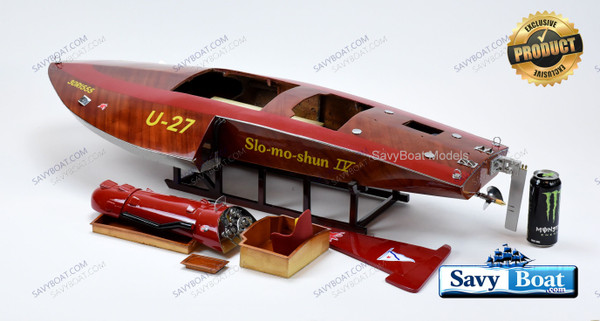
SLO-MO IV (U-27) UNLIMITED 48" RC READY HYDROPLANE
SAVY DIRECT PRICE $999.96MSRP: $1,049.99SLO-MO IV (U-27) UNLIMITED 48" HYDROPLANE FULLY BUILT AND READY TO DISPLAY BOAT MODEL Dimension approx.: 48″ L x 19″ W. The model is already built. THIS IS NOT A MODEL SHIP KIT Authentic...
Description

SLO-MO IV (U-27) UNLIMITED HYDROPLANE
FULLY BUILT AND READY TO DISPLAY MUSEUM QUALITY SHIP MODEL
- Dimension approx.: 30″ L x 12.5″ W x 8.5″ H – Scale 1:12
- The model is already built. THIS IS NOT A MODEL SHIP KIT
- Authentic gauges, dials and steering wheel on dash
In the cool early morning of June 26, 1950, when Lake Washington was still glass‑smooth and Seattle was barely awake, a long, low, mahogany‑skinned hydroplane came roaring down a measured mile near Sand Point. At the wheel was Stanley S. Sayres, a Seattle car dealer with a racer’s instincts and a dream that seemed impossible: to bring the world water‑speed record home to the Pacific Northwest.
The boat beneath him — Slo‑Mo‑Shun IV — was unlike anything the sport had ever seen. Designed by the brilliant Ted Jones and built by the Jensen Motor Boat Company in 1949, she was a radical leap forward: a four‑pointer hull with three sponsons and a V‑bottom that let a 28‑foot, 4,700‑pound monster behave like a tiny 135‑class runabout. Her Allison V‑12 aircraft engine, geared 3:1 to spin a Hi Johnson two‑blade prop at 10,800 rpm, delivered nearly 1,800 horsepower — enough to lift the hull almost entirely free of the water.
Sayres made two blistering runs that morning: 163.785 mph one way, 157.2 mph the other. The average — 160.3235 mph — shattered Sir Malcolm Campbell’s long‑standing 1939 record of 141.74 mph. Few spectators saw it happen, but the world took notice. Seattle had just become the new capital of speed on water.
Slo‑Mo‑Shun IV was a masterpiece of engineering. Jones incorporated features that would define unlimited hydroplane design for decades:
-
A V‑bottom spoiler at the bow to break up dangerous air pressure and prevent blow‑overs.
-
An offset rudder to starboard, chosen after exhaustive testing to avoid prop‑wash damage and improve control.
-
An air rudder in the tail for high‑speed stability (locked during sanctioned races).
-
Aircraft‑grade plywood and gusset construction for strength without weight.
She was the first Unlimited to fully embrace the “prop‑riding” concept — lifting the hull so high that only the propeller, the tips of the sponsons, and a sliver of the transom touched the water. It was a revolution in hydrodynamics, and Slo‑Mo‑Shun IV proved it worked.
The record run was only the beginning. In 1951, Slo‑Mo‑Shun IV won the APBA Gold Cup, bringing the race to Seattle for the first time. More than 200,000 spectators lined the shores of Lake Washington to watch her fly — a spectacle that helped launch the Seafair tradition and turned hydroplane racing into a civic obsession.
Seattleites donated more than $57,000 to the “Slo‑Mo Fund,” a testament to how deeply the boat had captured the city’s imagination. For the next several years, the Slo‑Mo boats dominated the sport, and Slo‑Mo‑Shun IV became the symbol of a new era of American speed.
Slo‑Mo‑Shun IV didn’t just win races — she changed the sport. Her design influenced every Unlimited hydroplane that followed, setting the template for the next twenty years of high‑speed watercraft engineering. She proved that prop‑riding was the future, and she brought global attention to Seattle’s boatbuilders, designers, and racers.
Today, the original Slo‑Mo‑Shun IV is preserved at the Museum of History and Industry (MOHAI) in Seattle, a gleaming reminder of the moment when a local dream became a world‑shaking achievement.
A Seattle Legend
More than a boat, Slo‑Mo‑Shun IV was a turning point — the machine that put Seattle on the map, redefined hydroplane racing, and pushed the limits of what was possible on water. Her roar across Lake Washington in 1950 still echoes through the city’s history, a symbol of innovation, daring, and Northwest pride.