













-

 img:low-2-bottom-with-special-offer.pngimg:low-2-bottom-with-special-offer.png
MISS THRIFTWAY (U-60) UNLIMITED HYDROPLANE
SAVY DIRECT PRICE $100.00 - $679.96MISS THRIFTWAY (U-60) UNLIMITED HYDROPLANE FULLY BUILT AND READY TO DISPLAY MUSEUM QUALITY SHIP MODEL Dimension approx.: 26″ L x 11″ W x 5.5″ H The model is already built. THIS IS NOT A... -


MISS THRIFTWAY (U-60) UNLIMITED HYDROPLANE 48" RC READY
SAVY DIRECT PRICE $1,049.96MSRP: $1,199.99MISS THRIFTWAY (U-60) UNLIMITED HYDROPLANE 48" RC READY FULLY BUILT AND READY TO DISPLAY HIGH QUALITY SHIP MODEL Dimension approx.: 48″ L x 19″ W. The model is already built. THIS... -

 img:low-3-bottom-with-special-offer.pngimg:low-3-bottom-with-special-offer.png
MISS WAHOO (U-77) UNLIMITED HYDROPLANE
SAVY DIRECT PRICE $100.00 - $679.96MISS WAHOO (U-77) UNLIMITED HYDROPLANE FULLY BUILT AND READY TO DISPLAY MUSEUM QUALITY SHIP MODEL Dimension approx.: 26″ L x 11″ W x 5.5″ H The model is already built. THIS IS NOT A...
Description

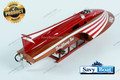
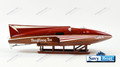
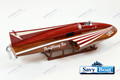
THRIFTWAY TOO (U-62) UNLIMITED HYDROPLANE
FULLY BUILT AND READY TO DISPLAY MUSEUM QUALITY SHIP MODEL
- Dimension approx.: 26″ L x 11″ W x 5.5″ H
- The model is already built. THIS IS NOT A MODEL SHIP KIT
- Rosewood, mahogany, teak and other exotic woods are carefully selected to build the model
- Hull handmade from wood, hollow inside
- Authentic gauges, dials and chrome steering wheel on dash
- All fittings such as windshield frame, wiper, navigation lights, mirror, and flag pole are made of stainless steel and chrome plated
- Propellers and rudders made from brass
- Hand stitched individual leather seats
- Highly polished finish with multi-layered micro-sanded varnish
- Flags and solid wood base included
- Handcrafted from scratch using finest woods & metal fittings
- The model is 100% hand built by artisans from scratch
- Hand-painted to match the actual ship.
THE ICONIC RACE BOAT - THRIFTWAY TOO - THE FIRST CAB-OVER HYDROPLANE
Thriftway Too entered the world in 1957 as something bold, almost defiant—a hydroplane that didn’t just challenge the conventions of its era but seemed to question them outright. Ted Jones, already a legend for reshaping the sport with his three‑point design, pushed further with this new idea: put the driver in front, perched over the bow, exposed to the wind and spray with nothing ahead but open water. It was a radical cabover layout, the kind of innovation that made traditionalists uneasy and engineers quietly excited. Les Staudacher, the master builder from Michigan, translated Jones’s sketches into a 34‑foot, Rolls‑Merlin‑powered machine that looked like it belonged a decade in the future.
From the moment it touched the water, Thriftway Too carried an aura of experimentation. It was big—one of the heaviest Unlimiteds of its time—and it handled differently from anything else in the pits. Drivers described the sensation of sitting so far forward as both thrilling and unnerving, like riding the edge of a knife. But the visibility was unmatched. For the first time, a hydroplane pilot could see the water ahead without the long nose of the hull blocking the horizon. It was a glimpse of what the sport might someday become.
On the racecourse, Thriftway Too lived a life of flashes—moments when everything aligned and the boat revealed its true potential. The 1957 Sahara Cup at Lake Mead became its defining chapter. In the dry desert heat, with the lake shimmering like hammered metal, Thriftway Too surged to life. In the final heat, it stunned spectators by outrunning the eventual winner, showing a burst of speed and stability that hinted at greatness. Even those who favored Miss Thriftway, the team’s more famous and more successful sibling, had to admit that the cabover experiment had teeth.
Yet the boat’s story was never one of dominance. It was a pioneer, not a champion. Its size made it demanding to handle. Its single Merlin engine, though powerful, had to work harder than the twin‑engine setups the hull had originally been designed to accommodate. And in an era crowded with legends—Slo‑Mo‑Shun, Hawaii Kai III, Miss Bardahl—Thriftway Too often found itself overshadowed.
But history has a way of elevating the bold. Over time, Thriftway Too became less a footnote and more a symbol of a turning point. Its cabover configuration foreshadowed the direction Unlimited hydroplanes would eventually take. Its emphasis on driver visibility and safety echoed through later designs. And its willingness to challenge the status quo earned it a quiet reverence among enthusiasts who appreciate innovation as much as victory.
Today, Thriftway Too is remembered not for the trophies it didn’t win, but for the ideas it introduced, the risks it embodied, and the unmistakable personality it brought to the roaring, spray‑filled world of mid‑century hydroplane racing. It remains a reminder that sometimes the boats that change the sport aren’t the ones that win the most—they’re the ones that dare to be different.