









-


SS VEENDAM STEAMSHIP
SAVY DIRECT PRICE $1,049.96MSRP: $1,149.99STEAMSHIP SS VEENDAM FULLY BUILT AND READY TO DISPLAY MUSEUM QUALITY SHIP MODEL Dimension approx.: 35L X 5W X 10H The model is already built, NOT a model ship kit Handcrafted from scratch... -


SS SHALOM STEAMSHIP
SAVY DIRECT PRICE $799.96MSRP: $899.99SS SHALOM LUXURY STEAM SHIP LINER FULLY BUILT AND READY TO DISPLAY, QUALITY SHIP MODEL Dimension approx.: 34″ L x 4.5″ W x 11″ H. This beautiful model is already built, NOT a kit. When... -


SS SHALOM LIGHTED STEAMSHIP
SAVY DIRECT PRICE $999.96MSRP: $1,099.99SS SHALOM LUXURY STEAM SHIP LINER FULLY BUILT AND READY TO DISPLAY, QUALITY SHIP MODEL Dimension approx.: 34″ L x 4.5″ W x 11″ H. This beautiful model is already built, NOT a kit. When...
Description

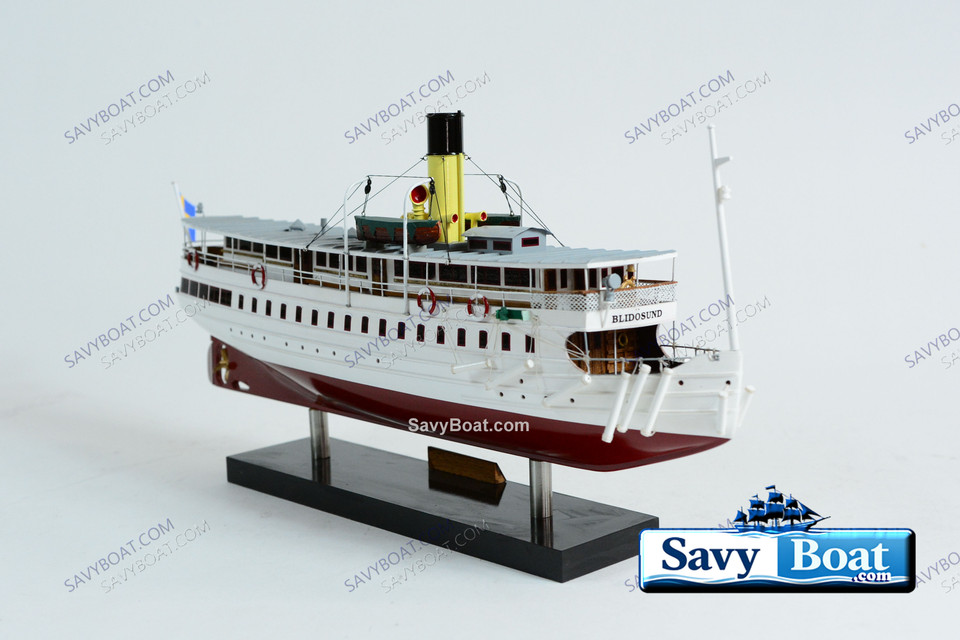
1911 SS BLIDOSUND (Blidösund) STEAMSHIP
FULLY BUILT AND READY TO DISPLAY BOAT MODEL
- Dimension approx.: 32"L x 9"W x 10"H
- The model is already built. THIS IS NOT A MODEL SHIP KIT
When S/S Blidösund was launched on 4 March 1911 from Eriksbergs Mekaniska Verkstad in Göteborg, she represented something rare in Swedish maritime history: a steamship built not by a company or a state agency, but by a community determined to secure its own future. The residents of Blidö, frustrated by Waxholmsbolaget’s refusal to serve their bays and routes, raised funds themselves to commission a vessel that would connect their island to Stockholm on their own terms. Blidösund was born of local pride, necessity, and stubborn independence.
Her maiden voyage began on 3 March 1911, sailing from Göteborg via Helsingborg and Simrishamn before arriving in Stockholm on 7 March. Two days later she made her ceremonial visit to Blidö, greeted with flags, garlands, speeches, and celebrations. When she entered regular service on 10 March 1911, she immediately sparked the so‑called “Blidökriget” — a spirited rivalry with Waxholmsbolaget over access to archipelago bays and passenger routes. For islanders, Blidösund was more than a ship; she was a symbol of autonomy.
Technically, Blidösund was a compact but capable archipelago steamer. At 35.29 meters long with a 6.91‑meter beam, she carried a compound steam engine producing 308 kW, fed by a coal‑fired boiler that gave her a speed of 10–12.5 knots. Her shallow 2.8‑meter draft allowed her to reach tight island harbors, and her modest tonnage — 218 gross, 102 net — made her ideal for the narrow waterways of Stockholm’s northern archipelago.
Blidösund’s popularity peaked between the 1920s and 1940s, when she carried islanders, cargo, and summer holidaymakers through the archipelago’s twisting channels. But after World War II, new roads, buses, and competition eroded demand. By the 1950s, she was aging and increasingly unprofitable. In 1960, after a loss year, she was withdrawn from service and spent years in lay‑up, occasional charter work, and even brief operation under other names, including Express II.
Her revival came in 1969, when she was restored and returned to the Stockholm–Blidö route. Over the following decades, Blidösund was preserved in her original condition — coal‑fired boiler, steam engine, wooden interiors, and classic archipelago lines. She became a floating museum, offering musical cruises, cultural excursions, and summer voyages that evoke the early 20th‑century archipelago experience. Today she is the only operational coal‑fired steamship in the Stockholm archipelago, a living artifact maintained by Blidösundsbolaget with support from the non‑profit Föreningen Blidösund.
Her homeport is Skeppsbron, Stockholm, where she welcomes up to 250 passengers (200 mingling) for routes to Blidö, Norrtälje, and summer excursions to bays throughout the archipelago. Passengers aboard Blidösund hear the rhythmic beat of her steam engine, smell the coal smoke drifting across the water, and feel the gentle vibration of a century‑old vessel still doing what she was built to do.
More than a ship, S/S Blidösund is a time capsule — a rare survivor of Sweden’s steamship era, preserved not as a static exhibit but as a working vessel. She remains a beloved symbol of the archipelago’s maritime heritage and a testament to the community that built her.