








-


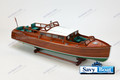
1929 CHRIS CRAFT COMMUTER (DARK FINISH)
SAVY DIRECT PRICE $799.96MSRP: $849.991929 CHRIS CRAFT COMMUTER (DARK FINISH) FULLY BUILT AND READY TO DISPLAY, SHIP MODEL Dimension approx.: 34″ (long) x 8″ (wide) x 11.5″ (high) The model is already built. THIS IS NOT A... -

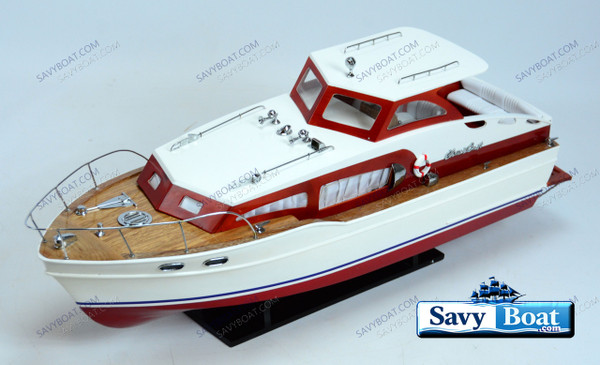
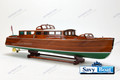
1956 CHRIS CRAFT CABIN CRUISER
SAVY DIRECT PRICE $829.96MSRP: $899.99CHRIS CRAFT CABIN CRUISER FULLY BUILT AND READY TO DISPLAY BOAT MODEL Dimension approx.: 34″ (long) x 11″ (beam) The model is already built. THIS IS NOT A MODEL SHIP KIT In... -

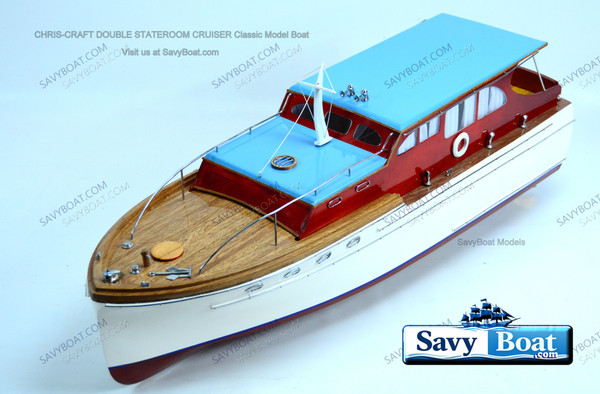
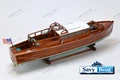
CHRIS-CRAFT DOUBLE STATEROOM CRUISER SAVY LOGO
SAVY DIRECT PRICE $579.96MSRP: $599.99CHRIS-CRAFT DOUBLE STATEROOM CRUISER FULLY BUILT AND READY TO DISPLAY HIGH QUALITY MODEL Dimension approx.: 32″ (long) x 7″ (wide) x 9″ (high) The model is already built. THIS IS...
Description

1929 CHRIS CRAFT COMMUTER CRUISER
FULLY BUILT AND READY TO DISPLAY, SHIP MODEL
- Dimension approx.: 34″ (long) x 8″ (wide) x 11.5″ (high)
- The model is already built. THIS IS NOT A MODEL SHIP KIT
When the Chris‑Craft Commuter line emerged at the end of the 1920s, it captured a very specific moment in American luxury culture. Cities like New York, Detroit, and Chicago were booming, and the nation’s industrial elite wanted a way to move between their urban offices and their waterfront estates with speed, style, and a touch of theater. The Commuter yachts became the answer: long, elegant wooden motor yachts that functioned as waterborne limousines, built for executives who preferred to travel above the traffic and in full view of the harbor.
The first of these vessels, the 38‑foot 1929 Commuter Cruiser, set the tone. Commissioned by New York businessman William F. Ladd, it was quickly nicknamed the Queen of the Fleet. With its mahogany hull over an oak frame, teak decks, enclosed cabin, and room for a dozen passengers, it embodied the glamour of the pre‑Depression years. Chris‑Craft recognized the appeal immediately and began scaling the concept upward.
The pinnacle of this evolution arrived in 1930 with the 48‑foot Commuter, a yacht that blended speed, capacity, and craftsmanship in a way few American builders could match. Hull No. 1, christened Allez—French for “Go”—was personally named by company founder Christopher Columbus Smith. It served as a prototype and showpiece, displayed at both the New York and Miami boat shows before entering private ownership. Only five of these 48‑footers were ever built, and just two are known to survive.
Allez was a marvel of its time. Capable of 30 mph and able to carry 30 passengers, it featured a full galley, salon, forward and aft staterooms, and a surprising array of comforts: sliding screens, crank‑operated windows, and even a salon radio—luxuries that made it feel more like a floating penthouse than a commuter craft. It was the embodiment of Chris‑Craft’s belief that speed and elegance could coexist without compromise.
Its provenance reads like a tour through American high society. The Smith family kept the yacht for its first six months before selling it to a New York City day trader. It later passed to Amy Guest, a wealthy New York–Florida entrepreneur—possibly Amy Phipps Guest, the aviation patron who helped launch Amelia Earhart’s career. From there, Allez spent years on Lake Champlain, then entered a Montreal private collection in 1976, where it remained out of public reach for decades.
The Commuter line as a whole represents the golden age of American luxury boating—a brief window when craftsmanship, optimism, and wealth converged to produce vessels that were as beautiful as they were functional. And within that lineage, the 1930 48‑foot Commuter Allez stands apart: a rare survivor of Depression‑era extravagance, a prototype of Chris‑Craft innovation, and a testament to the artistry of early 20th‑century yacht building.
Today, fully restored and offered for sale for the first time since the 1970s, Allez is more than a collector’s piece. It is a living artifact of an era when the journey itself was meant to be an experience—when the most powerful people in America crossed the water not to escape attention, but to command it.