







-


CHRIS CRAFT HOLIDAY RUNABOUT
SAVY DIRECT PRICE $629.96MSRP: $699.991962 CHRIS CRAFT HOLIDAY RUNABOUT FULLY BUILT AND READY TO DISPLAY BOAT MODEL Dimension approx.: 32″ (long) x 8″ (beam) The model is already built. THIS IS NOT A MODEL SHIP... -


1930 CHRIS CRAFT 24" RUNABOUT
SAVY DIRECT PRICE $589.96MSRP: $599.991930 CHRIS CRAFT 24"RUNABOUT Dimension approx.: 324.40L x 7.08W x 7.87H The model is already built. THIS IS NOT A MODEL SHIP KIT The 1930 Chris‑Craft runabout occupies a... -
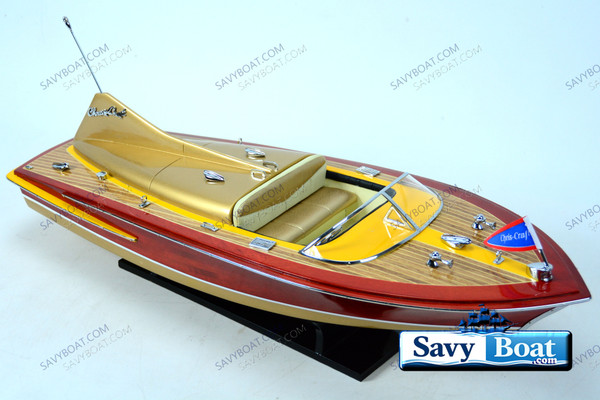

CHRIS CRAFT CLASSIC COBRA RUNABOUT
SAVY DIRECT PRICE $569.96MSRP: $599.99CHRIS CRAFT COBRA SPEED BOAT FULLY BUILT AND READY TO QUALITY MUSEUM DISPLAY MODEL Dimension approx.: 29″ L x 10″W x 9″H The model is COMPLETELY b
Description

1953 CHRIS CRAFT RACING RUNABOUT
FULLY BUILT AND READY TO DISPLAY BOAT MODEL
- Dimension approx.: 32″ (long) x 9.5″ (beam)
- The model is already built. THIS IS NOT A MODEL SHIP KIT
In the years after World War II, Chris‑Craft began exploring a new direction—boats built not just for family recreation, but for speed, competition, and the thrill of performance. The 19' Racing Runabout, produced from 1948 to 1954, was the centerpiece of that effort. By 1953, the model had reached its mature form: sleek, agile, and unmistakably purposeful, a wooden runabout designed to deliver excitement on the water.
Unlike Chris‑Craft’s more common planked mahogany hulls, the Racing Runabout used lapstrake plywood construction, a lightweight method that gave the boat quick acceleration and nimble handling. Its profile was low and fast, with a gently dipping bow and twin cockpits that allowed driver and passenger to sit close enough for easy conversation at cruising speeds. The design was simple, efficient, and unmistakably sporty—far removed from the company’s Cadet or Sea Skiff lines.
Power came from the Chris‑Craft MBL, a 158‑horsepower six‑cylinder engine known for its smooth running and reliability. Many surviving examples still carry their original, matching‑number MBL engines, often rebuilt during restorations to preserve authenticity. Inside, the boat featured leather upholstery, gray linoleum flooring, plated hardware, and clean, functional gauges—details that balanced durability with understated elegance.
Production numbers were small, and by the late 1950s the line had disappeared, leaving only a limited number of survivors. One well‑documented 1953 example, Hull 41797, underwent a full restoration in the 1990s, receiving new bottom, sides, decks, and interior. Its rebuilt MBL engine runs strong, and the boat has been lightly used and regularly maintained, appearing at shows with its trailer, mooring cover, and restoration records. Other boats have lived more complicated lives—like Ezduzit (R‑19‑492), converted into a ski boat in the 1960s–70s before being restored back to her original racing configuration.
Today, the 1953 Racing Runabout stands as one of Chris‑Craft’s most distinctive postwar designs. It represents a moment when the company experimented with high‑performance wooden boats, appealing to both racing enthusiasts and owners who simply wanted a spirited pleasure craft. Its rarity, speed, and unmistakable character make it a prized collectible—an artifact of an era when wooden runabouts were evolving from simple family boats into machines built for excitement.