




-


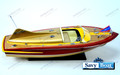
CHRIS CRAFT CLASSIC COBRA RC READY RUNABOUT
SAVY DIRECT PRICE $629.96MSRP: $699.99CHRIS CRAFT COBRA RC READY SPEED BOAT FULLY BUILT AND READY TO QUALITY MUSEUM DISPLAY MODEL Dimension approx.: 29″ L x 10″W x 9″H RC READY - -


CHRIS CRAFT HOLIDAY RUNABOUT
SAVY DIRECT PRICE $629.96MSRP: $699.991962 CHRIS CRAFT HOLIDAY RUNABOUT FULLY BUILT AND READY TO DISPLAY BOAT MODEL Dimension approx.: 32″ (long) x 8″ (beam) The model is already built. THIS IS NOT A MODEL SHIP... -


1953 CHRIS CRAFT RACING RUNABOUT
SAVY DIRECT PRICE $629.96MSRP: $699.991953 CHRIS CRAFT RACING RUNABOUT FULLY BUILT AND READY TO DISPLAY BOAT MODEL Dimension approx.: 32″ (long) x 9.5″ (beam) The model is already built. THIS IS NOT A MODEL SHIP KIT In...
Description

CHRIS CRAFT COBRA SPEED BOAT
FULLY BUILT AND READY TO QUALITY MUSEUM DISPLAY MODEL
- Dimension approx.: 29″ L x 10″W x 9″H
- The model is COMPLETELY built, NOT a model kit
- Flags and solid wood display base included
In the spring of 1955, when America was falling in love with tailfins, chrome, and the promise of a jet‑powered future, Chris‑Craft unveiled a boat that looked less like something meant for a lake and more like something meant for a dream. It was called the Cobra, and even at first glance it was clear this was no ordinary runabout. It sat low and sleek on its trailer, its varnished mahogany shimmering like warm honey, and rising from its stern was a sweeping metallic‑gold fiberglass fin—a flourish so bold it seemed to slice the air even when the boat was standing still.
The Cobra was the brainchild of A.W. Mackerer, a naval architect who had already given Chris‑Craft its famous Racing Runabout. But this time, he wasn’t designing for speed or practicality. He was designing for spectacle. Chris‑Craft wanted a showpiece—something that would stop crowds at boat shows, something that would make children tug at their parents’ sleeves and make grown men imagine themselves skimming across the water like movie stars. The Cobra was meant to be a halo, a beacon, a statement that Chris‑Craft could be as daring as Detroit’s automakers.
The hull was still classic Chris‑Craft mahogany, but the fin—oh, the fin—was fiberglass, a material that felt futuristic in 1955. It gleamed in gold, catching the light like a piece of jewelry. The cockpit was trimmed in alligator‑pattern vinyl, the seats upholstered in gold, and the deck planking was accented with crisp white stripes. It had only one row of seating, a choice that made it look even more like a race boat, even if most owners would never push it to its limits.
When the Cobra debuted at boat shows, it did exactly what Chris‑Craft hoped. People didn’t just look at it—they stared. They circled it slowly, taking in the proud “bull‑nose” bow, the impossibly low stern, the sculptural sweep of the deck. It was impractical, yes. The fin made waterskiing awkward. The single row of seats limited passengers. The high‑gloss finishes demanded constant care. But none of that mattered. The Cobra wasn’t built to be sensible. It was built to be unforgettable.
And because it was produced for only one year, it became rare almost instantly. Just a handful of 18‑foot and 21‑foot models left the factory before Chris‑Craft moved on to more conventional designs. But the Cobra’s impact lingered. Like the Corvette of the same era, it proved that style could be a kind of power—an emotional force that made people dream.
Today, when a restored Cobra appears at an antique boat show, crowds still gather around it just as they did in 1955. The gold fin still glows. The mahogany still gleams. And the boat still whispers the same promise it made all those years ago: that sometimes, beauty is reason enough to build something.