




-

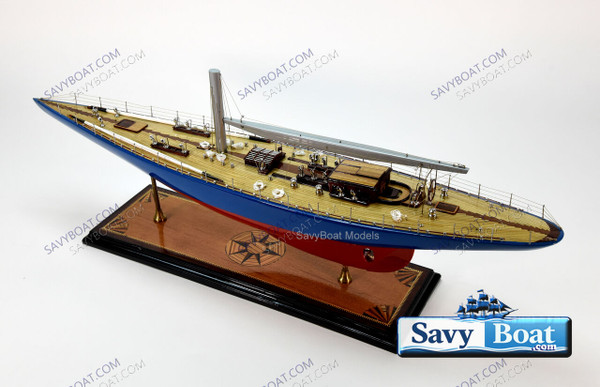
AMERICA'S CUP ENDEAVOUR RACING YACHT HALF MAST
SAVY DIRECT PRICE $1,499.96MSRP: $1,599.99AMERICA'S CUP ENDEAVOUR RACING SAILBOAT FULLY BUILT AND READY TO DISPLAY MODEL Dimension approx.: 38″ L x 7″ W x 14″ H Top quality fittings throughout The model is already built. ... -


RANGER SAILING YACHT
SAVY DIRECT PRICE $399.96MSRP: $469.99RANGER SAILING YACHT FULLY BUILT AND READY TO DISPLAY, HIGH QUALITY SHIP MODEL Dimension Approx.: 31.5L x 5W x 39.5H in The model is already built, NOT a model ship kit Whe -
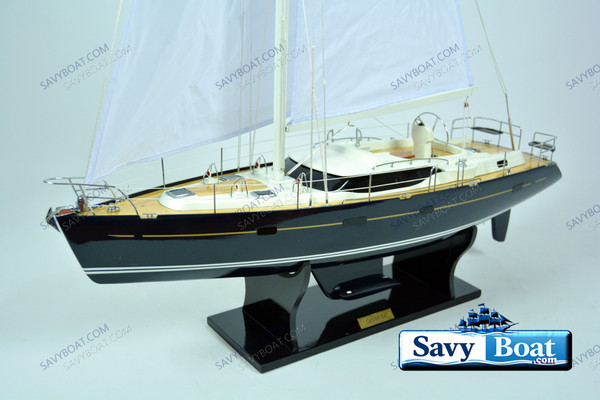

OYSTER 54 SAILING YACHT
SAVY DIRECT PRICE $689.96MSRP: $759.99OYSTER 54 SAILING YACHT FULLY BUILT AND READY TO DISPLAY, HIGH QUALITY SHIP MODEL Dimension Approx.: 32.25L x 9.5W x 48H The model is already built, NOT a model ship kit Introduc
Description

AMERICA'S CUP RANGER RACING SAILING YACHT HALF MAST
FULLY BUILT AND READY TO DISPLAY, MUSEUM QUALITY SAILBOAT MODEL
- Dimension Approx.: 38″ (long) xb 7″ (wide) x 14″ (high).
- Museum quality model ship including unique marquetry base
- The model is already built, NOT a model ship kit
When Ranger slid down the ways at Bath Iron Works on May 11, 1937, she represented the absolute zenith of J‑class yacht design — a “super‑J,” engineered with scientific precision and built to defend the America’s Cup at a moment when the class was reaching its final, breathtaking peak. Commissioned by Harold Stirling Vanderbilt, already a three‑time Cup defender, Ranger was conceived as the American answer to Sir T.O.M. Sopwith’s new British challenger, Endeavour II. The stakes were high, and the design brief was uncompromising: build the fastest J‑class yacht the world had ever seen.
The design collaboration between W. Starling Burgess and Olin Stephens of Sparkman & Stephens produced a hull that pushed the Universal Rule to its limits. Ranger carried the maximum 87‑foot waterline, a beam of 20 feet 10 inches, and a towering rig balanced over a deep 110‑ton lead keel. Her all‑steel hull — unusual for racing yachts of the era — was paired with an aluminum internal structure and a lightweight mast counterweight, giving her immense stiffness and power. Extensive towing‑tank testing in 1936 refined her underwater shape, making Ranger one of the first America’s Cup yachts shaped as much by science as by artistry.
At 135 feet overall and displacing 166 tons, Ranger was a giant, but she moved with astonishing grace. Vanderbilt’s financial backing and Bath Iron Works’ near‑cost construction offer made the project possible during the Depression, and the result was a yacht that embodied the very best of American naval engineering.
Ranger’s racing career was brief but spectacular. In the 1937 America’s Cup, sailed off Newport, Rhode Island, she faced Endeavour II in a highly anticipated showdown. Ranger proved overwhelmingly superior, winning the series 4–0 with a combination of raw speed, flawless crew work, and a hull that seemed to leap forward in light air. It was the last time a J‑class yacht would ever defend the Cup. Within a few years, war, economics, and evolving rules ended the era of these magnificent giants.
After her triumph, Ranger was retired and eventually scrapped — sources differ on whether this occurred in 1941 or 1946 — a fate shared by most of her J‑class contemporaries. Yet her legend endured. Designers and sailors alike remembered her as the ultimate expression of the class: powerful, elegant, and ahead of her time.
In 2003, a modern replica of Ranger was completed by Royal Denship in Denmark, built from the original Burgess–Stephens plans but updated for contemporary safety standards. This new Ranger carries forward the spirit of the 1937 champion, allowing a new generation to witness the beauty and scale of a J‑class yacht under sail.
Today, Ranger stands as the pinnacle of J‑class innovation — the final, triumphant flourish of an era when yacht design blended art, science, and national pride in equal measure.