





-

Brooklyn TB006P SAVY LOGO
SAVY DIRECT PRICE $1,199.96MSRP: $1,299.99Brooklyn Tugboat FULLY BUILT AND READY TO DISPLAY MUSEUM QUALITY SHIP MODEL Dimension approx.: 24″L x 6″W x 18″ H Base dimension: 30″L x 9″ W The model is already built. THIS IS NOT A... -

RIVA FLORIDA SAVY LOGO
SAVY DIRECT PRICE $729.96MSRP: $789.99RIVA FLORIDA Classic Speedboat Dimension Approx.: 34.25″ L x 10″ W x 9″ H This is a fully built model. it is NOT a kit When the -
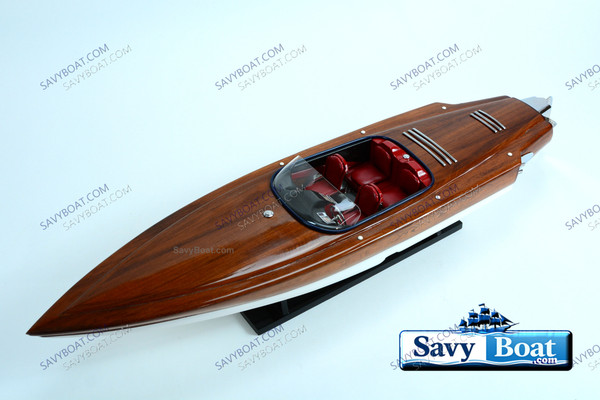

Alpha Z CB011 SAVY LOGO
SAVY DIRECT PRICE $599.96MSRP: $649.99ALPHA Z SPEED BOAT FULLY BUILT AND READY TO DISPLAY MODEL Dimension approx.: 36″ (long) x 8.5″ (wide) x 6″ (high) The model is already built. THIS IS NOT A MODEL SHIP KIT When Alpha Z
Description

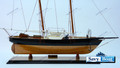
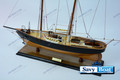
SAILING YACHT AMERICA
FULLY BUILT AND READY TO DISPLAY QUALITY SHIP MODEL
- Dimension approx.: 28″ (long) x 6″ (wide) x 26″ (high)
- The model is already built. THIS IS NOT A MODEL SHIP KIT
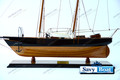
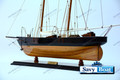
Long before the America’s Cup became the pinnacle of competitive sailing, there was a single schooner whose speed, audacity, and elegance reshaped the sport. That vessel was America, a lean, radical racing yacht launched in 1851 from William H. Brown’s New York shipyard. She was built not merely to compete, but to astonish — a floating declaration that American shipbuilders could out‑design and out‑sail the best of Britain.
Her creators, a syndicate of New York Yacht Club members led by Commodore John Cox Stevens, intended her as both a challenger and a statement. As the document notes, she was launched on May 3, 1851, costing $30,000 — a staggering sum at the time (“She cost $30,000…”). From the beginning, she was unlike anything in British waters.
America’s hull was the work of George and James Rich Steers, whose pilot boats had already earned a reputation for speed and seaworthiness. Instead of the traditional “cod‑head‑and‑mackerel‑tail” form, they gave America a concave clipper bow and placed her beam amidships — a design inspired by the pilot boat Mary Taylor (“She was designed along the lines of the pilot boat Mary Taylor.”). The result was a schooner that sliced through the water with unprecedented efficiency.
Her captain, Richard Brown, was himself a Sandy Hook pilot — a man accustomed to racing other pilots to incoming ships in all weather. His intimate understanding of Steers’ designs would prove decisive.
America sailed for Europe in June 1851, arriving at Le Havre on July 11 (“America left New York on June 21, 1851, and arrived at Le Havre on July 11.”). British yachtsmen watched her arrival with a mixture of curiosity and unease. An impromptu race with the yacht Laverock only deepened the tension, with conflicting reports about who prevailed — but the impression was clear: this foreign schooner was fast.
When no British yacht owner would agree to a direct match race, the Royal Yacht Squadron opened its annual regatta to “all nations,” setting the stage for one of the most famous contests in maritime history.
On August 22, 1851, America joined a fleet of cutters and schooners for the 53‑mile race around the Isle of Wight. A fouled anchor delayed her start, but within half an hour she was already climbing through the fleet (“Within half an hour however, she was in 5th place and gaining.”).
Her decisive moment came at the Nab Lightship, where tradition dictated passing on the seaward side. Captain Brown, drawing on pilot‑boat instincts, took the riskier landward route — a move allowed by the rules (“the official race rules did not specify on which side of the lightship a boat had to pass.”). It put America firmly in the lead.
Even a broken jib boom, replaced in fifteen minutes, could not slow her. She finished 18 minutes ahead of her nearest rival (“Aurora… was 18 minutes behind when America finished”). Legend claims that when Queen Victoria asked who placed second, the reply was: “There is no second, your Majesty.”
After her victory, America passed through a succession of owners and identities. She ran aground in 1852, was rebuilt, renamed Camilla, and eventually sold to the Confederate States in 1860 (“Decie sold the ship to the Confederate States of America…”). She served as a blockade runner, carrying Confederate agents on secret missions to Europe.
When Union forces captured Jacksonville, she was scuttled to avoid seizure — but raised and repaired by the Union Navy (“She was raised, repaired, and renamed America by the Union…”). Armed with Dahlgren guns, she helped destroy the blockade runner CSS Georgiana, described as “the most powerful Confederate cruiser then afloat.”
After the war, America became a training ship at the U.S. Naval Academy, even racing again in the 1870 America’s Cup, where she finished fourth.
Sold into private hands, America enjoyed a second racing career under General Benjamin Butler, who had her rebuilt and lengthened (“In the winter 1881… she was lengthened 6 1/2 feet”). But by the early 20th century she fell into disrepair.
In 1921 she was donated back to the Naval Academy, where she deteriorated until a snowstorm collapsed her shed in 1942 (“The shed which housed America collapsed during a heavy snowstorm on March 29, 1942.”). Her remains were scrapped in 1945.
She was one of only four U.S. Navy ships to serve in both the Civil War and World War II.
Though the original America is gone, her legacy endures. The New York Yacht Club preserves her transom eagle, rudder post, and a mast (“These include her transom eagle, rudder post and one of her masts.”). Multiple replicas — built in 1967, 1995, and 2005 — keep her silhouette alive on the water.A Legend That Redefined Sailing
America was more than a yacht. She was a turning point — the vessel that humbled Britain’s finest, reshaped yacht design, and gave her name to the world’s most prestigious sailing trophy. From her radical bow to her storied wartime service, she lived a life as dramatic as any ship of her century.
Her victory in 1851 was not just a race won. It was a new era begun.