










-
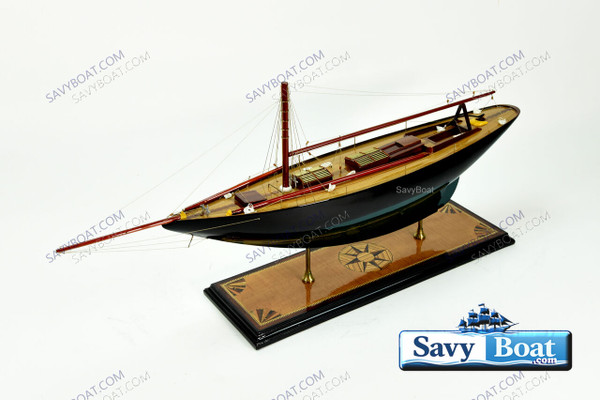

PENDUICK RACING SAIL BOAT
SAVY DIRECT PRICE $1,499.96MSRP: $1,599.99PENDUICK RACING SAIL BOAT FULLY BUILT AND READY TO DISPLAY MUSEUM QUALITY SHIP MODEL Dimension approx.: APPROX 38″ L x 7″ W x 14″ H The model is already built, NOT a model ship kit BEAUTIFUL... -


MISS SEVERN RACING BOAT
SAVY DIRECT PRICE $599.96MSRP: $649.99MISS SEVERN RACING BOAT FULLY BUILT AND READY TO DISPLAY HIGH QUALITY SHIP MODEL Dimension Approx.: 31.5″L x 8″W x 7″H -

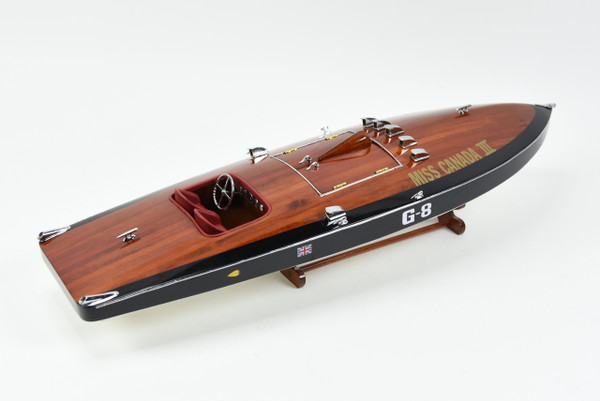
MISS CANADA III RACE BOAT
SAVY DIRECT PRICE $689.96MSRP: $699.99MISS CANADA III RACE BOAT FULLY BUILT AND READY TO DISPLAY HIGH QUALITY SHIP MODEL Dimension Approx.: 33.5″L x 9.5″W x 7″H
Description

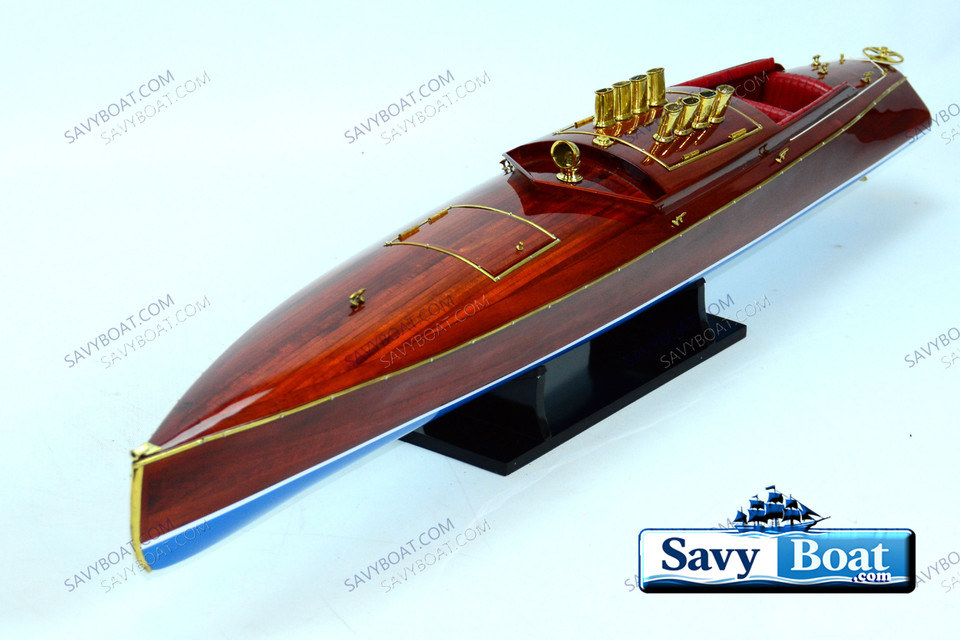
DIXIE II 1908 RACE BOAT
FULLY BUILT AND READY TO DISPLAY, QUALITY SHIP MODEL
- Dimension approx.: 38.5L x 6W x 7.5H (inches)
- The model is already built. THIS IS NOT A MODEL SHIP KIT
In 1908, at the dawn of high‑speed motorboat racing, Dixie II emerged as one of the most advanced and influential powerboats ever built. Designed by naval architect Clinton H. Crane for Commodore E. J. Schroeder of the Motor Boat Club of America, she was conceived as a direct successor to the original Dixie, which had stunned Europe by winning the 1907 Harmsworth Trophy. But Crane believed he could go further — not with more power, but with better engineering.
Where European challengers relied on massive twin‑screw, 400‑horsepower engines, Crane pursued a radical idea: a lightweight, single‑screw racer with half the horsepower but superior hydrodynamics. His team built a refined rib‑and‑keel hull of mahogany planking over elm frames, strengthened with yellow‑pine stringers. The stern was redesigned from the earlier Normand type to a flat transom, reducing drag and improving lift at speed. Scale‑model testing confirmed what Crane suspected — a carefully optimized hull could outrun heavier, more powerful rivals.
At the heart of Dixie II was a remarkable engine: a 200‑hp pushrod V8 built by Crane & Whitman of Bayonne, New Jersey. Weighing under 2,000 pounds, it delivered smooth, reliable power and allowed the boat to reach speeds over 37 mph, an extraordinary figure for the era.
Dixie II made her international debut at the 1908 Harmsworth Cup in England, where she proved Crane’s theory beyond doubt. Against larger, twin‑screw competitors, the American single‑screw racer dominated the course and captured the trophy. Over the next two years, she became nearly unbeatable, winning virtually every race she entered and cementing her place as one of the most successful racing motorboats of the early 20th century.
Her name carried forward the legacy of the original Dixie — a boat whose 1907 Harmsworth victory had been clouded by controversy over French entries. Dixie II, however, left no doubts. She was faster, cleaner in design, and a triumph of American engineering at a time when the sport was still defining itself.
Today, Dixie II is remembered as a breakthrough in racing‑boat design — a vessel that proved speed could be achieved not only through brute horsepower, but through careful study, model testing, and the pursuit of lightweight efficiency. She stands as one of Clinton Crane’s greatest achievements and a milestone in the evolution of high‑performance motorboats.