






-
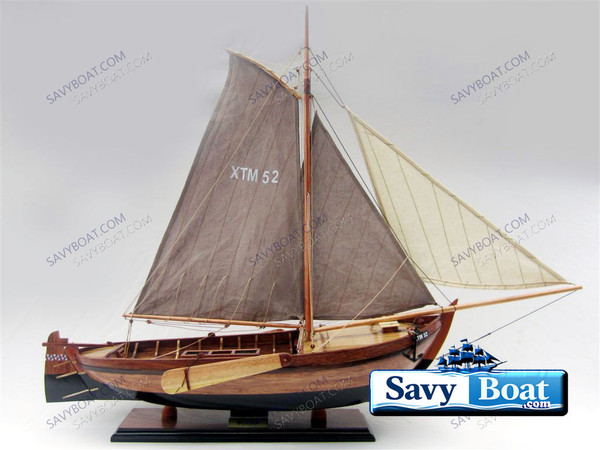
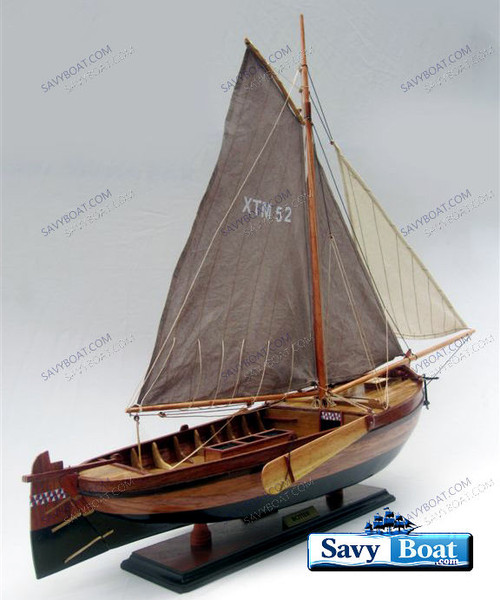
BOTTER SAIL BOAT
SAVY DIRECT PRICE $699.96MSRP: $749.99BOTTER SAIL BOAT FULLY BUILT AND READY TO DISPLAY MUSEUM QUALITY SHIP MODEL Dimension approx.: 31″ (long) x 7″ (wide) x 6″ (high) The model is already built. THIS IS NOT A MODEL SHIP... -


SHAMROCK SAIL BOAT
SAVY DIRECT PRICE $429.96MSRP: $449.99SHAMROCK SAIL BOAT FULLY BUILT AND READY TO DISPLAY BOAT MODEL Dimension approx.: 23.5"L x 4.5"W x 30"H The model is already built. THIS IS NOT A MODEL SHIP KIT The story... -


ENDEAVOUR SAIL BOAT 24"
SAVY DIRECT PRICE $289.96MSRP: $339.99ENDEAVOUR SAIL BOAT 24" FULLY BUILT AND READY TO DISPLAY MODEL Dimension approx.: 24″ L x 4″ W x 33″ H The model is already built. THIS IS NOT A MODEL SHIP KIT The story of...
Description

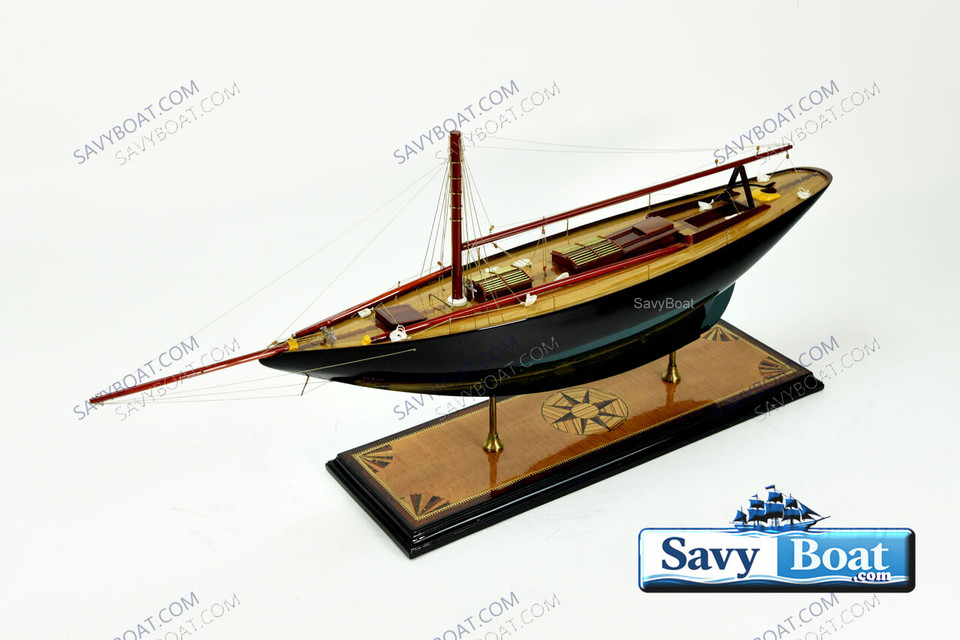
PENDUICK RACING SAIL BOAT
FULLY BUILT AND READY TO DISPLAY MUSEUM QUALITY SHIP MODEL
- Dimension approx.: APPROX 38″ L x 7″ W x 14″ H
- The model is already built, NOT a model ship kit
- BEAUTIFUL MUSEUM QUALITY MODEL
The name Pen Duick — Breton for coal tit — has become inseparable from the life and legend of Éric Tabarly, the sailor who transformed French ocean racing. What began as a century‑old gaff cutter inherited from his father became a lineage of experimental yachts that pushed the boundaries of design through the 1960s and 1970s. Each Pen Duick marked a new chapter in Tabarly’s relentless pursuit of speed, innovation, and mastery at sea.
Pen Duick I — The Beginning (1898)
The first Pen Duick was born as Yum, a 36‑ft linear rater designed by William Fife III and launched in 1898 at Carrigaloe, Cork Harbour. Fast and elegant, she quickly made her mark in Irish, British, and French racing circles. Tabarly’s father purchased her in 1938, and it was aboard this slender gaff cutter that young Éric first learned to sail.
After WWII, the boat deteriorated badly. When no buyer could be found, Tabarly persuaded his father to give her to him. Told her wooden hull was beyond saving, he refused to let her die. Instead, he built a mold and created a new fiberglass hull — the largest such project attempted at the time. Re-rigged and reborn, Pen Duick I became both a family heirloom and a symbol of Tabarly’s ingenuity.
It was aboard this same boat, a century after her launch, that tragedy struck: on the night of 12–13 June 1998, Tabarly fell overboard in the Irish Sea while en route to the Fife Regatta. He was never found.
Pen Duick II — The Breakthrough (1964)
Tabarly’s rise to international fame began with Pen Duick II, a wooden ketch built for the 1964 Singlehanded Transatlantic Race (OSTAR). Against expectations, he won the race outright, crossing the Atlantic alone and placing France at the forefront of offshore sailing. The victory made him a national hero and established the Pen Duick name as a force in ocean racing.
Pen Duick III — The Aluminum Clipper (1967)
Designed entirely by Tabarly, Pen Duick III was a 17.45‑meter aluminum schooner with a distinctive clipper bow — a blend of classic lines and modern materials. She proved devastatingly fast, winning the 1967 Sydney–Hobart Yacht Race and dominating the RORC circuit. Her success helped legitimize aluminum as a premier material for racing yachts.
Pen Duick IV — The Trimaran Pioneer (1968)
With Pen Duick IV, Tabarly leapt into the future. Designed by André Allègre, she was a 20.5‑meter aluminum trimaran with rotating masts — radical for her time. During the 1968 OSTAR, she collided with a ship and was forced to withdraw, but her potential was undeniable.
Sold to Alain Colas and renamed Manureva, she won the 1972 OSTAR before vanishing at sea in 1978, becoming one of sailing’s most haunting mysteries.
Pen Duick V — The Ballast Innovator (1969)
Built for the 1969 San Francisco–Tokyo Race, Pen Duick V was a compact 10.6‑meter sloop featuring novel ballast tanks — a precursor to the water‑ballast systems used in modern IMOCA and Vendée Globe yachts. Tabarly won the race, proving the concept’s effectiveness and influencing generations of offshore designs.
Pen Duick VI — The Steel Giant (1973)
The final and most imposing of the series, Pen Duick VI, was a 22.25‑meter steel ketch designed by André Mauric for the inaugural 1973–74 Whitbread Round the World Race. Built for a crew of twelve, she was powerful, heavy, and built to survive the Southern Ocean. She suffered two dismastings in the Whitbread but returned to win the 1976 Plymouth–Newport Transatlantic Race, even as competitors endured five consecutive storms.
In the 1977–78 Whitbread, she raced unofficially due to her depleted‑uranium ballasted keel, competing against the carbon‑fiber‑masted Heath’s Condor — a clash of experimental giants.
Today, Pen Duick VI sails under the command of Marie Tabarly, Éric’s daughter, who entered her in the 2023 Ocean Globe Race, honoring the 50th anniversary of the original Whitbread.
Across six yachts, the Pen Duick lineage charted the evolution of offshore sailing with classic wood to fiberglass restoration, aluminum monohulls and multihulls, rotating masts, water ballast, and steel global racers.
Each boat was a step forward. Each reflected Tabarly’s belief that innovation was not optional — it was the soul of the sport.
The Pen Duick yachts remain icons: elegant, experimental, and forever tied to the legacy of Éric Tabarly, the sailor who reshaped ocean racing and paid the ultimate price doing what he loved.