

















-
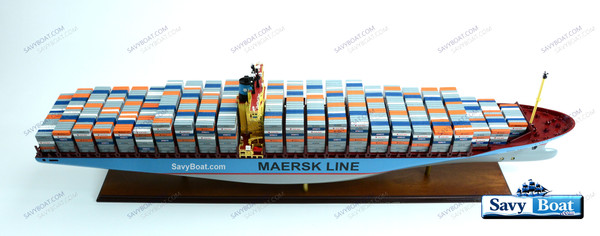
MAERSK EMMA CONTAINER 48” SHIP
SAVY DIRECT PRICE $1,099.96MSRP: $1,299.99Mærsk EMMA CONTAINER CARGO SHIP READY TO DISPLAY MUSEUM QUALITY SHIP MODEL Dimension Approx.: 48″L x 6.5"W x 13″H The model is already built, NOT a model ship kit -
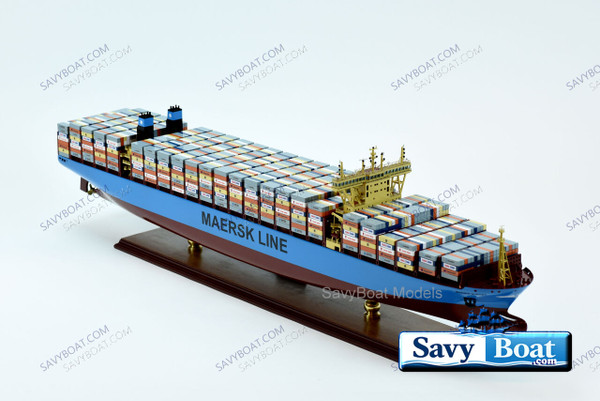

MAERSK MADRID CONTAINER SHIP
SAVY DIRECT PRICE $949.96MSRP: $999.99MAERSK MADRID CONTAINER SHIP FULLY BUILT AND READY TO DISPLAY MUSEUM QUALITY SHIP MODEL Dimension approx.: 39.3L x 6W x 9.8H(inch) The model is already built. THIS IS NOT A MODEL SHIP... -
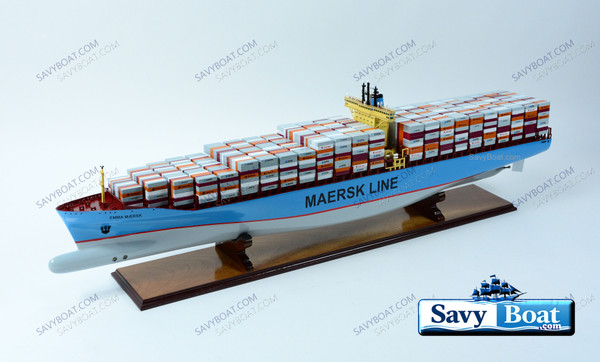

MAERSK EMMA CONTAINER 48” RC READY SHIP
SAVY DIRECT PRICE $1,299.96MSRP: $1,499.99Mærsk EMMA CONTAINER CARGO SHIP READY TO DISPLAY MUSEUM QUALITY SHIP MODEL Dimension Approx.: 48″L x 6.5"W x 13″H The model is already built, NOT a model ship kit
Description

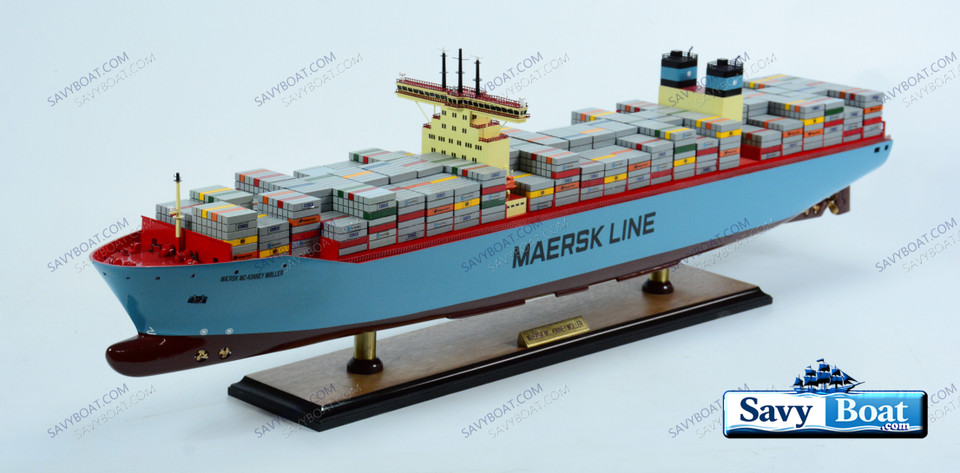
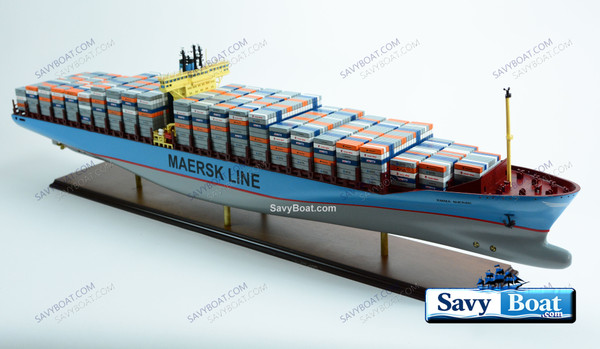
Mærsk Mc-Kinney Møller CONTAINER CARGO SHIP
FULLY BUILT AND READY TO DISPLAY MUSEUM QUALITY SHIP MODEL
- Dimension Approx.: 48″L x 6.25"W x 12″H
- The model is already built, NOT a model ship kit
When the Maersk Mc‑Kinney Møller slid down the ways at Daewoo Shipbuilding & Marine Engineering’s vast Geoje shipyard on 24 February 2013, she represented a new philosophy in global shipping. Built for Maersk Line, she was the first of the company’s revolutionary Triple‑E class — vessels designed around three principles: Economy of scale, Energy efficiency, and Environmental improvement. At nearly 400 meters long and with a capacity of 18,270 TEU, she was, at her debut, the largest container ship in the world.
Her construction was a feat of modern industrial engineering. Using 31 prefabricated mega‑sections, DSME assembled the ship like a colossal steel puzzle, reducing build time and ensuring precision. She was named in honor of Arnold Mærsk Mc‑Kinney Møller, the influential former CEO who had guided Maersk’s transformation into a global shipping titan. Though he passed away in 2012, the ship bearing his name embodied his vision of innovation and scale.
Powered by twin MAN‑B&W 8S80ME‑C 9.2 engines, each driving its own shaft and fixed‑pitch propeller, the Maersk Mc‑Kinney Møller was designed not for raw speed but for slow‑steaming efficiency. At 23 knots, she consumed far less fuel per container than earlier generations of ships, dramatically reducing emissions. Her 59‑meter beam, 165,000‑ton deadweight, and optimized hull form allowed her to carry more cargo with less environmental impact — a critical advantage in an era of rising fuel costs and tightening regulations.
She entered service on 2 July 2013, and her maiden voyage from Rotterdam to Asia via the Suez Canal that August drew global attention. Crowds gathered at ports to watch the enormous blue hull glide past, her towering stacks of containers dwarfing everything around her. She was the first of 20 identical Triple‑E vessels, each one a floating testament to Maersk’s commitment to scale and sustainability.
In operation, the Maersk Mc‑Kinney Møller became a backbone of the company’s Asia–Europe service, moving goods between the world’s largest manufacturing hubs and its biggest consumer markets. Her crew of 19, supported by accommodations for up to 34, managed a ship so automated and efficient that she could carry the equivalent of an entire small city’s worth of cargo with fewer people than a city bus.
Though newer ships — including 24,000‑TEU giants — have since surpassed her in size, the Maersk Mc‑Kinney Møller remains a milestone in maritime engineering. She demonstrated that ultra‑large container ships could be not only economically advantageous but also environmentally progressive, setting a standard that reshaped the global fleet.
The Maersk Mc‑Kinney Møller is more than a record‑breaker. She is the ship that ushered in the era of the mega‑container vessel, proving that scale, efficiency, and sustainability could coexist. Today she continues to serve Maersk’s worldwide network, a moving symbol of the company’s ambition and of the man whose name she carries — a legacy of leadership forged in steel and carried across the world’s oceans.