




-
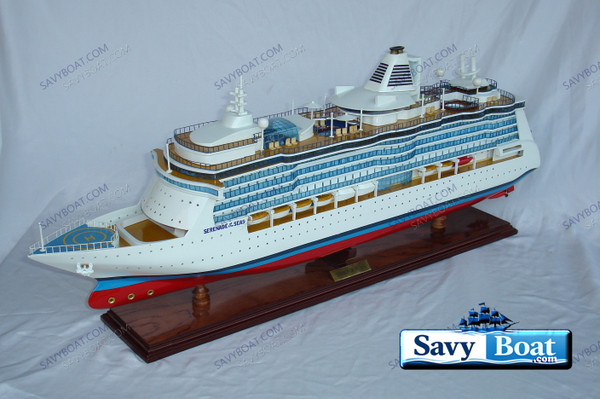

SERENADE OF THE SEAS CRUISE SHIP
SAVY DIRECT PRICE $649.96MSRP: $699.99SERENADE OF THE SEAS CRUISE SHIP FULLY BUILT AND READY TO DISPLAY BOAT MODEL Dimension approx.: 31"L x 6.5"W x 12"H The model is already built. THIS IS NOT A MODEL SHIP KIT Completed... -


EXPLORER OF THE SEAS CRUISE SHIP
SAVY DIRECT PRICE $1,699.96MSRP: $1,799.99MS EXPLORER OF THE SEAS FULLY BUILT AND READY TO DISPLAY MUSEUM QUALITY SHIP MODEL Dimension Approx.: 35″ L x 5″ W x 11″ H SCALE 1:350 The model is already built, NOT a model ship... -


MS NAVIGATOR OF THE SEAS CRUISE SHIP
SAVY DIRECT PRICE $1,699.96MSRP: $1,799.99MS NAVIGATOR OF THE SEAS FULLY BUILT AND READY TO DISPLAY MUSEUM QUALITY SHIP MODEL Dimension Approx.: 35″ L x 5″ W x 11″ H SCALE 1:350 The model is already built, NOT a model ship...
Description

FREEDOM OF THE SEAS CRUISE SHIP
FULLY BUILT AND READY TO DISPLAY, QUALITY SHIP MODEL
- Dimension approx.: 31″ (long) x 7″ (wide) x 14 (high)
- The model is already built. THIS IS NOT A MODEL SHIP KIT
Long before steamships crossed oceans or container vessels stitched together the global economy, the world’s great powers argued over a simple question: Who owns the sea? In the early 17th century, when European empires fought bitterly for control of trade routes, a young Dutch jurist named Hugo Grotius offered a radical answer. In 1609, in his treatise Mare Liberum, he declared that the oceans belonged to no one — that they were too vast, too fluid, and too essential to human commerce to be claimed by any single nation.
Grotius’ idea was revolutionary. At the time, Spain and Portugal sought to monopolize the lucrative East Indies trade, enforcing vast maritime empires through force and treaty. Grotius argued instead that the sea was a commons, open to all nations for navigation and trade. His reasoning laid the intellectual foundation for what would become one of the most enduring principles of international law: freedom of the seas.
The concept spread slowly. Throughout the 17th and 18th centuries, European states continued to test the limits of maritime sovereignty. But the Peace of Westphalia (1648) helped reinforce the idea that a nation’s authority ended at its coastline, leaving the high seas open to all. By the 19th century, as global trade expanded and liberal economic ideas took hold, Grotius’ vision gained broad acceptance. Freedom of the seas became not just a legal doctrine, but a cornerstone of the emerging international order.
No nation embraced the principle more fervently than the United States. From its earliest years, the young republic insisted that its merchant ships had the right to sail unmolested through international waters. This conviction shaped American foreign policy and led to several conflicts: the Quasi‑War with France, the Barbary Wars, and even the War of 1812, sparked in part by British interference with American shipping. For the United States, freedom of the seas was not an abstract ideal — it was a matter of national survival and economic independence.
The principle reached a new level of prominence during World War I. As European powers imposed sweeping naval blockades, neutral shipping — including American vessels — found itself caught in the crossfire. President Woodrow Wilson invoked freedom of the seas as a moral and strategic imperative, weaving it into his vision for a postwar world. It became one of the pillars of his diplomacy and a justification for America’s entry into the war.
In the century since, freedom of the seas has remained a bedrock of modern maritime law, shaping everything from commercial shipping to naval strategy. It underpins the globalized economy, allowing goods, energy, and information to move across oceans with minimal restriction. It also guides international disputes, ensuring that no nation can claim the open ocean as its own.
From Grotius’ 17th‑century manuscript to the legal frameworks that govern today’s oceans, freedom of the seas has evolved into one of the most important doctrines in global history. It has influenced wars, diplomacy, trade, and the very structure of international law. And even now — in an era of rising maritime competition — it remains a symbol of open access, shared space, and the enduring belief that the world’s oceans belong to all humankind.