





-
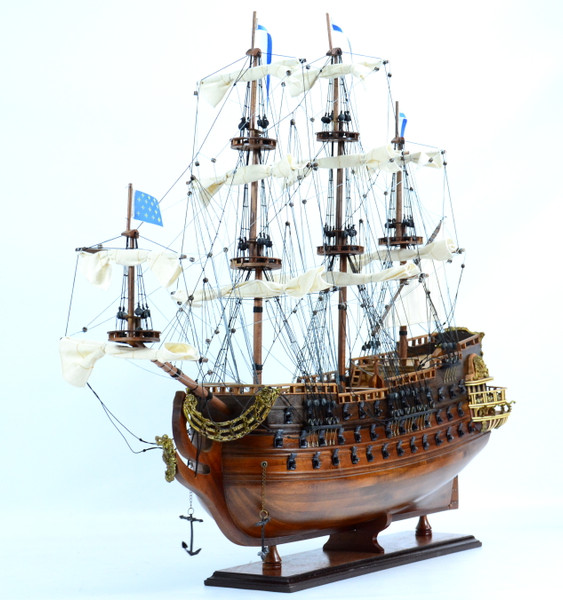
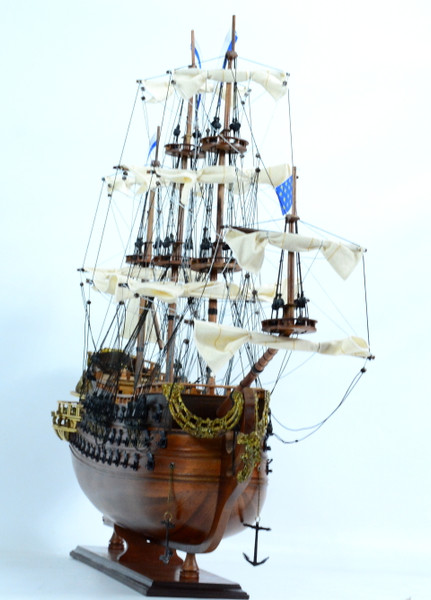
LE FURIEUX FRENCH TALL SHIP
SAVY DIRECT PRICE $1,199.96MSRP: $1,299.99LE FURIEUX FRENCH TALL SHIP FULLY BUILT AND READY TO DISPLAY MUSEUM QUALITY SHIP MODEL Dimension approx.: 32″ (long) x 11″ (wide) x 35″ (high) The model is already built. THIS IS NOT A...
Description

FURIE TUGBOAT
FULLY BUILT AND READY TO DISPLAY MUSEUM QUALITY SHIP MODEL
- Dimension approx.: 24″ (long) x 5.5″ (wide) x 13″ (high)
- The model is already built. THIS IS NOT A MODEL SHIP KIT
For more than a century, the steam tug Furie has lived many lives—quiet ones, hard‑working ones, and finally, a celebrated one. Today she rests proudly in Maassluis, but her journey began far from the crowds that now admire her.
She was launched in 1916 at the Bodewes shipyard in Martenshoek, Groningen, built sturdy and compact, meant for the German market. But the First World War closed borders and froze trade, leaving the new tug—then called Bodewes VI—waiting for a future that refused to arrive. For two years she sat idle, a ship without a purpose.
That changed in 1918, when she was sold to Holmen Bruks & Fabriks AB in Norrköping, Sweden. Renamed Sverige to signal neutrality, and later Holmen III, she entered a world of cold rivers, timber forests, and long industrial days. Her triple‑expansion steam engine—450 IPK of steady, rhythmic power—pulled enormous rafts of timber, sometimes as large as 9,000 cubic meters, from river mouths to the paper mills of Norrköping and Hallstavik. She was a workhorse, not glamorous, but essential. In 1957, she traded coal for oil, a small modernization in a world that was rapidly changing around her.
By the 1960s, the old ways of river towing were fading. Trucks and trains took over, and the once‑busy tug found herself without a role. Her captain bought her, renamed her Holmvik, and kept her close to Stockholm, where she lived out a quieter, more personal chapter—still steaming, still alive, but far from the heavy labor of her youth.
Then, unexpectedly, fame came calling.
In the 1970s, Dutch broadcaster AVRO searched the world for an authentic Dutch steam tug to star in the television adaptation of Hollands Glorie, Jan de Hartog’s beloved maritime novel. Their search led them to Sweden, where the old tug—weathered, renamed, and nearly forgotten—waited for someone to see her potential. She was purchased, brought home to the Netherlands, and restored to her original name: Furie.
The series aired in 1978, and the tug became a cultural icon overnight. But unlike most film props, Furie was not destined to fade after the credits rolled. The Stichting Hollands Glorie in Maassluis took ownership, preserving her as a living monument to Dutch maritime heritage.
Since then, Furie has been lovingly maintained, restored, and celebrated. She sits at the Stadhuiskade in Maassluis, open to visitors, steaming on special occasions, and serving as the centerpiece of the annual Furieade festival. A major restoration in the 2020s returned her to near‑original condition, honoring both her Dutch roots and her long Scandinavian service.
At 30 meters long, 6 meters wide, and 158 gross tons, she is not a large ship—but she carries a century of stories in her steel. From wartime uncertainty to Swedish industry, from quiet retirement to television stardom, Furie has survived because people kept finding new reasons to care about her.
Today, she is more than a tugboat. She is a survivor, a symbol, and a reminder of the age of steam—still warm, still breathing, still proud.