












-


HMS PANDORA TALL SHIP
SAVY DIRECT PRICE $549.95MSRP: $599.99Adirondack Guide boat FULLY BUILT AND READY TO DISPLAY MUSEUM QUALITY SHIP MODEL Dimension approx.: 26″ (long) x 7″ (wide) x 20″ (high) The model is already built. THIS IS NOT A MODEL... -


HMS VICTORY 44" TALL SHIP
SAVY DIRECT PRICE $1,749.96MSRP: $1,999.9944" HMS VICTORY TALL SHIP FULLY BUILT AND READY TO DISPLAY MUSEUM QUALITY SHIP MODEL Dimension Approx.: 44″L x 12"W x 33″H Highly complex rigging with varied thread gauge, hundreds o -
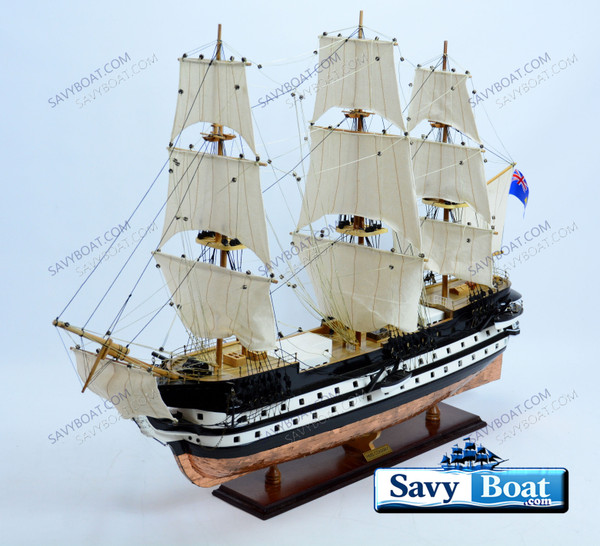

HMS CONWAY TALL TRAINING SHIP
SAVY DIRECT PRICE $1,249.96MSRP: $1,349.99HMS CONWAY TALL TRAINING SHIP FULLY BUILT AND READY TO DISPLAY MUSEUM QUALITY SHIP MODEL Dimension approx.: 39″ (long) x 10″ (wide) x 31″ (high) The model is already built. THIS IS NOT A...
Description

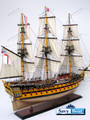
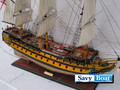
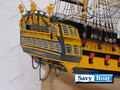
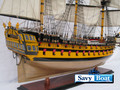
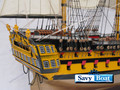
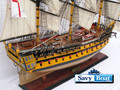
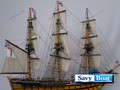
HMS AGAMEMNON TALL SHIP
FULLY BUILT AND READY TO DISPLAY MUSEUM QUALITY SHIP MODEL
- Dimension approx.: 35L x 11W x 31H (inch)
- The model is already built. THIS IS NOT A MODEL SHIP KIT
Among the many ships that carried the name HMS Agamemnon, none is more celebrated than the 64‑gun third‑rate launched in 1781—a ship forever linked with the rise of Horatio Nelson and the great age of fighting sail. Designed by Sir Thomas Slade, the same naval architect who created HMS Victory, Agamemnon was built at Buckler’s Hard from New Forest timber and launched into a world at war. Fast, responsive, and unusually handy for a ship of her size, she quickly earned a reputation as one of the finest 64‑gun ships in the Royal Navy.
Commissioned under Captain Benjamin Caldwell, Agamemnon first saw service in the closing years of the American Revolutionary War. But her most famous chapter began in 1793, when a young Captain Horatio Nelson hoisted his pennant aboard her. Nelson adored the ship, calling her “one of the finest 64s in the service,” and it was aboard Agamemnon that he forged much of his early combat reputation during the French Revolutionary Wars. She carried him through the Mediterranean campaigns, including the siege of Bastia and the battles around Corsica, and her speed and maneuverability made her a favorite in fleet actions and coastal operations alike.
Through the early 19th century, Agamemnon remained at the forefront of British naval power. She fought at the Battle of Copenhagen in 1801—though she ran aground before fully engaging—and later took her place in the line at the Battle of Trafalgar in 1805. There, she helped force the surrender of the massive Spanish four‑decker Santísima Trinidad, the largest warship in the world at the time. It was a remarkable achievement for a comparatively small 64‑gun ship, and it cemented her legacy as one of the most effective workhorses of the Royal Navy.
By the end of the decade, however, years of hard service had taken their toll. Sent to South American waters during the Napoleonic Wars, Agamemnon struck an uncharted shoal in the River Plate in June 1809. Her hull, worn and weakened, could not be saved. The crew and most of her stores were rescued, but the ship that had carried Nelson through his formative years was lost to the sea.
More than a century later, in 1993, maritime archaeologist Mensun Bound located the wreck. Subsequent surveys—including new work in 2024—revealed the remains of her starboard side, keel timbers, copper sheathing, and scattered shot, offering a rare archaeological window into a ship of the line from Nelson’s era.
The name Agamemnon lived on in the Royal Navy. Later vessels included a pioneering screw‑propelled battleship (1852), an ironclad of the Victorian fleet (1879), a Lord Nelson‑class pre‑dreadnought that fought in World War I (1906), a World War II auxiliary minelayer (M10), and today, the nuclear‑powered submarine HMS Agamemnon (S124)—commissioned in 2025 and armed with Spearfish torpedoes and Tomahawk missiles.
Across nearly 250 years, the name has come to symbolize speed, resilience, and naval excellence. Yet it is the 1781 ship—the beloved “Agamemnon” of Nelson—that remains the most storied, a vessel whose service spanned three great wars and whose legacy continues to echo through the modern Royal Navy.