




-


HMS AGAMEMNON TALL SHIP
SAVY DIRECT PRICE $989.96MSRP: $1,049.99HMS AGAMEMNON TALL SHIP FULLY BUILT AND READY TO DISPLAY MUSEUM QUALITY SHIP MODEL Dimension approx.: 35L x 11W x 31H (inch) The model is already built. THIS IS NOT A MODEL... -


HMS VICTORY 44" TALL SHIP
SAVY DIRECT PRICE $1,749.96MSRP: $1,999.9944" HMS VICTORY TALL SHIP FULLY BUILT AND READY TO DISPLAY MUSEUM QUALITY SHIP MODEL Dimension Approx.: 44″L x 12"W x 33″H Highly complex rigging with varied thread gauge, hundreds o -
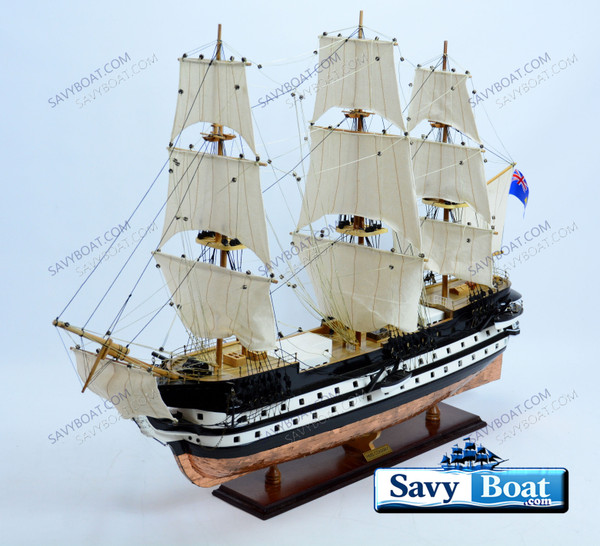

HMS CONWAY TALL TRAINING SHIP
SAVY DIRECT PRICE $1,249.96MSRP: $1,349.99HMS CONWAY TALL TRAINING SHIP FULLY BUILT AND READY TO DISPLAY MUSEUM QUALITY SHIP MODEL Dimension approx.: 39″ (long) x 10″ (wide) x 31″ (high) The model is already built. THIS IS NOT A...
Description

Adirondack Guide boat
FULLY BUILT AND READY TO DISPLAY MUSEUM QUALITY SHIP MODEL
- Dimension approx.: 26″ (long) x 7″ (wide) x 20″ (high)
- The model is already built. THIS IS NOT A MODEL SHIP KIT
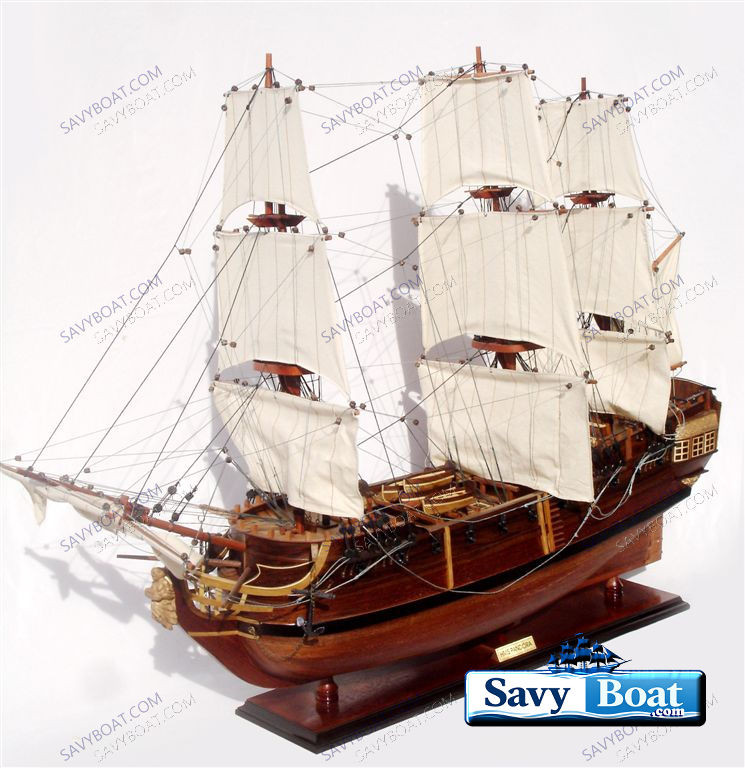
Launched from Deptford in May 1779, the 24‑gun sixth‑rate HMS Pandora entered the Royal Navy at a moment when Britain was fighting for control of the seas on multiple fronts. Built by Adams & Barnard, she was compact, fast, and well‑armed for her size — a post ship designed for patrol, escort, and independent cruising. With her 22 nine‑pounders and a crew of 160, she quickly found herself in the thick of the American Revolutionary War.
Her early service was steady and successful. In 1779, she patrolled the English Channel during the threatened Franco‑Spanish invasion. By 1780, she was escorting convoys to Quebec and hunting American privateers in the North Atlantic. Over the next several years she captured a string of enemy vessels — Jack, Terrible, Janie, Mercury, Louis, Lively, Port Royal, Superb, Nestor, and Financier — the kind of relentless commerce warfare that kept Britain’s trade routes open and its enemies off balance.
But Pandora would be remembered not for these victories, but for a mission that took her halfway around the world.
In 1790, the Admiralty dispatched her under Captain Edward Edwards (not McGuire — a common mix‑up) to pursue the mutineers of HMS Bounty. A year earlier, Fletcher Christian and his followers had seized the ship from Captain William Bligh and vanished into the Pacific. Pandora’s orders were stark: find the mutineers, arrest them, and bring them home for trial.
The voyage was long and punishing. After months of searching the scattered islands of Polynesia, Pandora finally located a group of mutineers at Tahiti in March 1791. Fourteen were taken prisoner and confined in a makeshift cell on the quarterdeck — the infamous “Pandora’s Box.” The rest of the mutineers, including Christian, had already fled to the unknown refuge of Pitcairn Island.
With her prisoners aboard, Pandora turned west toward home. But on 29 August 1791, while navigating the uncharted waters of the Torres Strait, she struck the Great Barrier Reef. The ship began to break apart in the pounding surf. In the chaos, 35 men — including four prisoners — were lost. The survivors escaped in the ship’s boats and made a harrowing open‑boat journey to Timor, echoing Bligh’s own ordeal after the mutiny.
For nearly two centuries, Pandora lay hidden beneath coral and sand. Then, in 1977, divers located the wreck, sparking one of Australia’s most ambitious maritime archaeological projects. Between 1979 and 1999, more than 6,500 artefacts were recovered: weapons, tools, ceramics, navigational instruments, personal belongings, and Polynesian items gathered during the search. The site remains a time capsule of 18th‑century naval life and cross‑cultural contact in the Pacific.
HMS Pandora began as a modest sixth‑rate patrolling the Channel, but her final mission bound her forever to one of the most famous naval stories in history. Her wreck — dramatic, tragic, and archaeologically rich — stands today as one of the Southern Hemisphere’s most important underwater heritage sites. And her name endures alongside Bounty, Bligh, and Fletcher Christian in the long, tangled saga of Britain’s Pacific adventures.