









-


GERMAN U-BOAT SUBMARINE
SAVY DIRECT PRICE $899.96MSRP: $959.99WWII GERMAN U-BOAT FULLY BUILT AND READY TO DISPLAY MUSEUM QUALITY SHIP MODEL Dimension approx.: 39.5″ (long) x 4″ (wide) x 11.5″ (high) The model is already built, NOT a model ship... -


USS BALAO submarine 40" fully built wood model with stand
SAVY DIRECT PRICE $899.96MSRP: $999.99USS BALAO SUBMARINE FULLY BUILT AND READY TO DISPLAY, QUALITY SHIP MODEL Dimension approx.: 39″ L x 4″ W x 10″ H This beautiful model is already built, NOT a kit. USS Balao (SS-285) and the... -
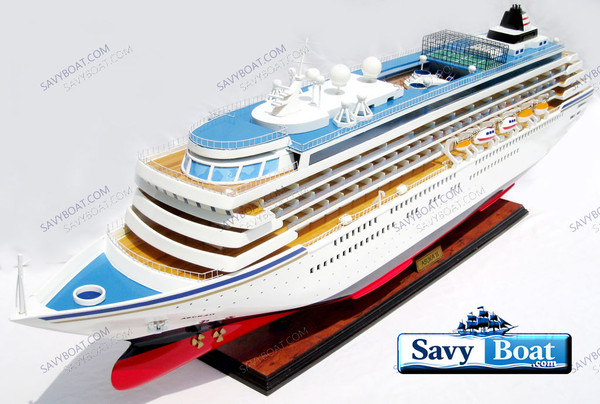

MS ASUKA II (飛鳥II) CRUISE SHIP
SAVY DIRECT PRICE $249.00MS ASUKA II (飛鳥II) CRUISE SHIP FULLY BUILT AND READY TO DISPLAY QUALITY SHIP MODEL Dimension approx.: 31.L x 4.W x 11H The model is already built. THIS IS NOT A MODEL SHIP...
Description

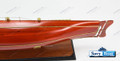
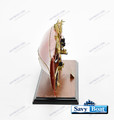
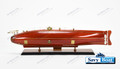
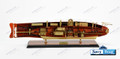
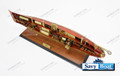
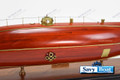
ICTINEO - THE FIRST POWERED SUBMARINE
FULLY BUILT AND READY TO DISPLAY MUSEUM QUALITY SHIP MODEL
- Dimension approx.: 28″ long x 6″ wide
- The model is already built. THIS IS NOT A MODEL SHIP KIT
In the bustling port of Barcelona in the mid‑19th century, a quiet revolution in engineering was taking shape. Catalan inventor Narcís Monturiol i Estarriol, a utopian thinker and self‑taught engineer, believed that humanity could work beneath the sea as safely as on land. His first submarine, Ictíneo I, had proven the concept — but Monturiol wanted something far more ambitious. The result was Ictíneo II, launched on 2 October 1864, a vessel decades ahead of its time.
Monturiol’s dream began not with warfare, but with compassion. He had witnessed the dangers faced by coral divers along the Catalan coast and envisioned a submarine that could harvest coral safely. But the Spanish Navy, though intrigued, offered no funding. Undeterred, Monturiol turned to the public, raising 300,000 pesetas through a subscription campaign and founding La Navegación Submarina, one of the world’s first submarine development companies.
The Ictíneo II was larger and more sophisticated than its predecessor. Built of olive wood reinforced with copper, she first sailed under human power on 20 May 1865, diving to 27.5 meters — deeper than any submarine of her era. But Monturiol knew that muscle power alone could never unlock the submarine’s true potential.
So he invented something unprecedented: an air‑independent engine.
Using a chemical reaction involving potassium chlorate, zinc, and manganese dioxide, Monturiol created a system that produced both oxygen and heat. The heat powered a steam engine, while the oxygen sustained the crew — allowing the submarine to operate underwater without surfacing. It was the world’s first fully functional AIP (air‑independent propulsion) submarine, a concept that would not reappear in practical form until the mid‑20th century.
With this breakthrough, Ictíneo II achieved remarkable performance for her time:
-
4.5 knots on the surface
-
~2.5 knots submerged
-
Up to 7 hours underwater endurance
-
Test depth of 30 meters
Monturiol even equipped her with a small underwater cannon, demonstrating that a submarine could load, aim, and fire a weapon beneath the waves — though the Spanish military showed little interest.
The submarine completed around 20 successful dives, including a submerged run under full chemical‑engine power on 14 December 1867. Engineers and scientists across Europe took notice. But innovation alone could not keep the company afloat. By 1868, La Navegación Submarina was bankrupt. Creditors seized the Ictíneo II, and the world’s most advanced submarine was dismantled for scrap — a tragic end for a vessel so far ahead of its time.
Yet Monturiol’s legacy endured. His pioneering work on air‑independent propulsion, hull design, and underwater safety laid the groundwork for modern submarine engineering. Today, a full‑scale replica of Ictíneo II stands in Barcelona’s Maritime Museum, honoring the visionary who imagined the future of underwater navigation long before the world was ready for it.