



-


FLYING DUTCHMAN PIRATE SHIP
SAVY DIRECT PRICE $1,399.96MSRP: $1,549.99FLYING DUTCHMAN PIRATE SHIP FULLY BUILT AND READY TO DISPLAY MUSEUM QUALITY SHIP MODEL Dimension Approx.: 35″L x 14.5″W x 31″H The model is already built, NOT a model shi -

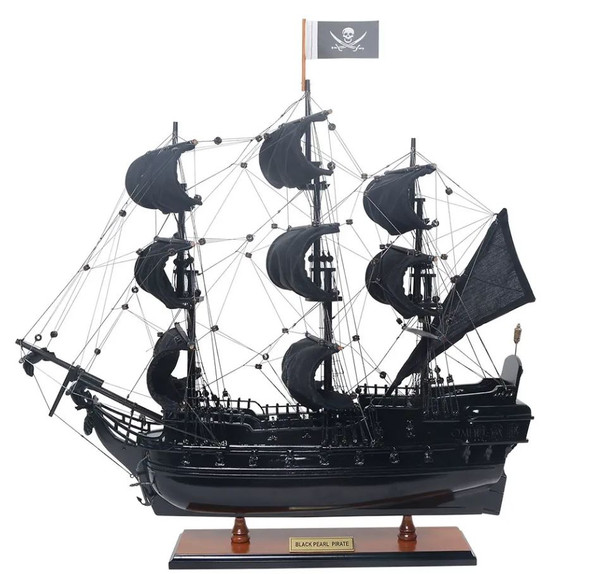
BLACK PEARL PIRATE SHIP 20"
SAVY DIRECT PRICE $389.96MSRP: $429.99BLACK PEARL PIRATE SHIP 20" FULLY BUILT AND READY TO DISPLAY MUSEUM QUALITY SHIP MODEL Dimension approx.: 20L x 6.5W x 19H (inches) The model is already built. THIS IS NOT A MODEL SHIP... -


1715 WHYDAH GALLY PIRATE SHIP
SAVY DIRECT PRICE $699.96MSRP: $799.991715 WHYDAH GALLY PIRATE SHIP FULLY BUILT AND READY TO DISPLAY QUALITY SHIP MODEL Dimension Approx.: 36″ (long) x 11″ (wide) x 27″ (high) The
Description

JOLLY ROGER PIRATE SHIP
FULLY BUILT AND READY TO DISPLAY MUSEUM QUALITY SHIP MODEL
- Dimension approx.: 30″ (long) x 12″ (wide) x 32″ (high)
- The model is already built. THIS IS NOT A MODEL SHIP KIT
HISTORY OF THE JOLLY ROGER FLAG
The Jolly Roger is one of the most recognizable symbols in maritime history, yet its origins are far more tangled and varied than the familiar skull‑and‑crossbones suggests. The term itself appears in print as early as 1724 in Charles Johnson’s A General History of the Pyrates, where he notes that both Bartholomew Roberts and Francis Spriggs called their black flags “Jolly Roger.” Their designs, however, were completely different — a clear sign that the name already referred not to a single emblem, but to the general category of black pirate flags.
Contemporary accounts reinforce this. In 1724, Richard Hawkins described a pirate flag showing a skeleton stabbing a heart with a spear, a design closely matching several Golden Age pirate flags. And in 1723, a London newspaper reported that captured pirates had flown a black banner depicting Death with an hourglass and a dart striking a bleeding heart, a flag they called “Old Roger.” The name “Roger,” in this context, was a colloquial term for the devil — not a reference to any real pirate named Roger.
Over time, fanciful theories emerged: that the name came from the French joli rouge (“pretty red”), or from an Indian pirate called Ali Rajah. But historians dismiss these as later inventions. The evidence points instead to a simple truth: “Jolly Roger” was pirate slang for the banner of death, a symbol meant to terrify victims into surrendering without a fight.
The earliest pirate flags were often plain black, flown by figures such as Peter Easton (1612), Captain Martel (1716), Charles Vane (1718), and Richard Worley (1718). Black signaled that the pirates might show mercy if a ship surrendered quickly. A red flag, by contrast, meant no quarter — a warning that resistance would lead to slaughter.
The skull‑and‑crossbones motif emerged gradually. A 1687 French logbook records pirates using a skull‑and‑crossbones on a red flag on land. By the early 1700s, captains like Emanuel Wynn were reportedly flying black flags with skulls, bones, and hourglasses at sea. After the War of the Spanish Succession ended in 1714, thousands of unemployed privateers turned to piracy, and the black flag rapidly evolved into a shared visual language. Marcus Rediker notes that between 1716 and 1726, pirate crews across the Atlantic adopted increasingly standardized designs — skeletons, bleeding hearts, hourglasses, and eventually the iconic skull‑and‑crossbones.
By 1730, the classic Jolly Roger had become the dominant symbol of piracy.
Pirates rarely flew the Jolly Roger continuously. Instead, they approached under false colors — often a friendly national flag — and only hoisted the black flag at the last moment, signaling their identity and offering a chance to surrender. The psychological effect was immense. When Bartholomew Roberts sailed into Trepassey, Newfoundland in 1720 with black flags flying, the crews of all 22 ships in the harbor abandoned their vessels in panic.
The Jolly Roger was never just a flag. It was a message: We are pirates. You have one chance to yield.
Though the Golden Age of Piracy ended nearly three centuries ago, the Jolly Roger endures — in folklore, fiction, and popular culture. Its meaning has shifted from terror to adventure, from a threat to a symbol of rebellion. But its origins remain rooted in the real flags flown by real pirates, each design a stark reminder of a world where a piece of black cloth could decide the fate of a ship and everyone aboard.