







































-


LA BRETAGNE TALL SHIP 34
SAVY DIRECT PRICE $999.96MSRP: $1,049.99LA BRETAGNE TALL SHIP 32 FULLY BUILT AND READY TO DISPLAY MUSEUM QUALITY SHIP MODEL Dimension approx.: 31.5 L x 7 W x 31 H The model is already built. THIS IS NOT A MODEL SHIP... -

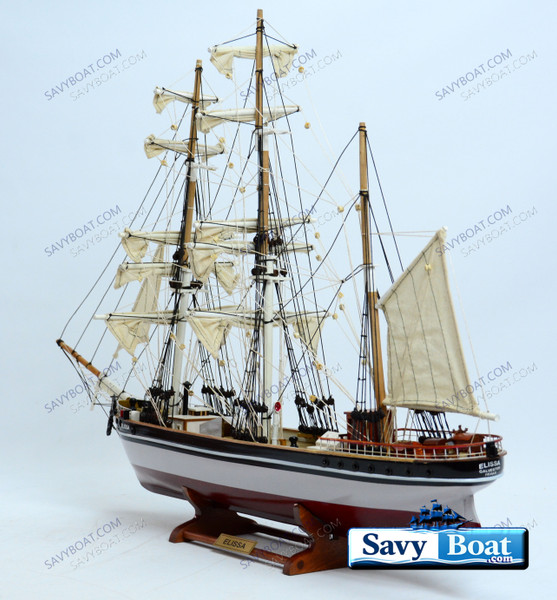
ELISSA TALL SHIP
SAVY DIRECT PRICE $739.96MSRP: $789.99ELISSA TALL SHIP FULLY BUILT AND READY TO DISPLAY QUALITY SHIP MODEL Dimension approx.: 31″ (long) x 9″ (wide) x 19″ (high) The model is already built. THIS IS NOT A MODEL SHIP... -
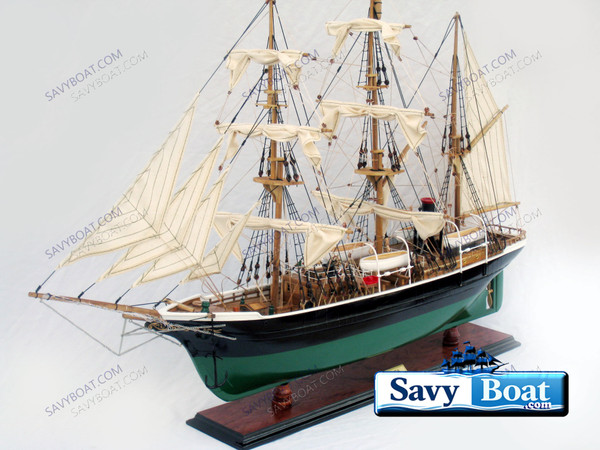
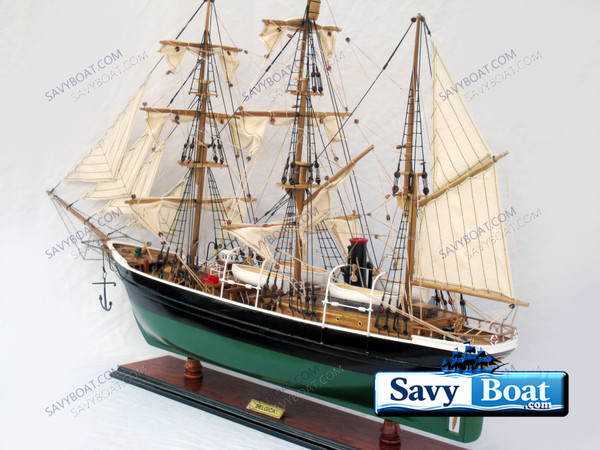
BELGICA TALL SHIP
SAVY DIRECT PRICE $799.96MSRP: $849.99BELGICA TALL SHIP FULLY BUILT AND READY TO DISPLAY, QUALITY SHIP MODEL Dimension approx.: 28.74L x 5.51W x 25.59H (inches) The model is already built. THIS IS NOT A MODEL SHIP KIT When...
Description

LA BRETAGNE TALL SHIP 25
FULLY BUILT AND READY TO DISPLAY MUSEUM QUALITY SHIP MODEL
- Dimension approx.: 25 L x 5.5 W x 26H
- The model is already built. THIS IS NOT A MODEL SHIP KIT
When SS La Bretagne slid down the ways at the Penhoët shipyard in Saint‑Nazaire on 9 September 1885, she represented a new chapter in France’s bid to challenge British and German dominance on the North Atlantic. Built for the Compagnie Générale Transatlantique (CGT)—the French Line—she was one of four near‑sister ships constructed under a government subsidy program that required them to be suitable for wartime requisition. At 7,112 gross tons and nearly 151 meters long, she was a modern steel liner for her day, with a hull forged from Terre‑Noire steel and divided into twelve watertight compartments. Her decks, planked in Canadian elm and teak, carried the elegance expected of a French passenger ship.
La Bretagne entered service in August 1886, departing Le Havre on her maiden voyage to New York. The crossing was stormy, but she arrived on schedule—an early demonstration of the reliability that would define her long career. She carried a typical French Line passenger mix: a refined first class, a modest second class, and a large steerage contingent. Initially designed for 600 steerage passengers, she was later refitted to carry 1,500, reflecting the era’s booming transatlantic migration.
Her early years were marked by both routine and drama. In 1891, a disturbed passenger threw his son overboard and had to be restrained mid‑voyage. In 1892, a cholera outbreak in Europe temporarily halted steerage traffic, forcing La Bretagne and her sisters to sail with reduced loads. Yet she remained a dependable workhorse on the Le Havre–New York route for more than 25 years, carrying mail, cargo, and thousands of travelers between the Old World and the New.
A major refit in 1895 modernized her machinery. Her original twin triple‑expansion engines were replaced with quadruple‑expansion engines, boosting efficiency and maintaining her service speed of 17 knots. Her four masts were reduced to two, reflecting the declining role of auxiliary sail on steamships. Inside, French designer Jules Allard had already given her a refined interior—$75,000 worth of decoration that helped distinguish CGT ships from their rivals.
By the early 20th century, however, the age of turbine giants had arrived. New liners like Lusitania, Mauretania, and France made ships like La Bretagne seem small and old‑fashioned. In 1912, she was sold to the Compagnie de Navigation Sud‑Atlantique for service to South America, a quieter route where her size and speed remained adequate. After World War I, in 1919, she was renamed SS Alesia, continuing to serve in secondary roles as newer ships took center stage.
Her end came not with fanfare but with misfortune. In December 1923, while under tow to a Dutch scrapyard, she grounded off Texel and was declared a total loss. After nearly four decades of service, the once‑proud liner met her fate on a quiet stretch of coast far from the busy ports she had long connected.
Yet La Bretagne remains an important vessel in the story of French ocean liners. She represented a moment when France was asserting itself on the Atlantic, building steel‑hulled, elegantly appointed ships capable of competing with the best of Europe. Her career spanned the golden age of steamship travel—an era of migration, luxury, and industrial ambition—and her legacy endures as part of the French Line’s long pursuit of maritime prestige.