








-

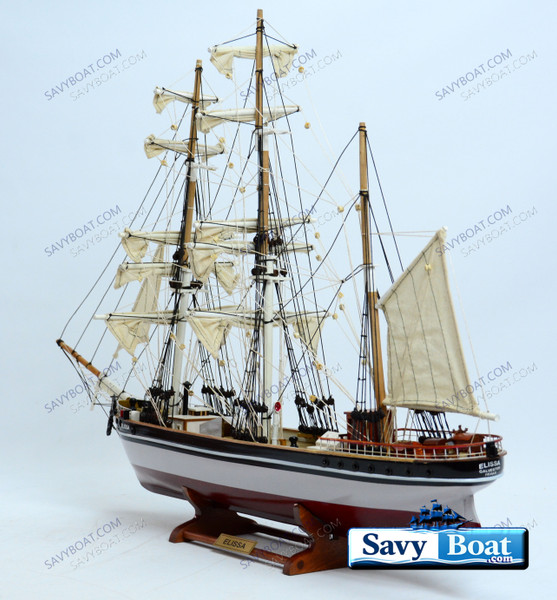
ELISSA TALL SHIP
SAVY DIRECT PRICE $739.96MSRP: $789.99ELISSA TALL SHIP FULLY BUILT AND READY TO DISPLAY QUALITY SHIP MODEL Dimension approx.: 31″ (long) x 9″ (wide) x 19″ (high) The model is already built. THIS IS NOT A MODEL SHIP... -


FRAM (FORWARD) TALL SHIP
SAVY DIRECT PRICE $499.96MSRP: $549.99FRAM (FORWARD)TALL SHIP FULLY BUILT AND READY TO DISPLAY HIGH QUALITY SHIP MODEL Dimension approx.: 28 inch L x 8 inch W x 23 inch H The model is already built. THIS IS NOT A... -
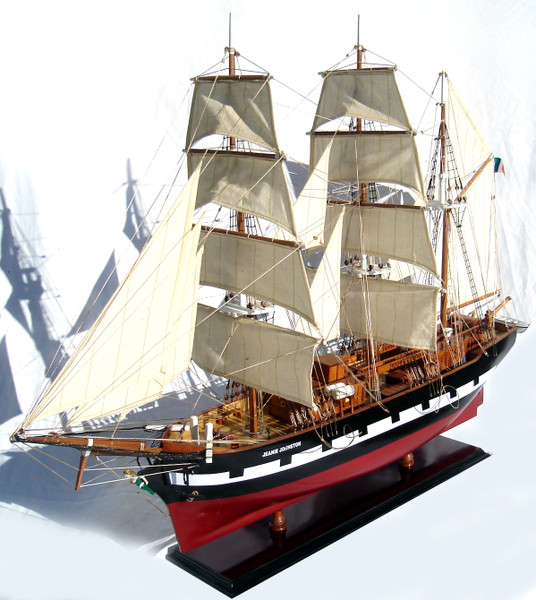

JEANIE JOHNSTON TALL SHIP
SAVY DIRECT PRICE $1,099.99JEANIE JOHNSTON TALL SHIP FULLY BUILT AND READY TO DISPLAY, QUALITY SHIP MODEL Dimension approx.: 31″ (long) x 7″ (wide) x 30″ (high) The model is already built. THIS IS NOT...
Description

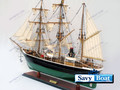
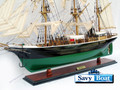
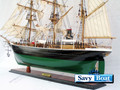
BELGICA TALL SHIP
FULLY BUILT AND READY TO DISPLAY, QUALITY SHIP MODEL
- Dimension approx.: 28.74L x 5.51W x 25.59H (inches)
- The model is already built. THIS IS NOT A MODEL SHIP KIT
When the barque‑rigged steamship Patria slid into the water at Svelvik, Norway, in 1884, she was built for the brutal work of northern whaling. Constructed of pine and American pine over oak ribs, strengthened with greenheart planking and iron reinforcement, she was a compact but rugged vessel—designed to survive ice, storms, and the long, lonely months of Arctic hunting. Her hybrid propulsion, a 35‑horsepower steam engine paired with full sails, gave her the flexibility needed for whaling voyages that could stretch across seasons.
For more than a decade, Patria worked as a whaler, complete with onboard tryworks for rendering blubber into oil. She was a tough, utilitarian ship—nothing yet hinted at the extraordinary role she would play in the history of exploration.
That changed in 1896, when Belgian naval officer Adrien de Gerlache purchased her for a bold and unprecedented mission. Renamed Belgica, she was refitted for science rather than hunting, her holds transformed into laboratories and storage for the Belgian Antarctic Expedition. On 16 August 1897, she sailed from Antwerp with a remarkable crew that included Roald Amundsen, future conqueror of the South Pole; Henryk Arctowski, the expedition’s chief scientist; Antoni Dobrowolski; and Emil Racoviță, one of the first polar biologists.
Belgica crossed the Antarctic Circle in February 1898—only the second ship in history to do so—but soon became trapped in pack ice off the Antarctic Peninsula. By March, she was frozen fast. What followed was a 13‑month ordeal, the first overwintering in Antarctic history. The crew endured unbroken darkness, crushing cold, scurvy, and psychological collapse. Expedition doctor Frederick Cook improvised treatments for what he called “polar anergia,” prescribing light exposure, fresh meat, and strict hygiene—measures that likely saved the crew’s lives. Despite the suffering, the expedition produced groundbreaking meteorological, biological, and hydrographic data, laying the foundation for future Antarctic science.
After returning to Belgium in 1899, Belgica’s career continued in the north. She took part in Arctic expeditions in 1905 and 1907–1909, proving her durability in both polar regions. But her life would shift again as she passed through new owners and new roles.
In 1916, she was sold to Det Norske Kulsyndikat and renamed Isfjord, serving as a passenger and cargo ship in Spitsbergen. A year later she was sold again, renamed Belgica once more, and converted into a factory ship—a far cry from her days of scientific glory.
Her final chapter came during the chaos of World War II. In 1940, as Allied forces evacuated northern Norway, the British requisitioned Belgica as a dépôt ship during the Franco‑British Expeditionary Force’s operations around Harstad. When the evacuation became inevitable, she was scuttled in June 1940 to prevent capture—ending the life of a vessel that had survived more than half a century of ice, storms, and war.
Today, Belgica is remembered as one of the most important ships in the history of polar exploration. Her Antarctic overwintering shaped the careers of Amundsen and Cook, influenced every major expedition that followed, and demonstrated the resilience—and fragility—of humans in the polar night. Plans announced in 2007 to build a modern replica reflect her enduring legacy.
From whaler to research vessel, from Arctic trader to wartime depot ship, Belgica’s story is one of transformation, endurance, and the extraordinary places a single wooden hull can carry human ambition.