









-


RMS QUEEN ELIZABETH OCEAN LINER
SAVY DIRECT PRICE $1,099.96MSRP: $1,199.99CURNARD LINES, RMS QUEEN ELIZABETH FULLY BUILT AND READY TO DISPLAY MUSEUM QUALITY SHIP MODEL Open die cut side hull windows, NOT painted like those built by most other companies... -
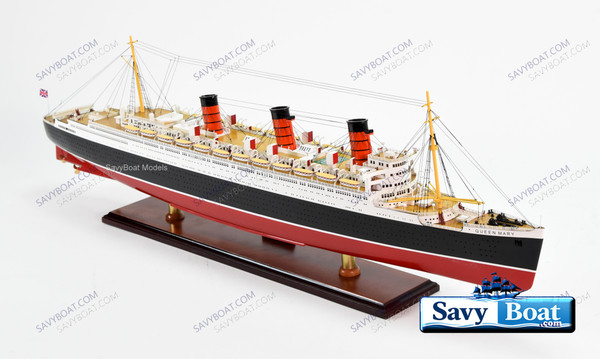

RMS QUEEN MARY LIGHTED OCEAN LINER
SAVY DIRECT PRICE $1,199.96MSRP: $1,299.99FULLY BUILT AND READY TO DISPLAY MUSEUM QUALITY SHIP MODEL Dimension approx.: 40″ L x 5″ W x 12.5″ H LIGHTED WITH LED LIGHTS INSTALLED (power supply not included) The model is already... -


MS QUEEN ELIZABETH II (QE2 LIGHTED OCEAN LINER
SAVY DIRECT PRICE $1,199.96MSRP: $1,349.99MS QUEEN ELIZABETH II (QE2) - LIGHTED FULLY BUILT AND READY TO DISPLAY MUSEUM QUALITY SHIP MODEL Dimension Approx.: 39.5″L x 4.5″W x 12″H SCALE 1:300 LIGHTED - LED LIGHTS pre-installed...
Description

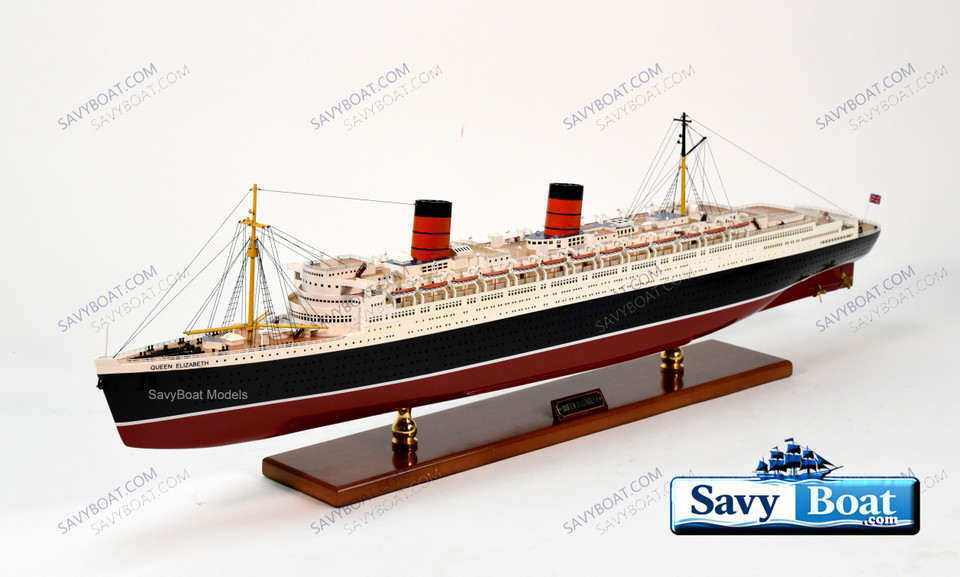
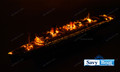
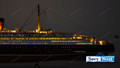
CURNARD LINES RMS QUEEN ELIZABETH- LIGHTED
FULLY BUILT AND READY TO DISPLAY MUSEUM QUALITY SHIP MODEL
- Dimension Approx.: 40″ L x 5″ W x 11″ H
- The model is already built, NOT a model ship kit
- LIGHTED SHIP MODEL- PREINSTALLED LED LIGHTS (power supply not included)
- Open die cut side hull windows, NOT painted like those built by most other companies.
When the RMS Queen Elizabeth slid down the ways at John Brown & Company’s Clydebank yard on 27 September 1938, she was the largest passenger ship the world had ever seen. At 1,031 feet long and 118 feet wide, she surpassed even her celebrated sister, the Queen Mary. Named for Queen Elizabeth, consort of King George VI, she embodied the height of British shipbuilding — a sleek, two‑funnel Art Deco masterpiece built for speed, luxury, and the prestige of the Cunard Line.
But the world she was built for vanished almost immediately. Before she could enter commercial service, war engulfed Europe. In March 1940, painted in wartime grey and shrouded in secrecy, the Queen Elizabeth slipped out of the Clyde under sealed orders. She crossed the Atlantic alone — a daring escape designed to evade German spies and U‑boats — and arrived safely in New York. There she joined the Queen Mary and Normandie, forming the most extraordinary trio of liners ever assembled in one harbor.
Converted into a troopship, the Queen Elizabeth became one of the Allies’ most valuable assets. Her immense size allowed her to carry entire divisions — more than 15,000 troops at a time — and her speed made her nearly impossible for submarines to catch. Over the course of the war, she transported over 750,000 troops across the Atlantic and Pacific, earning the nickname “The Grey Ghost” for her ability to appear and vanish across vast distances without escort.
When peace returned, she was refitted for civilian service and entered the transatlantic trade in October 1946. With accommodations for more than 2,200 passengers and 1,000 crew, she became a floating palace of postwar optimism — a ship of grand ballrooms, sweeping staircases, and polished Art Deco interiors. For two decades, she and the Queen Mary ruled the North Atlantic, symbols of British elegance and engineering.
But the jet age was relentless. By the 1960s, airliners were crossing the Atlantic in hours, not days, and passenger numbers dwindled. In 1968, after just over twenty years of service, the Queen Elizabeth was retired. Her first buyers attempted to convert her into a hotel and casino in Florida, but the venture failed. She was then sold to Hong Kong businessman Tung Chao‑yung, who envisioned transforming her into a floating university — Seawise University.
It was a bold dream, but it ended in catastrophe. On 9 January 1972, as the ship neared completion in Hong Kong’s Victoria Harbour, multiple fires broke out aboard. The blaze raged through her decks, and despite desperate firefighting efforts, she capsized and sank, her great hull lying on her side in shallow water. The wreck was partially scrapped in 1974–75, and later buried beneath land reclamation — an unmarked grave for one of the greatest liners ever built.
The Queen Elizabeth’s lineage continued with the Queen Elizabeth 2 (QE2) in 1969 — a smaller, faster, more versatile liner that served for nearly forty years and even saw action in the Falklands War. Today, the name lives on with the MS Queen Elizabeth (2010), a modern Vista‑class cruise ship that echoes the Art Deco elegance of her predecessors.
Yet it is the original RMS Queen Elizabeth that remains the most mythic: a wartime legend, a postwar icon, and a ship whose tragic end only deepened her mystique. She was the last and greatest of the classic superliners — a vessel built for a world that changed too quickly, but whose memory endures as one of the crowning achievements of the golden age of ocean travel.