







-


SS SHALOM LIGHTED STEAMSHIP
SAVY DIRECT PRICE $999.96MSRP: $1,099.99SS SHALOM LUXURY STEAM SHIP LINER FULLY BUILT AND READY TO DISPLAY, QUALITY SHIP MODEL Dimension approx.: 34″ L x 4.5″ W x 11″ H. This beautiful model is already built, NOT a kit. When... -
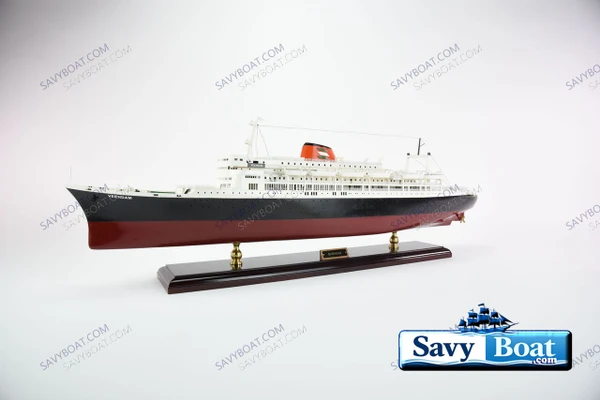

SS VEENDAM STEAMSHIP LIGHTED
SAVY DIRECT PRICE $1,149.96MSRP: $1,249.99STEAMSHIP SS VEENDAM FULLY BUILT AND READY TO DISPLAY MUSEUM QUALITY SHIP MODEL Dimension approx.: 35L X 5W X 10H LIGHTED WITH LED LIGHTS INSTALLED (power supply not included) The model is... -


SS VEENDAM STEAMSHIP
SAVY DIRECT PRICE $1,049.96MSRP: $1,149.99STEAMSHIP SS VEENDAM FULLY BUILT AND READY TO DISPLAY MUSEUM QUALITY SHIP MODEL Dimension approx.: 35L X 5W X 10H The model is already built, NOT a model ship kit Handcrafted from scratch...
Description

LIGHTED SS ARGENTINA 1958 LIGHTED STEAM SHIP
- LIGHTED - LED LIGHTS pre-installed (power supply not included)
-
Dimension approx.: 37.5″L x 5″W x 11.5″H
-
APPROX SCALE 1:200
- The model is already built, NOT a model ship kit
She began her life not as Argentina, but as Pennsylvania—a sleek, modern turbo‑electric liner launched in the summer of 1929, just months before the world changed. Built at Newport News Shipbuilding for the Panama Pacific Lines, she was one of three sister ships designed to knit together the long, glamorous route from New York to Havana, through the Panama Canal, and up the Pacific coast to Los Angeles and San Francisco. With room for 500 passengers and a reputation for smooth, quiet running thanks to her electric propulsion, she represented the optimism of an era that believed ocean travel would only grow grander.
But the 1930s reshaped her destiny. In 1937, the U.S. Maritime Commission acquired the ship, refitted her, and gave her a new name—SS Argentina. Under Moore‑McCormack’s American Republics Lines, she became part of the celebrated “Good Neighbor Fleet,” sailing bi‑weekly from New York to Rio de Janeiro, Santos, Montevideo, and Buenos Aires. Her voyages were more than commercial service; they were instruments of diplomacy, carrying businessmen, diplomats, and tourists as the United States sought closer ties with South America. She was a familiar sight in the great ports of the southern hemisphere, her white hull reflecting the warmth of a region she helped connect.
Everything changed again after Pearl Harbor. On 2 January 1942, Argentina was requisitioned by the War Shipping Administration and transformed into a U.S. Army troop transport. Gone were the leisurely days of cruising; in their place came urgent crossings of the Atlantic, often unescorted, carrying thousands of soldiers toward the war. She ferried troops to Italy, France, and England, and in November 1945 she carried 88 German scientists to the United States under the secretive Operation Paperclip. Weeks later, she returned home with a very different group—452 war brides and children arriving under Operation Diaper, greeted in New York by cheering crowds and newspaper photographers.
With the war over, Argentina was refitted once more, her passenger spaces restored and modernized. She returned to commercial service in 1948, but the world she had known was fading. Air travel was rising, operating costs were climbing, and the once‑busy routes of the Good Neighbor Fleet grew quieter. By August 1958, after nearly three decades of service in peace and war, she was laid up in the James River Reserve Fleet—her long career effectively complete.
In 1964, the ship that had carried diplomats, soldiers, refugees, scientists, and families across two oceans was sold for scrap. Her steel was cut apart, but her story endured: a vessel that lived multiple lives, each shaped by the changing tides of American diplomacy, global conflict, and the evolution of ocean travel.
nd departed New York on her maiden voyage for Buenos Aires” . Over the decades she changed names as often as she changed oceans: Veendam, Brasil, Monarch Star, Bermuda Star, Enchanted Isle, and finally New Orleans. Each identity marked a new chapter—glamorous South American service, Alaskan summers, Caribbean cruises, even a stint as a floating hotel in Russia. She survived collisions, fires, groundings, bankruptcies, and the slow decline of the classic liner era. In the end, after nearly half a century at sea, she made her final voyage in 2003 to the shipbreaking beaches of Alang, India, where the once‑proud liner that had carried so many stories was quietly dismantled, leaving only her history to sail on.