






-

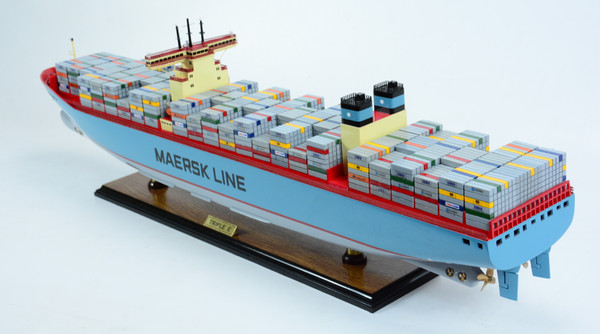
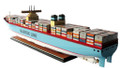
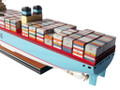
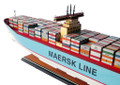
MAERSK TRIPLE E CLASS CONTAINER SHIP 28
SAVY DIRECT PRICE $499.96MSRP: $549.99Mærsk TRIPLE E CLASS CONTAINER SHIP 28 FULLY BUILT AND READY TO DISPLAY, QUALITY SHIP MODEL Dimension approx.: 28″ L x 3.5″ W x 8.5″ H The model is already built. THIS IS NOT A MODEL... -
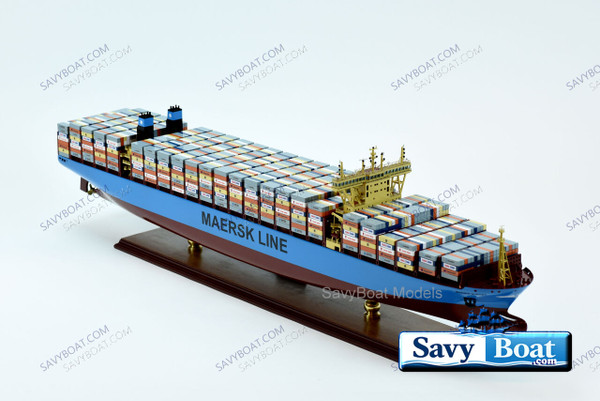

MAERSK MADRID CONTAINER SHIP
SAVY DIRECT PRICE $949.96MSRP: $999.99MAERSK MADRID CONTAINER SHIP FULLY BUILT AND READY TO DISPLAY MUSEUM QUALITY SHIP MODEL Dimension approx.: 39.3L x 6W x 9.8H(inch) The model is already built. THIS IS NOT A MODEL SHIP... -

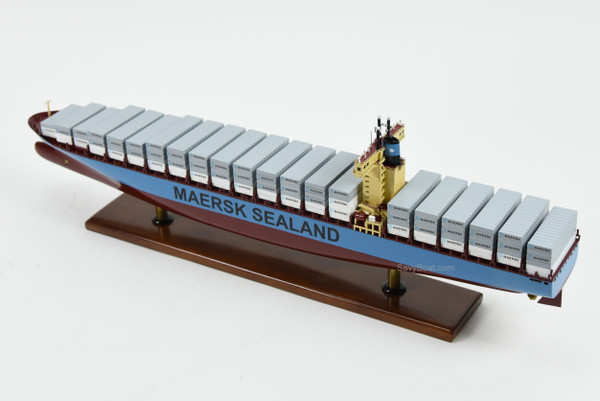
MAERSK SEALAND CONTAINER SHIP
SAVY DIRECT PRICE $949.96MSRP: $999.99MAERSK SEALAND CONTAINER SHIP FULLY BUILT AND READY TO DISPLAY, QUALITY SHIP MODEL Dimension approx.: 39.3L x 6W x 9.8H(inch) The model is already built. THIS IS NOT A MODEL SHIP...
Description

Mærsk TRIPLE E CLASS CONTAINER SHIP
FULLY BUILT AND READY TO DISPLAY, QUALITY SHIP MODEL
- Dimension approx.: 41.3L x 5.9W x 10.2H (inch)
- The model is already built. THIS IS NOT A MODEL SHIP KIT
In the early 2010s, as global trade surged and the world’s shipping lanes grew ever busier, Maersk Line set out to build a new kind of giant — a vessel not defined merely by size, but by purpose. The result was the Triple‑E class, a family of container ships so vast and so efficient that they would redefine what a modern cargo fleet could be.
Their name carried their philosophy: Economy of scale, Energy efficiency, and Environmental impact improvement. These were not just ships; they were a strategy.
In February 2011, Maersk placed one of the most ambitious orders in maritime history: ten ultra‑large container ships from Daewoo Shipbuilding & Marine Engineering in South Korea, valued at $1.9 billion. Four months later, they doubled the order — twenty ships in total, each nearly 400 meters long and 59 meters wide, capable of carrying more than 18,000 TEU. As your document notes, “they were the largest container ships in the world” when built.
The Triple‑E class was not designed for speed, but for efficiency. Their twin‑skeg hulls housed two ultra‑long‑stroke MAN diesel engines, each driving its own propeller — a rare configuration in container shipping. Running at just 19 knots, they consumed dramatically less fuel, reducing emissions per container by 50%. Slow steaming was no longer a compromise; it was a competitive advantage.
Their hulls were broad and box‑shaped, allowing more containers to sit lower in the ship. Though only slightly larger than the earlier Maersk E‑class, they carried 2,500 more containers, a triumph of naval architecture. With their deckhouse pushed forward and engines set far aft, they could stack containers higher without obstructing the bridge’s line of sight — a design that echoed CMA CGM’s Explorer class.
The first ship, Mærsk Mc‑Kinney Møller, was delivered on 2 July 2013, followed quickly by her sisters: Majestic, Mary, Marie, Madison, and many more. Each new hull slid into service on the Asia–Europe route, the busiest trade corridor on Earth. Ports from Shanghai to Rotterdam scrambled to upgrade cranes, deepen berths, and expand terminals to accommodate these new leviathans.
The Triple‑E class became symbols of a changing industry — one where size, efficiency, and sustainability mattered as much as speed. Their waste‑heat recovery systems, low‑RPM engines, and cradle‑to‑cradle design principles earned Maersk the “Most Sustainable Ship Operator of the Year” award in 2011.
But the story didn’t end there. In 2015, Maersk ordered a second generation: eleven ships, each capable of 20,568 TEU. The first, Madrid Maersk, entered service in 2017 and briefly held the title of the world’s largest container ship before being surpassed by the OOCL Hong Kong.
Even so, the Triple‑E class remains one of the most influential ship designs of the 21st century. They reshaped port infrastructure, altered global shipping economics, and set new standards for environmental performance. They were built for a world where efficiency was no longer optional — and they delivered.
Today, all thirty‑one vessels continue to operate across the Asia–Europe corridor, carrying the goods that keep the modern world moving. They are not just ships; they are the backbone of global trade, steel giants whose quiet engines and towering stacks have become icons of the maritime age.