




-


MS KUNGSHOLM OCEAN LINER
SAVY DIRECT PRICE $999.96MSRP: $1,049.99MS KUNGSHOLM OCEAN LINER FULLY BUILT AND READY TO DISPLAY MUSEUM QUALITY SHIP MODEL Dimension approx.: 40″ (long) x 4.75″ (wide) x 12″ (high) The model is already built. THIS IS NOT A... -

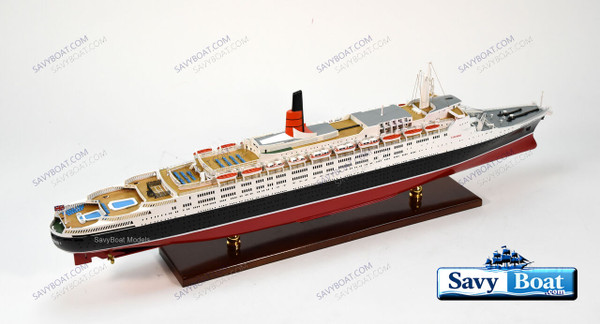
MS QUEEN ELIZABETH II (QE2) OCEAN LINER
SAVY DIRECT PRICE $1,099.96MSRP: $1,199.99MS QUEEN ELIZABETH II (QE2) FULLY BUILT AND READY TO DISPLAY MUSEUM QUALITY SHIP MODEL Dimension Approx.: 39.5″L x 4.5″W x 12″H SCALE 1:300 Open die cut side hull windows, NOT painted... -


MS QUEEN ELIZABETH II (QE2 LIGHTED OCEAN LINER
SAVY DIRECT PRICE $1,199.96MSRP: $1,349.99MS QUEEN ELIZABETH II (QE2) - LIGHTED FULLY BUILT AND READY TO DISPLAY MUSEUM QUALITY SHIP MODEL Dimension Approx.: 39.5″L x 4.5″W x 12″H SCALE 1:300 LIGHTED - LED LIGHTS pre-installed...
Description

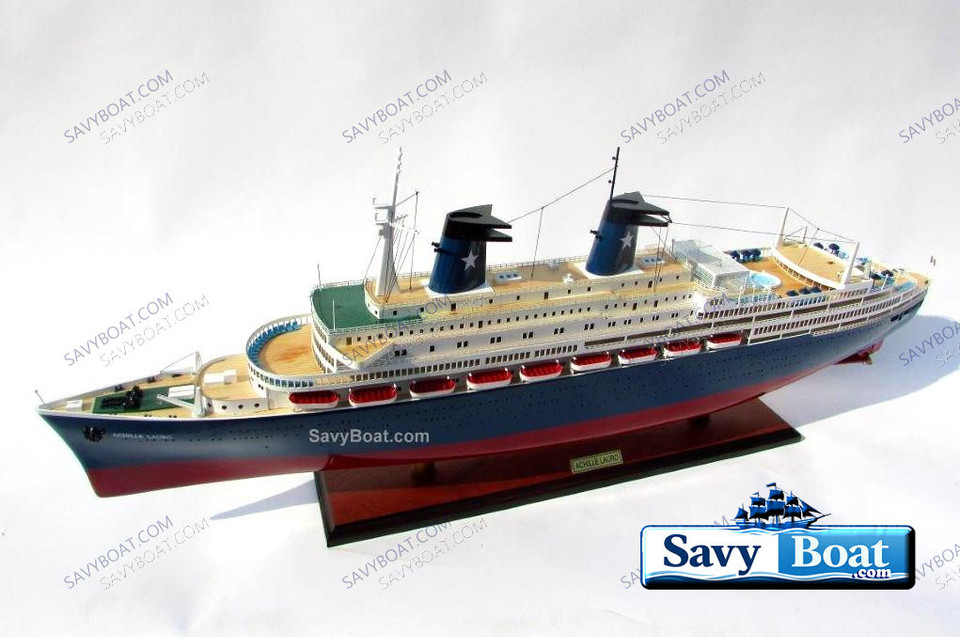
MS ACHILLE LAURO OCEAN LINER
FULLY BUILT AND READY TO DISPLAY, HIGH QUALITY SHIP MODEL
- Dimension Approx.: 40L x 6W x 14H
- The model is already built, NOT a model ship kit
The ship that would one day become the Achille Lauro began life under a very different name and purpose. Ordered in 1938 and laid down the following year at the De Schelde shipyard in Vlissingen, she was christened Willem Ruys, intended to serve the Dutch East Indies route for Rotterdamsche Lloyd. War intervened. Bombing raids, occupation, and material shortages slowed construction to a crawl, and the ship was not launched until July 1946 nor completed until late 1947. Her name honored Willem Ruys, the founder’s grandson, who had been taken hostage and killed during the war — a somber legacy for a ship meant to symbolize renewal.
As Willem Ruys, she sailed as a stylish postwar liner, though not without incident. She collided with the passenger liner Oranje in 1953, an early sign of the misfortunes that would follow her throughout her life.
In 1965, Italian shipping magnate Achille Lauro purchased the vessel and transformed her into a modern cruise ship, renaming her MS Achille Lauro. The conversion ushered in a new era of Mediterranean glamour, but the ship’s luck did not improve. She suffered multiple onboard fires — in 1965, 1972, 1981, and 1994 — and collided with the cargo ship Youseff in 1975. Yet she remained a popular cruise vessel, known for her distinctive blue hull and classic ocean‑liner silhouette.
The Achille Lauro entered the global spotlight on 7 October 1985, when four militants from the Palestine Liberation Front hijacked the ship off Alexandria, Egypt. The hijackers — members of a group responsible for severe harm and loss of life — demanded the release of Palestinian prisoners held by Israel. During the ordeal, they murdered Leon Klinghoffer, a 69‑year‑old Jewish‑American passenger in a wheelchair, and threw his body overboard. The crisis ended when U.S. Navy F‑14s intercepted an Egyptian airliner carrying the hijackers, forcing it to land at Sigonella, Sicily, where Italian authorities took them into custody. The event had far‑reaching political repercussions and remains one of the most infamous acts of maritime terrorism of the 20th century.
Despite the notoriety, the Achille Lauro continued sailing for nearly another decade. But on 2 December 1994, while cruising off the coast of Somalia, a fire broke out aboard the ship. The blaze spread rapidly, forcing the evacuation of passengers and crew. The vessel burned for hours before finally sinking in the Indian Ocean, coming to rest at a depth of roughly 4,000 meters. Miraculously, most aboard survived.
Today, the Achille Lauro is remembered as a ship of striking contrasts — a vessel born in wartime, reborn as a glamorous cruise liner, thrust into the center of a geopolitical crisis, and ultimately lost to the sea. Her story blends maritime engineering, Cold War politics, and human tragedy, making her one of the most unforgettable ships of the 20th century.