




-


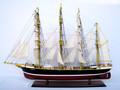
NIPPON MARU JAPANESE WINDJAMMER TALL SHIP W/SAILS
SAVY DIRECT PRICE $749.96MSRP: $799.99NIPPON MARU, 4 MASTED BARQUE TALL SHIP W/ SAILS FULLY BUILT AND READY TO DISPLAY QUALITY SHIP MODEL Dimension Approx.: 31.5″ (long) x 8.5″ (wide) x 27.5″ (high) -

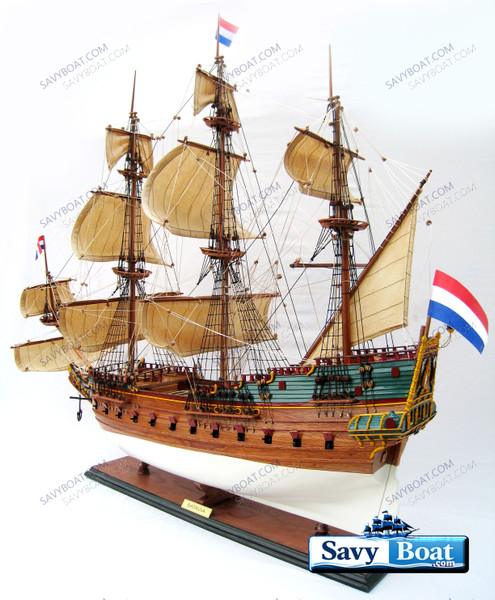
BATAVIA MERCHANT TALL SHIP W/ SAILS
SAVY DIRECT PRICE $1,099.96MSRP: $1,199.99BATAVIA MERCHANT TALL SHIP (WITH SAILS) FULLY BUILT AND READY TO DISPLAY MUSEUM QUALITY SHIP MODEL Dimension approx.: 32.6L x 7.4W x 29.5H The model is already built. THIS IS... -


USS OHIO TALL SHIP W/ SAILS
SAVY DIRECT PRICE $799.96MSRP: $799.99USS OHIO TALL SHIP WITH SAILS FULLY BUILT AND READY TO DISPLAY QUALITY SHIP MODEL Dimension Approx.: 32″ (high) x 7″ (wide) x 28″ (high) The model is already built, NOT a model shi
Description

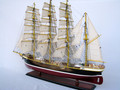
(1902-1938) PARMA TALL SHIP W/ SAILS
FULLY BUILT AND READY TO DISPLAY QUALITY SHIP MODEL
- Dimension Approx.: 31.5″ (long) x 7″ (wide) x 27.5″ (high)
- The model is already built, NOT a model ship kit
The Parma was one of the great steel windjammers of the early 20th century, a four‑masted barque built for long ocean passages at a time when sail still carried bulk cargoes across the world. Launched in 1902 from A. Rodger & Co. in Port Glasgow, she began life as Arrow, a massive steel‑hulled carrier for the Anglo‑American Oil Company. At more than 327 feet long and capable of hauling over 5,300 tons of cargo, she was built for endurance — a ship meant to cross oceans under canvas with the reliability and economy that only wind could provide.
In her early career, Arrow sailed the case‑oil routes between New York, Philadelphia, Australia, and Japan. But her destiny changed in 1912, when she was purchased by the German firm F. Laeisz and renamed Parma. Under her new owners, she joined the legendary fleet of “Flying P‑Liners,” the fastest and most efficient commercial sailing ships of their era. In the nitrate trade between Chile and Europe, Parma proved her worth, regularly completing eastbound passages in roughly 96 days — a testament to her speed, her crew, and the mastery of Laeisz seamanship.
When World War I began, Parma found herself trapped in Iquique, Chile, interned as a belligerent vessel in a neutral port. After the war, she was assigned to the United Kingdom as part of Germany’s reparations, briefly sold to Belgium, and then reacquired by Laeisz in 1921. Though the age of sail was fading, Parma continued to work the long-distance trades with the quiet determination of a ship built for the horizon.
Her greatest fame came in the 1930s. Sold in 1931 to Ruben De Cloux and the young Australian sailor‑author Alan Villiers, she entered the Australian grain trade — the final arena of the great windjammers. Loaded with up to 62,000 bags of wheat, she raced from Port Victoria to Falmouth in the annual “Grain Race,” a last proving ground for square‑rigged ships. In 1933, under Villiers’ command, Parma completed the passage in 83 days, setting a 20th‑century record for a commercial sailing ship rounding Cape Horn. Villiers documented the voyage in photographs and film, preserving one of the most vivid records of the final years of working sail.
Her end came quietly. In 1936, a sudden gust pushed Parma into an observation tower at Princes Dock in Glasgow, damaging her hull. No longer economical to repair, she was sold, stripped of her rig, and converted into a storage hulk in Haifa. In 1938, after more than three decades of service, she was scrapped — one of the last great barques to vanish from the world’s harbors.
Today, the Parma is remembered as a symbol of the Golden Age of Sail’s final chapter: a ship that carried the traditions of the windjammer era into the 20th century, raced around Cape Horn with the grace of a bygone world, and left behind a legacy of seamanship, endurance, and the romance of wind‑powered trade.