












-


40" DISPLAY CASE FOR LARGE TALL SHIP
SAVY DIRECT PRICE $879.96MSRP: $899.99DISPLAY CASE FOR LARGE TALL SHIP Beautiful Wood Framed Display Case Dimension approx: Inside 40L x 13.5W x 39.5H (inches) Suitable for models or combination of models up to 58... -

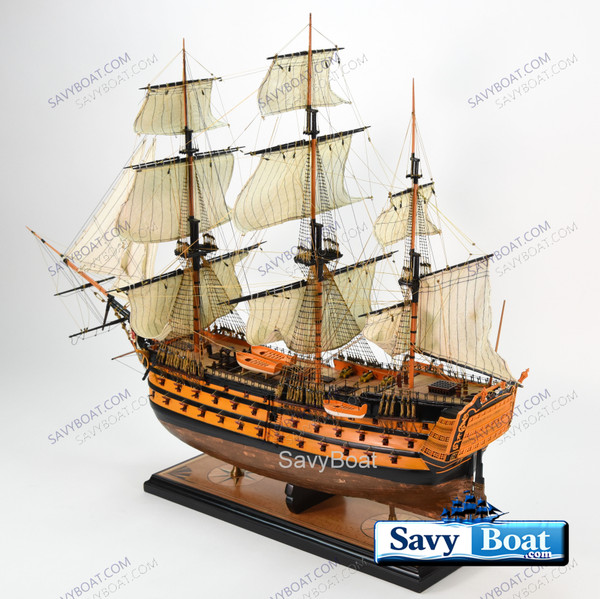
HMS VICTORY LARGE 46'' TALL SHIP
SAVY DIRECT PRICE $2,749.96MSRP: $2,999.99HMS VICTORY TALL SHIP W/COPPER HULL FULLY BUILT AND READY TO DISPLAY MUSEUM QUALITY SHIP MODEL LARGE HIGH QULITY MODEL COPPER CLADDED HAND HULL Dimension Approx.: 46L x 16W x 33H -

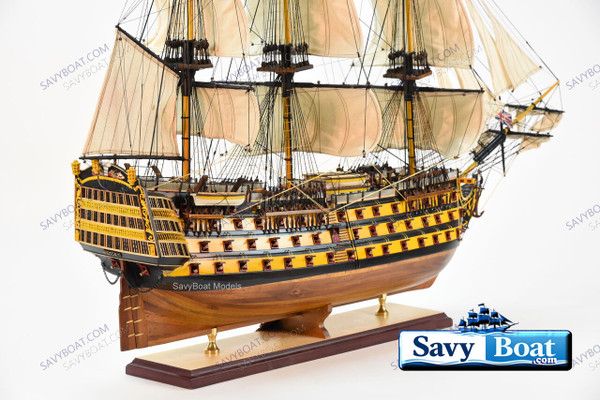
HMS VICTORY LARGE 46" TALL SHIP (NATURAL)
SAVY DIRECT PRICE $1,849.96MSRP: $2,199.99LARGE HMS VICTORY TALL SHIP FULLY BUILT AND READY TO DISPLAY MUSEUM QUALITY SHIP MODEL LARGE HIGH QUALITY MODEL Dimension Approx.: 46L x 16W x 33H (inch) The model is alrea
Description

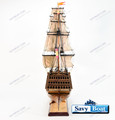
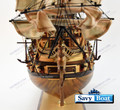
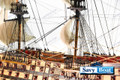
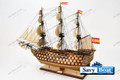
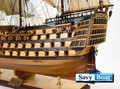
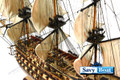
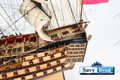
SANTISIMA TRINIDAD (1755) WITH SAILS
FULLY BUILT AND READY TO DISPLAY MUSEUM QUALITY SHIP MODEL
- Dimension Approx.: 45″ L x 12″ W x 33″ H
- HUGE SCALE MODEL
- The model is already built, NOT a model ship kit
When the Santísima Trinidad y Nuestra Señora del Buen Fin slid into the water in 1751, she was already a ship of superlatives. Built at the Real Astillero of Bagatao Island in the Philippines, she was one of the largest Manila galleons ever constructed — a towering, 167‑foot, 2,000‑ton floating fortress intended to carry the wealth of Asia across the world’s largest ocean. Her crew called her El Poderoso — The Mighty — and for a time, she lived up to the name.
Commissioned by Governor‑General Don Francisco José de Ovando, the Santísima Trinidad was armed with 60 guns and built to haul staggering quantities of silk, porcelain, spices, lacquerware, and other Asian luxuries to Acapulco. She could carry more than 5,000 crates of cargo, an immense volume even by the standards of the Manila trade.
But her size came with problems. Construction flaws and excessive displacement forced modifications in 1757, a reminder that the Manila galleons — built of tropical hardwoods and often pushed to their limits — were as temperamental as they were profitable.
Her most infamous voyage began on 23 July 1755, when she departed Manila under the guidance of French pilot Antoine Lemaire de Boucourt. What followed was a nightmare crossing: 221 days at sea, the third‑longest in the history of the route.
Disease — tabardillo, a form of typhus — swept the ship. Water ran low. 74 people died, including the former Governor‑General Ovando and his infant son. The galleon limped into San José del Cabo for relief before finally reaching Acapulco on 27 February 1756.
It was a grim reminder that the Manila–Acapulco run, though immensely profitable, was also one of the most dangerous voyages on Earth.
In September 1762, Santísima Trinidad set out once more for Acapulco — unaware that Manila had just fallen to the British during the Seven Years’ War. A violent storm near the Marianas shattered one of her masts, forcing the captain to turn back toward the Philippines.
That decision sealed her fate.
As she approached the archipelago, two British warships — the 60‑gun HMS Panther and the 28‑gun HMS Argo — intercepted her. Panther opened fire, but the Manila galleon’s massive tropical‑hardwood hull absorbed the blows with little effect. Casualties were minimal.
Yet the crew, demoralized by the storm, the damage, and the news of Manila’s capture, chose to surrender.
When the British boarded her, they found a treasure ship. Her cargo was valued at $1.5 million, and the ship itself at $3 million — a staggering sum in the 18th century. The captains of Panther and Argo received £30,000 each, enough to make them wealthy men for life.
The Santísima Trinidad was taken to Portsmouth, where she quietly disappears from the historical record. Most historians believe she was broken up — an unceremonious end for a ship that had once carried the riches of an empire.
Though overshadowed by the later four‑deck Spanish warship of a similar name, the Manila galleon Santísima Trinidad remains one of the most remarkable vessels of the Pacific trade. She embodied the extremes of the route: immense wealth, immense risk, and the immense distances that tied Asia and the Americas together for more than two centuries.