








-


SS POSEIDON LIGHTED OCEAN LINER
SAVY DIRECT PRICE $1,099.96MSRP: $1,199.99SS POSEIDON LIGHTED OCEAN LINER FULLY BUILT AND READY TO DISPLAY, HIGH QUALITY SHIP MODEL Dimension Approx.: 36.5″ L x 4.5″ W x 11.5″ H LIGHTED - LED LIGHTS pre-install -

SS BREMEN LIGHTED OCEAN LINER
SAVY DIRECT PRICE $1,199.96MSRP: $1,299.99SS BREMEN LIGHTED OCEAN LINER FULLY BUILT AND READY TO DISPLAY, QUALITY SHIP MODEL Dimension Approx.: 37.5″ L x 4.5″ W x 15″ H Approx Scale 1:300 LIGHTED - LED LIGHTS pre-insta -


SS FAIRWIND LIGHTED OCEAN LINER
SAVY DIRECT PRICE $1,099.96MSRP: $1,199.99SS FAIRWIND LIGHTED CRUISE SHIP FULLY BUILT AND READY TO DISPLAY MUSEUM QUALITY SHIP MODEL Dimension approx.: 40″ (long) x 4.75″ (wide) x 12″ (high) Lighted with LED lighting (power supply not...
Description

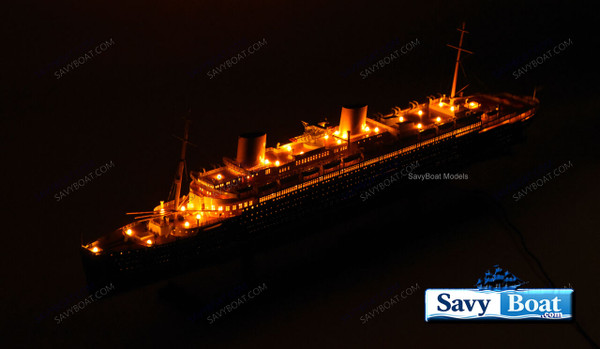
SS EUROPA LIGHTED OCEAN LINER (1928-1962)
FULLY BUILT AND READY TO DISPLAY HIGH QUALITY SHIP MODEL
- Dimension Approx.: 37.5″ L x 4.5″ W x 15″ H
- LIGHTED - LED LIGHTS INSTLALLED (power supply not included)
- approx SCALE 1:300
- The model is already built, NOT a model ship kit
When SS Europa slid down the ways at Blohm & Voss on 15 August 1928, she represented Germany’s bold attempt to reclaim dominance on the North Atlantic. Built for Norddeutscher Lloyd (NDL), she and her sister ship Bremen were conceived as “speed queens,” vessels whose sleek lines, powerful turbines, and modern profiles would restore German prestige in the fiercely competitive interwar liner race. A devastating fire during fitting‑out delayed her completion until February 1930, but the setback only heightened anticipation for her debut.
At 49,746 gross tons and stretching 283.5 meters in length, Europa was a masterpiece of streamlined design. Her quadruple‑screw turbine machinery produced roughly 105,000 shaft horsepower, driving her to a cruising speed of 27.5 knots. She carried more than 2,100 passengers across four classes, and her silhouette—two masts, two funnels, and a bulbous bow—announced her as a vessel built for speed and efficiency. Even her deck plan, spread across ten to twelve levels depending on the source, reflected the era’s fascination with modern engineering.
Her maiden voyage on 19 March 1930 proved her worth. Departing Bremerhaven and calling at Southampton and Cherbourg before striking out for New York, Europa captured the Blue Riband for the westbound crossing. Averaging 27.91 knots, she completed the Atlantic in 4 days, 17 hours, 6 minutes, securing her place among the fastest liners ever built. She even carried a small aircraft launched by catapult—an audacious experiment in mail delivery and maritime aviation.
During the 1930s, Europa and Bremen became icons of German maritime prowess, maintaining tight schedules and offering swift, stylish service across the Atlantic. But the outbreak of World War II halted her career. Unlike many liners pressed into wartime duty, Europa remained laid up in a German port, never entering active service. When the conflict ended, she was seized by Allied forces and claimed by the U.S. Navy as a war prize.
In 1945–46, she briefly served as USS Europa (AP‑177), transporting American troops from Brest to New York. Soon after, the United States transferred her to the French Line (CGT) as partial compensation for the loss of the legendary Normandie. Rechristened SS Liberté, she underwent a major refit at Le Havre—an effort complicated when a violent gale in December 1946 drove her against the wreck of the liner Paris. Refloated and repaired, she finally entered service in 1950, reborn as France’s postwar flagship.
For more than a decade, Liberté sailed the Le Havre–New York route, admired for her elegance and reliability. She remained in service until the arrival of the new SS France in 1961, after which she was retired and sent to La Spezia for scrapping in 1963.
From her Blue Riband triumph as Europa to her dignified second life as Liberté, the ship’s story spans two nations, two identities, and two eras of ocean‑liner history. She stands as one of the great transatlantic liners of the 20th century—an engineering marvel, a survivor of war, and a symbol of renewal on both sides of the Atlantic.