








-
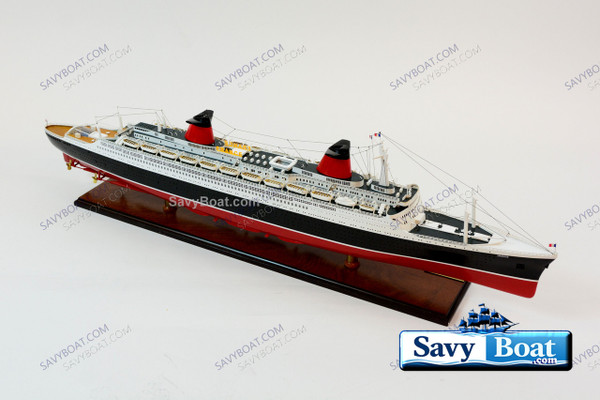

SS FRANCE 41" LIGHTED OCEAN LINER
SAVY DIRECT PRICE $1,199.96MSRP: $1,299.99SS FRANCE LIGHTED OCEAN LINER FULLY BUILT AND READY TO DISPLAY, QUALITY SHIP MODEL Dimension Approx.: 41.5″ L x 4.5″ W x 11.5″ H Scale 1:300 LIGHTED - LED LIGHTS pre-installed (power supply not... -

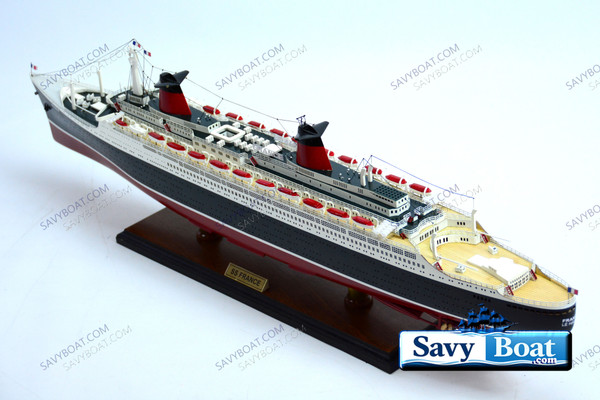
SS FRANCE 32" OCEAN LINER
SAVY DIRECT PRICE $849.96MSRP: $899.99SS FRANCE 32" OCEAN LINER FULLY BUILT AND READY TO DISPLAY, QUALITY SHIP MODEL Dimension Approx.: 32″ L x 11″ W x 15″ H The model is already built, NOT a model ship kit When SS France sl -


SS Île de FRANCE OCEAN LINER
SAVY DIRECT PRICE $999.96MSRP: $1,099.99SS lle de FRANCE OCEAN LINER FULLY BUILT AND READY TO DISPLAY MUSEUM QUALITY SHIP MODEL Open die cut side hull windows, NOT painted like those built by most other companies. Dimension...
Description

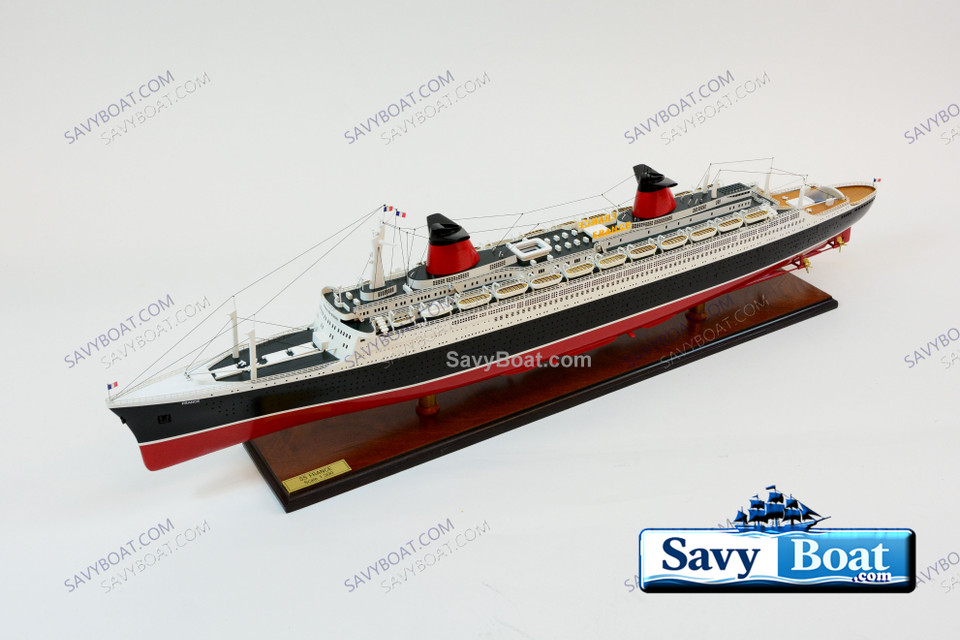
SS FRANCE OCEAN LINER
FULLY BUILT AND READY TO DISPLAY, QUALITY SHIP MODEL
- Dimension Approx.: 41.5″ L x 4.5″ W x 11.5″ H
- Scale 1:300
- The model is already built, NOT a model ship kit
When SS France slid down the ways at Saint‑Nazaire on 11 May 1960, she was more than a ship — she was a national statement. France, still recovering from the political and cultural strain of the 1950s, wanted a symbol of modern elegance and technological prowess. As your document notes, she was conceived after fierce debate in the French parliament, with Charles de Gaulle insisting that the nation needed “one grand ocean liner… an ocean‑going showcase for France.” And so she became: 316 meters of welded steel, the longest passenger ship ever built until 2004, and the last great expression of the classic transatlantic liner.
Her construction was itself a feat of innovation. Rather than building her piece by piece in one yard, vast sections were prefabricated in Orléans, Le Havre, and Lyon, then assembled at Chantiers de l’Atlantique. She was fully welded, fitted with stabilizers, and designed to withstand the brutal North Atlantic at high speed. During sea trials in 1961, she averaged 35.21 knots, a remarkable figure for a ship of her size.
When she entered service in February 1962, France embodied the glamour of a bygone era. Her maiden voyage carried aristocrats, film stars, and dignitaries from Le Havre to New York. Later that year, she transported the Mona Lisa across the Atlantic — a floating ambassador of French culture. For thirteen years she sailed the Le Havre–Southampton–New York route, her black hull and red‑topped funnels becoming icons of mid‑century ocean travel.
But the world was changing. Jetliners like the Boeing 707 and 747 were shrinking the Atlantic, and by the early 1970s France relied heavily on government subsidies. She adapted by cruising in winter, but her design revealed quirks in warm climates: as your document notes, both swimming pools were indoors, and much of her deck space was enclosed behind windshields meant for the North Atlantic, not the tropics.
Still, she remained beloved. In 1972 she completed her first world cruise, rounding Cape Horn and the Cape of Good Hope because she was too large for the Panama and Suez Canals. When the former Queen Elizabeth burned in Hong Kong that same year, France became the largest passenger ship in service.
The end came abruptly. In 1974, amid the oil crisis, the French government chose to subsidize the Concorde instead of the aging liner. On her 202nd crossing, the crew staged a dramatic strike, anchoring France across the entrance to Le Havre and blocking the port. It was a symbolic act of defiance — and her final day in service. She was laid up at the “quai de l’oubli,” the pier of oblivion, interiors untouched, awaiting her fate.
Rebirth as Norway
In 1979, Norwegian Caribbean Line purchased the dormant giant. After an $80 million refit, she reemerged in 1980 as SS Norway — the world’s first true mega‑cruise ship. Her transformation was dramatic: vast new lido decks, expanded public spaces, and later, in 1990, two additional decks of suites. She carried her own registered tenders, Little Norway I and II, making her the only passenger ship in the world to carry ships of her own.
As Norway, she revolutionized cruising. Her size made the ship itself the destination, and her success triggered the industry’s shift toward ever‑larger vessels. For two decades she sailed the Caribbean, beloved by passengers and instantly recognizable in every port.
But age and cost caught up with her. Mechanical failures mounted, and in 2003, a catastrophic boiler explosion in Miami killed eight crew members. She was towed to Europe, laid up, and eventually sold for scrap.
The Final Chapter — Blue Lady
Renamed Blue Lady, she became the center of international controversy. Environmental groups protested her asbestos‑laden hull; courts intervened; governments debated. After years of legal and political struggle, she was finally beached at Alang, India, in 2006. Scrapping began in 2007 and was essentially complete by late 2008.
Yet pieces of her survived. As your document notes, the tip of her bow was returned to France in 2009 and now stands on display in Le Havre. One of her original neon “FRANCE” signs has been restored and exhibited in Paris and Le Havre. Even in dismantling, she refused to disappear quietly.
As SS France, she was the last great French liner — elegant, nationalistic, and technologically bold. As SS Norway, she reinvented herself and reshaped the cruise industry. As Blue Lady, she became a symbol of nostalgia, controversy, and the complex afterlife of great ships.
Few vessels have lived so many lives or inspired such devotion. Even in pieces, France endures — a reminder of the age when nations built ships not just to cross oceans, but to define themselves.