









-
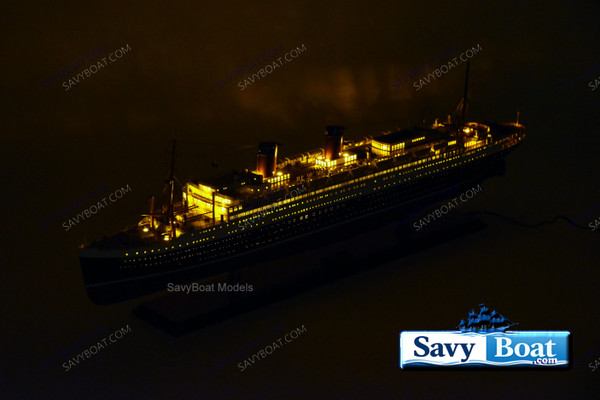
SS Île de FRANCE LIGHTED OCEAN LINER
SAVY DIRECT PRICE $1,049.96MSRP: $1,199.99SS lle de FRANCE LIGHTED OCEAN LINER FULLY BUILT AND READY TO DISPLAY MUSEUM QUALITY SHIP MODEL Open die cut side hull windows, NOT painted like those built by most other companies... -

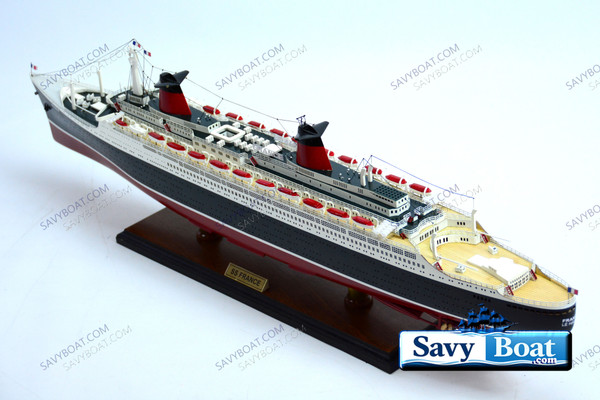
SS FRANCE 32" OCEAN LINER
SAVY DIRECT PRICE $849.96MSRP: $899.99SS FRANCE 32" OCEAN LINER FULLY BUILT AND READY TO DISPLAY, QUALITY SHIP MODEL Dimension Approx.: 32″ L x 11″ W x 15″ H The model is already built, NOT a model ship kit When SS France sl -


SS FRANCE 41" OCEAN LINER
SAVY DIRECT PRICE $1,099.96MSRP: $1,199.99SS FRANCE OCEAN LINER FULLY BUILT AND READY TO DISPLAY, QUALITY SHIP MODEL Dimension Approx.: 41.5″ L x 4.5″ W x 11.5″ H Scale 1:300 The model is already built, NOT a model ship kit When
Description

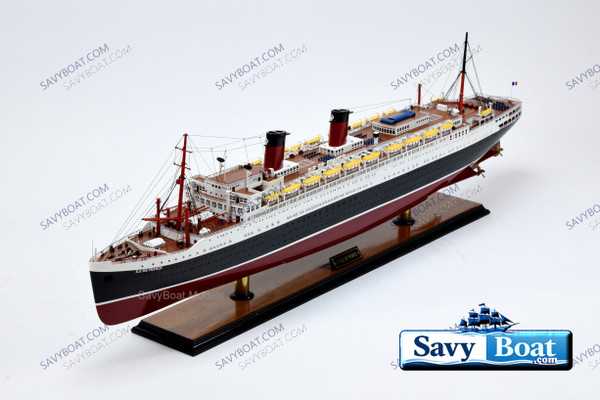
SS lle de FRANCE OCEAN LINER
FULLY BUILT AND READY TO DISPLAY MUSEUM QUALITY SHIP MODEL
- Open die cut side hull windows, NOT painted like those built by most other companies.
- Dimension Approx.: 38″ L x 5″ W x 12″ H
- Approx SCALE 1:250
- The model is already built, NOT a model ship kit
When the SS Île de France was launched at Saint‑Nazaire on 14 March 1926, she represented a new vision of French maritime prestige. Built for the Compagnie Générale Transatlantique — the famed “French Line” — she was the first major ocean liner constructed after World War I, and she arrived not as a record‑breaker in size or speed, but as a masterpiece of modern Art Deco design. When she entered service in June 1927, sailing from Le Havre to New York, she immediately became the most stylish ship on the Atlantic.
At 791 feet long and over 43,000 gross tons, the Île de France was large but not colossal. What set her apart was her interior: sleek geometric lines, lacquered panels, sculpted glass, and bold modernist décor that made her a floating exhibition of French artistry. She carried 1,786 passengers across three classes, and her reputation for elegance quickly made her a favorite among diplomats, celebrities, and the fashionable elite of the interwar years.
When World War II erupted, the Île de France’s glamorous career was abruptly interrupted. In 1941, she was requisitioned by the British Admiralty and converted into a troopship, carrying thousands of soldiers across the Atlantic. After the war, she returned to France in battered condition and underwent a massive two‑year refit (1947–1949). One funnel was removed, the others streamlined, and her accommodations modernized — third class transformed into the more democratic “tourist class.” When she returned to service in July 1949, she was sleeker, more efficient, and ready for a new era of transatlantic travel.
Her most famous moment came on the night of 25 July 1956. When the Italian liner Andrea Doria collided with the Stockholm and began sinking off Nantucket, the Île de France rushed to the scene. In darkness and heavy fog, she launched 13 lifeboats and rescued 753 survivors, many of them injured or trapped in the chaos. Her crew’s courage earned the ship the Gallant Ship Award, and the event cemented her place in maritime history as a symbol of seamanship and humanity.
But the age of the great liners was ending. Jet travel was transforming transatlantic crossings, and by 1958–1959, the Île de France’s service was no longer economically viable. In 1959, she was sold to Japanese shipbreakers, renamed Furansu Maru, and made her final voyage from Le Havre to Osaka. Between 1960 and 1961, she was dismantled — a quiet end for a ship that had once embodied the height of French luxury.
The SS Île de France remains one of the most beloved liners of the 20th century. She was the first great Art Deco ship, a cultural icon of the 1920s and 1930s, a wartime workhorse, and the heroine of the Andrea Doria rescue. Though she is gone, her influence lives on in museum exhibits, maritime history, and the enduring memory of a ship that combined beauty, innovation, and bravery in equal measure.