




-

 img:low-bottom-with-special-offer.pngimg:low-bottom-with-special-offer.png
CHERYL ANN TUG BOAT
SAVY DIRECT PRICE $100.00 - $439.96THE FAMED CHERYL ANN TUG BOAT FULLY BUILT AND READY TO DISPLAY, QUALITY SHIP MODEL Dimension approx.: 20″ (long) x 7″ (wide) x 11″ (high) The model is already built. THIS IS NOT A MODEL... -

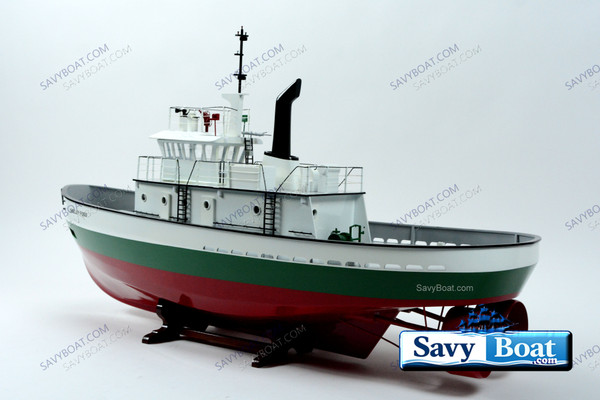
SHELLEY FOSS LIGHTED TUG BOAT
SAVY DIRECT PRICE $829.96MSRP: $899.99SHELLEY FOSS TUG BOAT, LIGHTED, RC READY FULLY BUILT AND READY TO DISPLAY, QUALITY SHIP MODEL Dimension approx.: 36″ (long) x 12″ (wide) x 20″ (high) The model is already built. THIS IS... -


SANSON SEA GOING TUG BOAT
SAVY DIRECT PRICE $549.96MSRP: $599.99Sanson Tugboat FULLY BUILT AND READY TO DISPLAY MUSEUM QUALITY MODEL LARGE MUSEUM QUALITY MODEL Dimension approx.: 24.00" L x 5.00″ W x 15.50″ H The model i
Description

SS MASTER TUGBOAT
FULLY BUILT AND READY TO DISPLAY MUSEUM QUALITY SHIP MODEL
- Dimension approx.: 24″ (long) x 5.5″ (wide) x 13″ (high)
- The model is already built. THIS IS NOT A MODEL SHIP KIT
More than a century ago, in the working harbors of Vancouver, B.C. a small steam tug took shape—one that would outlive an entire era. Built in 1922 at the Beach Avenue Shipyard in False Creek, the SS Master was the creation of Arthur Moscrop, British Columbia’s most respected tugboat builder. Moscrop, trained by the legendary Arthur Wallace, designed only a handful of large steam tugs in his career. Of the six over forty feet built in the province at the time, the Master would become the sole survivor.
She was compact, purposeful, and unmistakably a working tug. Beneath her wooden hull beat the heart of a war‑surplus 1916 Triple Expansion Steam Engine—British Navy built, rugged, and efficient. Paired with a ten‑ton Scotch boiler, the machinery delivered roughly 330 horsepower and pushed the tug along at a steady seven knots. It was a simple, honest system, the kind that defined coastal industry in the early twentieth century.
Her early years were spent towing heavy log booms and barges for Fraser Mills and later the Lamb Logging Company. Day after day, she hauled timber down the coast toward False Creek, her stack breathing steam into the Pacific air. In 1940, she joined the Marpole Towing Company fleet, carrying the black‑diamond insignia once used for coal barge operations between Vancouver Island and Coal Harbour. Through the 1950s she worked under Gilley Bros., part of the Evans, Coleman & Evans empire—one tug among many in a bustling, diesel‑dominated fleet.
But time was not kind to steam. By the late 1950s, the Master was aging, tied up at the mouth of the Brunette River and left to deteriorate. In 1962 she was sold “where is, as is,” stripped of fittings, and abandoned. For most vessels of her type, this was the end. Steam tugs across the coast were disappearing, scrapped, or left to rot—relics of a technology the industry had moved beyond.
The Master was saved only because a handful of enthusiasts refused to let her vanish. In 1971, members of the World Ship Society of Western Canada stepped in, rescuing the tug from scrap and beginning the long, patient work of restoration. That same year, they founded the SS Master Society, a volunteer‑run nonprofit dedicated to preserving the vessel as a living artifact of British Columbia’s maritime past.
Their work has been steady and meticulous: hull repairs, structural reinforcement, 3D scanning for future restoration planning, and constant maintenance of her original 1916 steam engine. Against all odds, the Master still operates much as she did a century ago—steam‑powered, hand‑tended, authentic.
Today, she is more than a museum piece. She is the last operational steam tug of her kind in British Columbia, a rare survivor of the transition from steam to diesel that reshaped the coastal towing industry. Her presence at maritime festivals and heritage events is a reminder of the province’s working‑waterfront history, and of the volunteers who keep that history alive.
The SS Master endures because people continue to care—donating time, resources, and skill to ensure that her boiler fires, her engine turns, and her story remains part of the living fabric of the coast.