






-

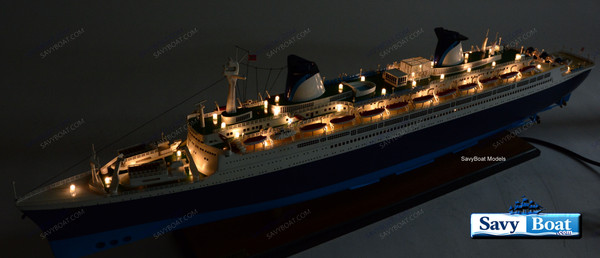
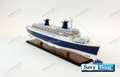
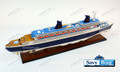
SS NORWAY LIGHTED CRUISE SHIP
SAVY DIRECT PRICE $899.96MSRP: $949.99SS NORWAY, LIGHTED OCEAN LINER FULLY BUILT AND READY TO DISPLAY, QUALITY SHIP MODEL Dimension approx.: 40″ (long) x 5″ (wide) x 10″ (high) The model is already built. THIS IS NOT A... -

SS CONSTITUTION HAWAII CRUISE SHIP
SAVY DIRECT PRICE $699.96MSRP: $749.99SS CONSTITUTION HAWAII CRUISE SHIP FULLY BUILT AND READY TO DISPLAY BOAT MODEL Dimension approx.: 32.5″ (long) x 4.5″ (wide) x 11″ (high) Aprox Scale 1/250 The model is already built. ... -


AIDAvita CRUISE SHIP
SAVY DIRECT PRICE $799.96MSRP: $899.99AIDAVITA (BLUE DREAM MELODY) PASSENGER SHIP FULLY BUILT AND READY TO DISPLAY, QUALITY SHIP MODEL Dimension approx.: 33″ L x 7″ W x 16″ H The model is already built. THIS IS NOT A...
Description

SS NORWAY OCEAN LINER
FULLY BUILT AND READY TO DISPLAY, QUALITY SHIP MODEL
- Dimension approx.: 40″ (long) x 5″ (wide) x 10″ (high)
- The model is already built. THIS IS NOT A MODEL SHIP KIT
The Long Life of France — and the Reinvention of Norway
When she emerged from the Saint‑Nazaire shipyard in 1962, the new SS France was more than a ship — she was a national statement. At 1,035 feet long, she was the longest passenger vessel ever built, a sleek black‑hulled monument to French engineering and elegance. Inside, she was a floating embassy of French culture: grand dining rooms, sweeping promenades, and interiors that blended modernist flair with old‑world refinement. She could carry more than 2,000 passengers in comfort and cross the Atlantic at high speed, a final masterpiece of the classic ocean‑liner age.
For more than a decade she sailed the North Atlantic, completing 377 crossings, her sharp bow slicing through heavy seas with the confidence of a ship built for the roughest waters. But the world around her was changing. Jetliners were shrinking oceans in hours, not days, and the glamorous transatlantic run — once the pinnacle of maritime travel — was fading into memory. By the mid‑1970s, France was sailing half‑empty, expensive to operate, and increasingly out of step with the economics of modern travel.
In 1974 she made her last Atlantic crossing. Her crew staged a dramatic protest to keep her in service, but the era of the great liners was ending. She was laid up, silent and uncertain, a giant without a purpose.
Then, in 1979, a new life beckoned.
Norwegian Cruise Line purchased the dormant liner for $18 million, seeing in her not a relic, but a foundation for something bold. After a massive refit — including the removal of two of her four propellers, a reduction in speed, and a complete reimagining of her interiors — she reemerged as SS Norway, painted bright blue and ready for a different kind of ocean travel.
If France had been the last great expression of the liner age, Norway became the first icon of the modern cruise era.
She was enormous compared to her competitors — the largest cruise ship in the world at the time — and her size allowed NCL to experiment with a new idea: the ship itself could be the destination. Her decks filled with pools, lounges, theaters, and entertainment spaces. Her Caribbean itineraries from Miami became wildly popular. As one maritime historian put it, Norway proved that “big ships could not only work — they could thrive.”
Her success changed the industry. Cruise lines began ordering larger and larger vessels, each one more ambitious than the last. The age of the mega‑ship — the floating resort — can be traced directly to Norway’s triumphant second life.
She sailed for more than two decades in this role, beloved by passengers and instantly recognizable in every port she visited. But time, once again, caught up with her. After mechanical issues and a tragic boiler explosion in 2003, she was retired from service. Attempts to preserve her failed, and in 2008 she was finally scrapped — a quiet end for a ship that had lived two extraordinary lives.
Yet her legacy endures. As France, she was the last great transatlantic liner built for national prestige. As Norway, she became the blueprint for the modern cruise ship. Few vessels have bridged two eras so completely — and fewer still have left such a lasting imprint on maritime history.
She began as a symbol of a nation. She ended as a symbol of an industry. And in both roles, she was unforgettable.