









-


SS VEENDAM STEAMSHIP
SAVY DIRECT PRICE $1,049.96MSRP: $1,149.99STEAMSHIP SS VEENDAM FULLY BUILT AND READY TO DISPLAY MUSEUM QUALITY SHIP MODEL Dimension approx.: 35L X 5W X 10H The model is already built, NOT a model ship kit Handcrafted from scratch... -


HOHENTWIEL PADDLE STEAMSHIP
SAVY DIRECT PRICE $699.95MSRP: $749.99HOHENTWIEL PADDLE STEAMSHIP FULLY BUILT AND READY TO DISPLAY HIGH QUALITY SHIP MODEL Dimension approx.: 30″ (long) x 7″ (wide) x 13″ (high) The model is already built. THIS IS NOT A... -


SS SHALOM LIGHTED STEAMSHIP
SAVY DIRECT PRICE $999.96MSRP: $1,099.99SS SHALOM LUXURY STEAM SHIP LINER FULLY BUILT AND READY TO DISPLAY, QUALITY SHIP MODEL Dimension approx.: 34″ L x 4.5″ W x 11″ H. This beautiful model is already built, NOT a kit. When...
Description

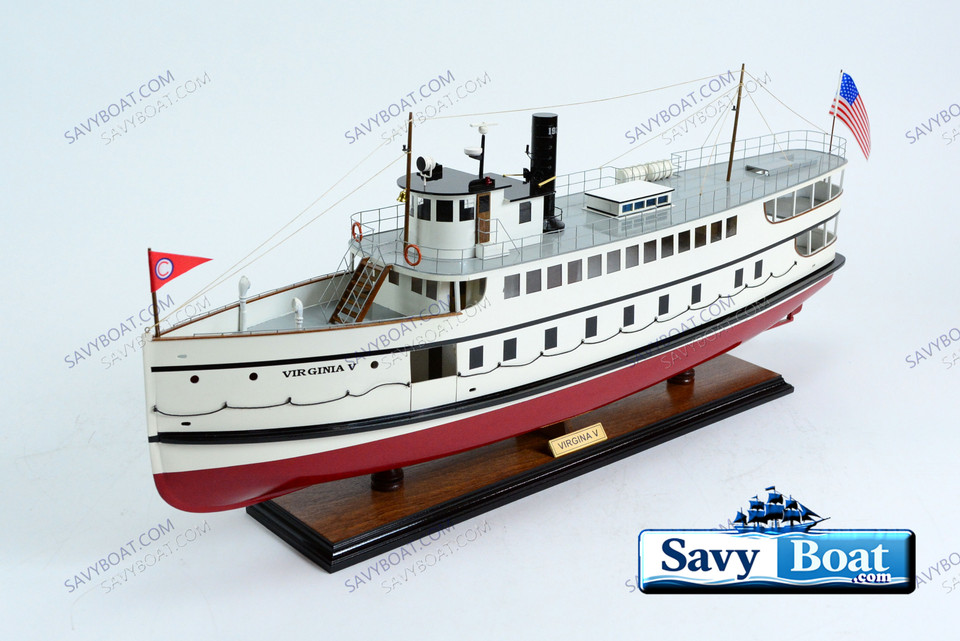
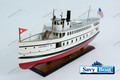
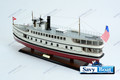
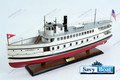
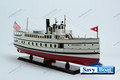
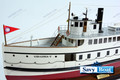
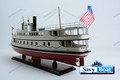
VIRGINIA V - PNW MOSQUITO FLEET STEAMSHIP
FULLY BUILT AND READY TO DISPLAY, QUALITY SHIP MODEL
- Dimension approx.: 30″ (long) x 5″ (wide) x 12″ (high)
- The model is already built. THIS IS NOT A MODEL SHIP KIT
Virginia V — The Last Queen of the Mosquito Fleet
In the early 1920s, when Puget Sound’s islands still depended on small steamers for mail, freight, and the daily rhythm of life, a graceful wooden vessel slid down the ways at Maplewood, Washington. She was the Virginia V, the final ship in a line of West Pass steamers and the last of her kind that would ever be built — a wooden‑hulled, steam‑powered passenger vessel destined to outlive the entire Mosquito Fleet that once defined the region.
The West Pass Transportation Company, founded in 1910 by Captain Nels Christensen and John Holm, had already operated four earlier “Virginia” steamers. The fifth — and finest — was laid down in October 1921 by Anderson & Company. Built of old‑growth fir and powered by a 400‑horsepower triple‑expansion steam engine, she measured 125 feet long and carried the clean, purposeful lines of a vessel meant for hard work and daily service.
Launched on March 9, 1922, and completed that June, she made her maiden voyage on June 11, steaming from Seattle to Tacoma through the sheltered waters of the West Pass. Locals quickly took to calling her the “Virginia Vee” or simply “Ginny.”
For more than a decade, the Virginia V stitched together the communities of Vashon Island, Tacoma, and Seattle. She carried freight, mail, and commuters, but she became especially beloved for her annual summer duty: transporting thousands of children to Camp Sealth on Vashon Island. For generations of Camp Fire Girls, the sound of her whistle meant the beginning of summer.
By 1933, she had logged more than 320,000 miles without a serious mishap — a testament to her sturdy construction and the skill of her crews.
Her luck faltered on October 21, 1934, when a violent Pacific storm swept across Puget Sound. As she attempted to dock at Ollala, winds reaching 70 mph slammed her into the pilings. The impact crushed parts of her superstructure and twisted her upper deck. Miraculously, no one was injured, but repairs cost $11,000 — a significant sum during the Depression.
Still, the Virginia V returned to service, her whistle echoing once again across the Sound.
By the late 1930s, the world that had created the Virginia V was disappearing. Automobiles, trucks, and state‑run auto ferries replaced the small steamers that once darted between islands. The Mosquito Fleet faded, and the Virginia V was laid up in 1938–1939, revived only briefly during ferry strikes.
In the 1940s, she shifted to mixed routes and holiday excursions, even carrying servicemen during World War II. But by mid‑century, she was one of the last steamers still operating — a relic of an era that had vanished almost overnight.
Unlike her sister ships, which were scrapped or abandoned, the Virginia V found champions. Maritime enthusiasts, preservationists, and Puget Sound residents recognized her significance and rallied to save her. Over decades, she underwent extensive restoration — including a complete rebuild of her hull and superstructure — always preserving her original steam engine and whistle.
Today, she is a Seattle Landmark, a U.S. National Historic Landmark, and listed on the National Register of Historic Places. She operates from Heritage Wharf at Lake Union Park, offering public excursions, charters, and tours. Her triple‑expansion engine still beats with the same rhythmic pulse it did in 1922.
The Virginia V is more than a museum ship — she is a survivor. The last operational wooden‑hulled, steam‑powered passenger vessel in the United States, she carries the memory of the Mosquito Fleet into the 21st century. When her whistle sounds across Lake Union, it is the voice of a century‑old maritime tradition, still alive, still steaming, and still beloved.
She remains, quite simply, the last queen of Puget Sound’s steam era.