





-


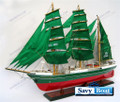
DANMARK TRAINING TALL SHIP
SAVY DIRECT PRICE $899.96MSRP: $999.99DANMARK TRAINING TALL SHIP FULLY BUILT AND READY TO DISPLAY MUSEUM QUALITY SHIP MODEL Dimension Approx.: 34″L x 10″W x 25″H The model is already built, NOT a model ship kit -
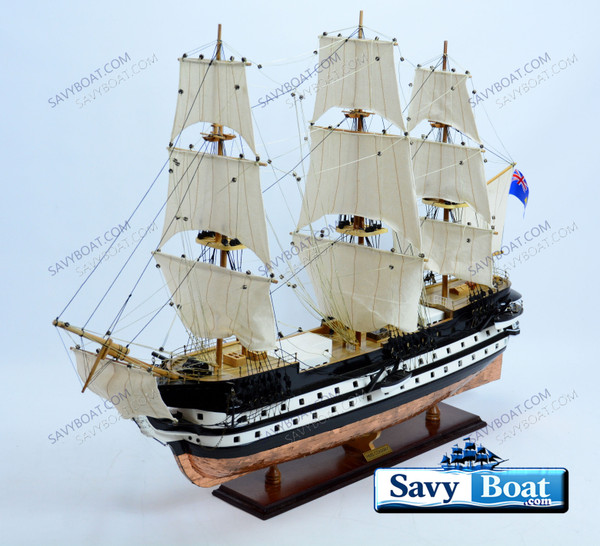

HMS CONWAY TALL TRAINING SHIP
SAVY DIRECT PRICE $1,249.96MSRP: $1,349.99HMS CONWAY TALL TRAINING SHIP FULLY BUILT AND READY TO DISPLAY MUSEUM QUALITY SHIP MODEL Dimension approx.: 39″ (long) x 10″ (wide) x 31″ (high) The model is already built. THIS IS NOT A... -


LARGE AMERIGO VESPUCCI TRAINING SHIP
SAVY DIRECT PRICE $2,999.96MSRP: $3,499.99AMERIGO VESPUCCI LARGE TRAINING SAILING SHIP FULLY BUILT AND READY TO DISPLAY MUSEUM QUALITY SHIP MODEL LARGE MUSEUM QUALITY MODEL Dimension Approx.: 48″L x 14″W x 33″H The model is al
Description

ALEXANDER VON HUMBOLDT GERMAN TRAINING SHIP
FULLY BUILT AND READY TO DISPLAY, QUALITY SHIP MODEL
- Dimension approx.: 38″ (long) x 7″ (wide) x 24″ (high)
- The model is already built. THIS IS NOT A MODEL SHIP KIT
Long before she became a floating hotel glowing green along Bremen’s Schlachte promenade, the Alexander von Humboldt lived a very different life. She began not as a sailing ship at all, but as a working lightship — a steel sentinel built in 1906 at AG Weser, tasked with holding position in the storm‑torn waters of the North and Baltic Seas. Under the name Reserve Sonderburg, she spent eight decades anchored against the elements, her lanterns and fog signals guiding merchantmen, trawlers, and naval vessels through some of Europe’s busiest and most treacherous shipping lanes.
For most ships, that would have been the end of the story. But this one was destined for reinvention.
When she was retired from lightship duty in 1986, the old hull was purchased with an audacious idea in mind: transform a stationary beacon into a full‑rigged sailing vessel. In 1988, Motorwerke Bremerhaven undertook the conversion, reshaping the ship into a three‑masted barque with sweeping yards, a proud bowsprit, and a rig that evoked the great training ships of the early 20th century.
Rechristened Alexander von Humboldt, she emerged in a blaze of emerald canvas — the now‑iconic green sails that would make her instantly recognizable wherever she traveled. For more than two decades she served as a sail training ship, carrying young crews across the Atlantic, through the Caribbean, and along the coasts of Europe. Her voyages were equal parts adventure and education, teaching seamanship, teamwork, and the romance of traditional sailing.
Her fame grew beyond maritime circles when she appeared in a long‑running Beck’s beer commercial, her green sails billowing against cinematic horizons. For many Germans, she became the image of a tall ship — graceful, bold, and unmistakably green.
By 2011, after thousands of nautical miles and countless trainees, the Alexander von Humboldt was retired from active sailing. But once again, she avoided the scrapyard. Instead, she was refitted for a new role — not at sea, but as a place where people could stay, eat, and celebrate aboard a historic vessel.
Since 2016, she has been permanently moored along the Schlachte in Bremen, transformed into a hotel, restaurant, and event ship. Her former bunks have been reimagined into 9 double cabins and 5 four‑berth cabins, each with private bathrooms, television, and modern comforts. The ship’s interior retains its maritime character — polished wood, narrow passageways, messrooms turned into dining spaces — but now offers warmth, hospitality, and a sense of stepping into a living piece of nautical history.
Weddings, corporate gatherings, and private celebrations unfold beneath her masts. Visitors dine in a setting where the creak of timbers and the scent of varnished wood mingle with the hum of modern life along the riverfront. She is no longer a traveler, but she remains a storyteller.
Today, the Alexander von Humboldt is as much a symbol of Bremen as the Roland statue or the town musicians. She embodies the city’s maritime heritage — a ship that has lived three distinct lives: a steadfast lightship, a globe‑roaming barque, and now a floating inn of green‑sailed nostalgia.
Her days of crossing oceans may be over, but her presence along the Schlachte continues to draw visitors who want to experience a ship that has reinvented herself again and again. In her stillness, she remains vibrant — a reminder that even the most utilitarian vessels can become legends when given the chance to evolve.