








-


DANMARK TRAINING TALL SHIP
SAVY DIRECT PRICE $899.96MSRP: $999.99DANMARK TRAINING TALL SHIP FULLY BUILT AND READY TO DISPLAY MUSEUM QUALITY SHIP MODEL Dimension Approx.: 34″L x 10″W x 25″H The model is already built, NOT a model ship kit -


ALEXANDER VON HUMBOLDT TRAINING SHIP
SAVY DIRECT PRICE $1,199.96MSRP: $1,299.99ALEXANDER VON HUMBOLDT GERMAN TRAINING SHIP FULLY BUILT AND READY TO DISPLAY, QUALITY SHIP MODEL Dimension approx.: 38″ (long) x 7″ (wide) x 24″ (high) The model is already built. THIS... -
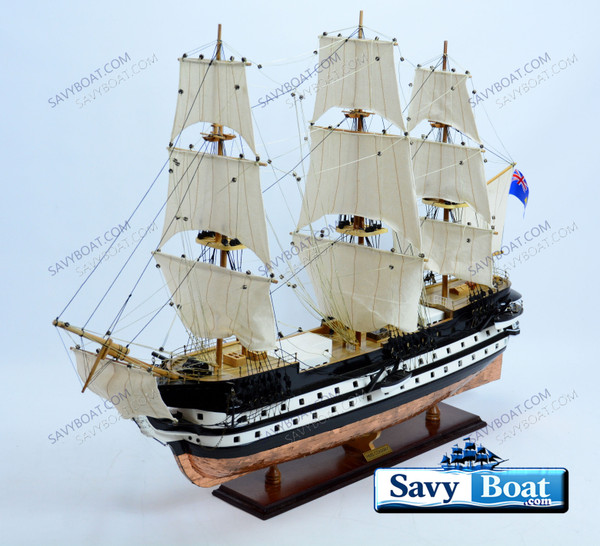

HMS CONWAY TALL TRAINING SHIP
SAVY DIRECT PRICE $1,249.96MSRP: $1,349.99HMS CONWAY TALL TRAINING SHIP FULLY BUILT AND READY TO DISPLAY MUSEUM QUALITY SHIP MODEL Dimension approx.: 39″ (long) x 10″ (wide) x 31″ (high) The model is already built. THIS IS NOT A...
Description

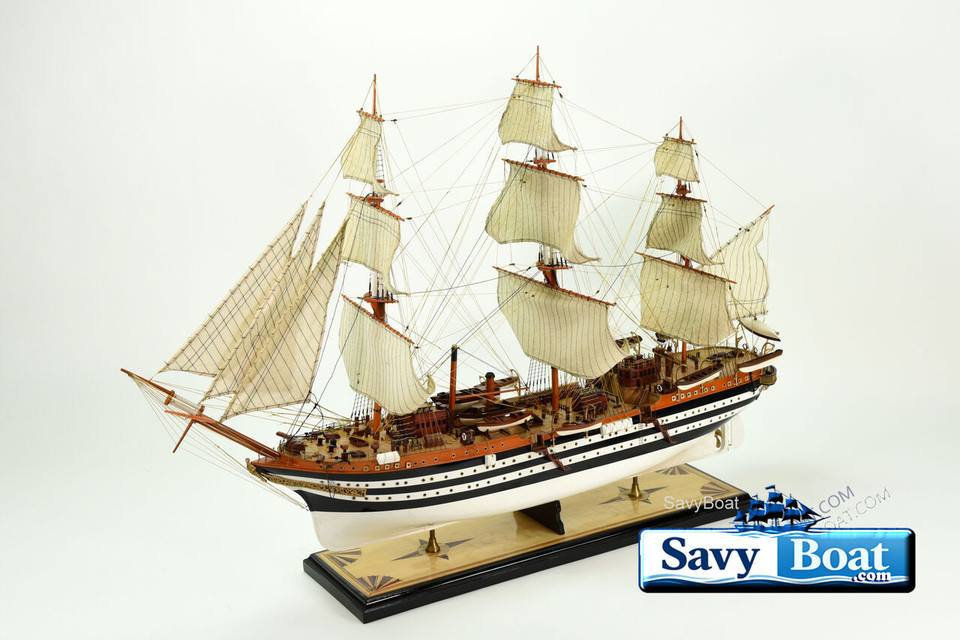
AMERIGO VESPUCCI LARGE TRAINING SAILING SHIP
FULLY BUILT AND READY TO DISPLAY MUSEUM QUALITY SHIP MODEL
- LARGE MUSEUM QUALITY MODEL
- Dimension Approx.: 48″L x 14″W x 33″H
- The model is already built, NOT a model ship kit
- Handcrafted from scratch using finest woods & metal fittings
- Freight shipping required. Please contact us with any questions.
When the Amerigo Vespucci first slipped into the waters of Castellammare di Stabia on 22 February 1931, she was already something of a paradox: a full‑rigged sailing ship launched in an age dominated by steel warships and diesel engines. Designed in 1925 by Lieutenant Colonel Francesco Rotundi, she was conceived not as a relic, but as a living classroom — a vessel that would preserve the seamanship traditions of the Italian Navy while preparing cadets for the modern fleet.
Her design paid homage to the great ships of the 18th and 19th centuries. With a 101‑meter steel hull, three towering masts rising to 54, 50, and 43 meters, and 26 sails spreading more than 2,000 square meters of canvas, she looked every bit the classic tall ship. Her black‑and‑white hull stripes echoed the gunports of old ships of the line, while her gilded bronze figurehead — the explorer Amerigo Vespucci himself — proclaimed her identity with unmistakable pride.
Commissioned in June 1931, she joined her sister ship Cristoforo Colombo as a training vessel for the Italian Naval Academy. From the beginning, her mission was clear: to teach cadets the fundamentals of navigation, rigging, discipline, and leadership through the demanding realities of life under sail. Her training cruises took young officers across the Mediterranean and far beyond, forging character as much as competence.
World War II briefly interrupted her voyages, but the Vespucci survived the conflict intact and returned to service in the postwar years. As Italy rebuilt, she became a symbol of continuity — a reminder of maritime heritage in a rapidly changing world. Over the decades she underwent numerous refits, each carefully modernizing her systems while preserving her historic form. A major update in 2000 added accommodations for female personnel, reflecting the evolving face of the Italian Navy.
By the late 20th century, the Amerigo Vespucci had become more than a training ship; she was a floating ambassador. She crossed the Atlantic, sailed to the Americas, visited Northern Europe, and circumnavigated the globe. She represented Italy at international maritime festivals, the 2004 Athens Olympics, and the 2005 Trafalgar bicentennial in Portsmouth. Wherever she went, crowds gathered to admire her — and sailors from other navies saluted her with respect.
Her reputation for beauty became legendary. In 1962, when she encountered the American aircraft carrier USS Independence, the carrier signaled across the water: “You are the most beautiful ship in the world.” It was a sentiment echoed by nearly everyone who saw her.
Today, the Amerigo Vespucci is the oldest active ship in the Italian Navy, still training cadets with the same blend of tradition and challenge that has defined her for nearly a century. Her motto — “Non chi comincia ma quel che persevera” (“Not he who begins, but he who perseveres”) — captures her spirit perfectly.
She is not just a ship, but a symbol: of craftsmanship, heritage, and the enduring power of sail in a modern world.