






-
 img:low-2-bottom-with-special-offer.pngimg:low-2-bottom-with-special-offer.png
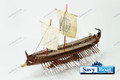
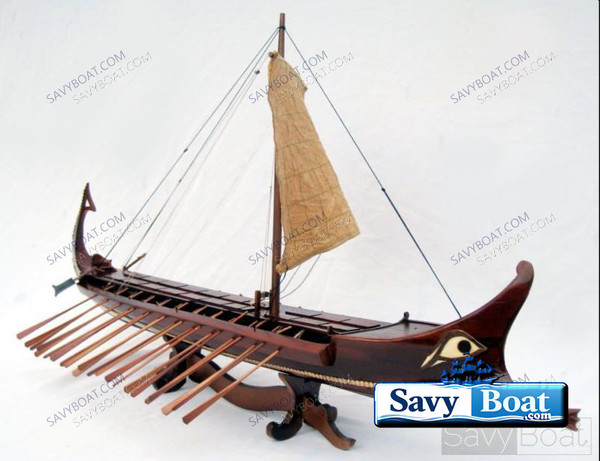
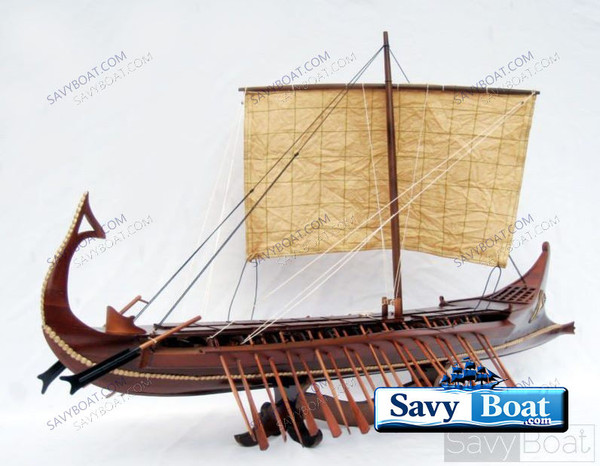
ANCIENT BIREME - ROMAN WARSHIP
SAVY DIRECT PRICE $100.00 - $449.96ANCIENT BIREME - ROMAN WARSHIP FULLY BUILT AND READY TO DISPLAY, QUALITY SHIP MODEL Dimension approx.: 31.5 L x 5.5 W x 17.5 H (inches) The model is already built. THIS IS NOT A MODEL... -

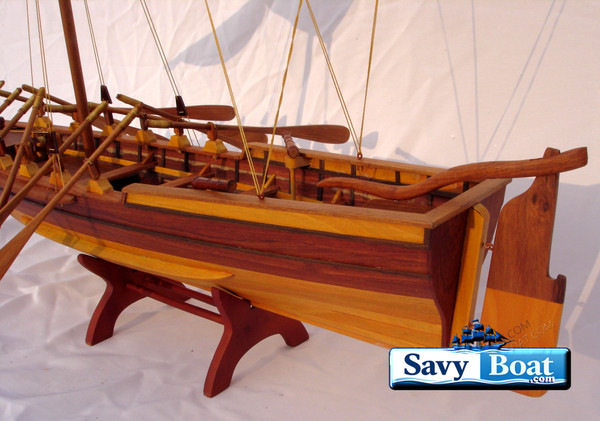
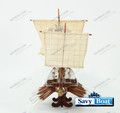
ANCIENT ARMED LAUNCH W/SAIL
SAVY DIRECT PRICE $324.96MSRP: $359.99ANCIENT ARMED LAUNCH FULLY BUILT AND READY TO DISPLAY MUSEUM QUALITY SHIP MODEL Dimension approx.: 25.5L x 6W x 22.5H The model is already built. THIS IS NOT A MODEL SHIP KIT Long...
Description

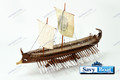
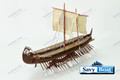
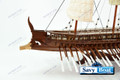
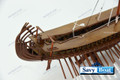
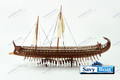
ANCIENT TRIREME - GREEK WARSHIP
FULLY BUILT AND READY TO DISPLAY, QUALITY SHIP MODEL
- Dimension approx.: 31.5 L x 5.5 W x 17.5 H (inches)
- The model is already built. THIS IS NOT A MODEL SHIP KIT
The Trireme — The Warship That Ruled the Ancient Sea
Long before the age of sail, before towering masts and billowing canvas, the Mediterranean was ruled by long, narrow vessels driven by human muscle and tactical precision. Among them, none was more feared, more celebrated, or more transformative than the trireme — the three‑banked galley that became the signature warship of the ancient world.
From the 7th to the 4th centuries BC, the trireme was the apex predator of the sea, the vessel that shaped empires, won decisive battles, and turned the Mediterranean into a theater of naval innovation.
The trireme’s ancestry stretched back to the penteconter, a swift, single‑banked galley with 25 oars per side, and the bireme, which added a second tier of oars. Sometime in the late 8th or early 7th century BC, shipwrights — whether Greek or Phoenician remains debated — achieved a breakthrough: three staggered tiers of oars, each manned by a single rower.
This innovation allowed unprecedented speed and maneuverability without enlarging the hull. The result was a vessel light enough to beach at night, fast enough to ram an enemy amidships, and agile enough to execute complex battle maneuvers.
By the early 5th century BC, the trireme had become the dominant warship of the eastern Mediterranean.
The trireme reached its zenith during the Persian Wars. As the Persian Empire assembled a massive invasion fleet, Athens — guided by the statesman Themistocles — invested the wealth of the Laurion silver mines into building 200 triremes. This decision would change the course of history.
At Artemisium and, more decisively, at Salamis, Greek triremes fought in tight straits where their speed and maneuverability neutralized the Persian numerical advantage. The Greek victory at Salamis forced Xerxes to retreat and preserved the independence of the Greek city‑states.
From this triumph emerged the Athenian maritime empire, a thalassocracy built on the backs of 200 triremes and the thousands of citizens who rowed them.
The trireme was a marvel of precision and balance:
Hull and Structure
-
About 37 meters long and 6 meters wide
-
Built of fir, pine, cedar, and oak, using mortise‑and‑tenon joints
-
Light enough to be carried ashore by roughly 140 men
-
Reinforced by the hypozōma, a massive tensioned cable running the length of the hull, essential for strength and ramming
Oar System
-
170 rowers arranged in three tiers:
-
Thranites (upper)
-
Zygites (middle)
-
Thalamites (lower)
-
-
Only the top row could see the water; the rest rowed by rhythm and command
-
A skilled crew could maintain 6–7 knots and sprint at 8 knots
Armament
-
A bronze‑sheathed ram (embolon) at the bow
-
A small complement of marines (10–20 hoplites and archers)
-
Two masts with square sails for travel, lowered before battle
The trireme was built for one purpose: to strike fast and hard. Naval warfare in the classical world revolved around maneuver and impact. The trireme excelled at:
Ramming
The preferred method — striking the enemy’s hull at an angle to tear open planking and disable the ship.
Diekplous
Breaking through the enemy line, then wheeling to attack from the rear.
Periplous
Sailing around the enemy flank to strike from behind.
Kyklos
A defensive circle to prevent outflanking.
These maneuvers required extraordinary discipline. A trireme was only as effective as its crew — and Athens, with its trained citizen rowers, became the greatest naval power of the age.
During the Peloponnesian War, triremes were the backbone of Athenian strategy. They protected grain routes, enforced tribute, and projected power across the Aegean. But the war also revealed the trireme’s vulnerabilities were Crews needed constant training, Ships required nightly beaching, and the Fleets were vulnerable while foraging for supplies
Athens’ catastrophic defeat in the Sicilian Expedition and the destruction of its fleet at Aegospotami ended its naval supremacy — and with it, the golden age of the trireme.
By the 4th century BC, larger warships — quadriremes and quinqueremes — began to replace the trireme. Yet none matched its elegance, speed, or cultural significance.
The trireme was, The ship that saved Greece, The engine of Athenian democracy, A symbol of naval innovation, adn A masterpiece of ancient engineering.
Modern reconstructions, such as the Olympias, have confirmed what ancient writers claimed: the trireme was one of the fastest and most agile human‑powered vessels ever built.
More than a warship, it was a technological triumph — a vessel that shaped the history of the Mediterranean and the destiny of civilizations.