










-
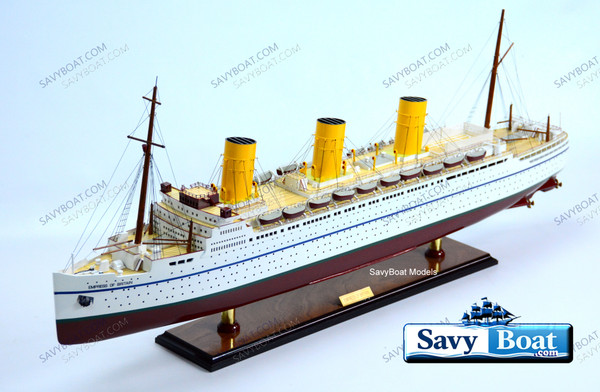

RMS EMPRESS OF BRITAIN
SAVY DIRECT PRICE $899.96MSRP: $999.99EMPRESS OF BRITAIN FULLY BUILT AND READY TO DISPLAY MUSEUM QUALITY SHIP MODEL Dimension approx.: 33″ L x 5.5″W x 13″ H Scale 1:250 The model is already built, NOT a model ship... -


RMS EMPRESS OF IRELAND
SAVY DIRECT PRICE $999.96MSRP: $1,099.99RMS EMPRESS OF IRELAND, CANADIAN PACIFIC LINE FULLY BUILT AND READY TO DISPLAY MUSEUM QUALITY SHIP MODEL Dimension approx.: 36″ L x 5.5″W x 13″ H Scale 1:250 The model is already built,... -

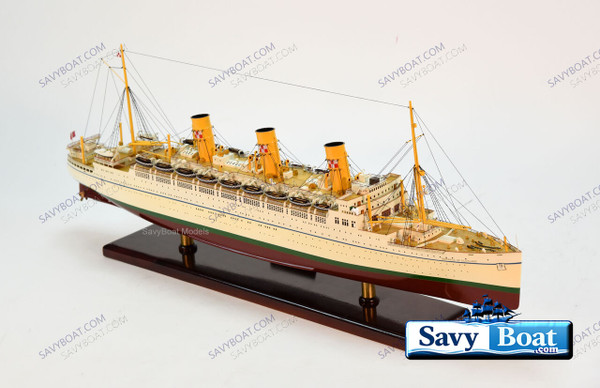
RMS EMPRESS of SCOTLAND
SAVY DIRECT PRICE $1,199.96MSRP: $1,299.99RMS EMPRESS OF SCOTLAND, CANADIAN PACIFIC LINE FULLY BUILT AND READY TO DISPLAY MUSEUM QUALITY SHIP MODEL Dimension approx.: 36″ L x 5.5″W x 13″ H Scale 1:200 The model is already...
Description

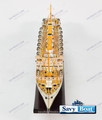
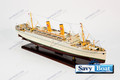
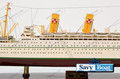
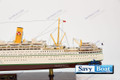
RMS EMPRESS OF FRANCE, CANADIAN PACIFIC LINE
(formerly Duchess of Bedford)
FULLY BUILT AND READY TO DISPLAY MUSEUM QUALITY SHIP MODEL
- Dimension approx.: 36″ L x 5.5″W x 13″ H Scale 1:200
- The model is already built, NOT a model ship kit
- Handcrafted from scratch using finest woods & metal fittings
- This beautiful model is already built, NOT a kit.
- Handcrafted from finest wood and metal fittings.
- Open die cut side hull windows, NOT painted like those built by most other companies.
- The model is 100% hand built by artisans from scratch
- Hand-painted to match the actual ship.
RMS EMPRESS OF FRANCE began her life in 1928 on the River Clyde, rising from the slips at John Brown’s yard with the clean, purposeful lines of a ship built for distance and ambition. They named her Duchess of Bedford, one of four “Mini‑Empresses” designed to push deeper into the St. Lawrence than the great liners could, carrying travelers straight to Montreal before the rails whisked them toward Chicago and the American Midwest. She was modern for her time—hot and cold running water in every cabin—and notorious for her lively motion at sea. Sailors called her and her sisters the “Drunken Duchesses,” affectionate and exasperated in equal measure.
In the early years she carried a curious mix of passengers: financiers, writers, families, dreamers. In 1931, Montagu Norman, Governor of the Bank of England, paced her decks as the world’s financial order shifted beneath his feet. Two years later, Elspeth Huxley sat in a quiet corner of the ship, shaping the life of Lord Delamere into prose as the Atlantic rolled beneath her.
Then came the war.
In September 1939, the Duchess of Bedford was taken into Admiralty service, her peacetime elegance stripped back to the hard necessities of a troopship. She carried officials to India, then joined the desperate, chaotic evacuation of Singapore. In January 1942 she brought nearly two thousand men of the 18th Infantry Division toward a city already trembling on the edge of collapse. Ten days across dangerous waters, then a hurried departure with evacuees as the noose tightened.
Her most storied moment came later, in 1942, when she sailed in the great armada of Operation Torch. From Greenock she carried the men of the U.S. 16th Infantry Regiment toward the shores of Algeria, landing them at Arzew on 8 November—the first American troops to step into the North African campaign. She returned to war again and again: Sicily, Salerno, the long push up Italy. In 1944 she carried West African soldiers from Lagos to India, bound for the jungles of Burma.
When peace finally returned, the Canadian Pacific fleet was a shadow of what it had been. The Duchess of Bedford survived, battered but serviceable, and in 1947 she was reborn. At the Fairfield yard in Govan, her interiors were remade, her passenger lists reduced, her purpose refined. India’s independence ended plans to rename her Empress of India, so she emerged instead as RMS Empress of France, a title she carried with quiet dignity.
She resumed her old route—Liverpool to Montreal—now sleeker, more modern, her funnel tops streamlined in a 1958 refit. But the world was changing. Jets shrank oceans in hours, and the age of the great liners dimmed.
In 1960, after more than three decades of crossings, evacuations, invasions, and migrations, the Empress of France made her final voyage—this time to the breakers at Newport. Steel that had carried empires, armies, and ordinary lives was cut apart and sold for scrap.
Yet in memory she remains: a ship that rolled like a drunkard, served like a veteran, and lived through some of the most turbulent decades of the twentieth century.