







-
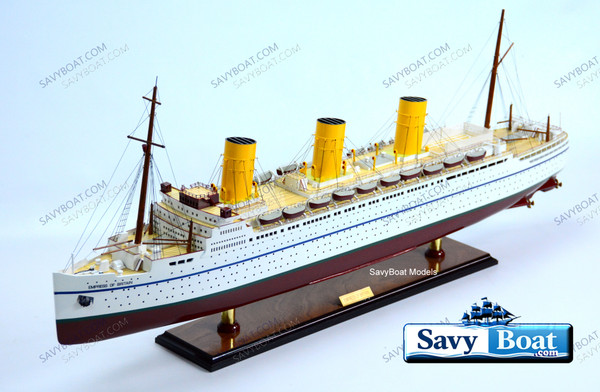

RMS EMPRESS OF BRITAIN
SAVY DIRECT PRICE $899.96MSRP: $999.99EMPRESS OF BRITAIN FULLY BUILT AND READY TO DISPLAY MUSEUM QUALITY SHIP MODEL Dimension approx.: 33″ L x 5.5″W x 13″ H Scale 1:250 The model is already built, NOT a model ship... -


RMS EMPRESS OF IRELAND
SAVY DIRECT PRICE $999.96MSRP: $1,099.99RMS EMPRESS OF IRELAND, CANADIAN PACIFIC LINE FULLY BUILT AND READY TO DISPLAY MUSEUM QUALITY SHIP MODEL Dimension approx.: 36″ L x 5.5″W x 13″ H Scale 1:250 The model is already built,... -

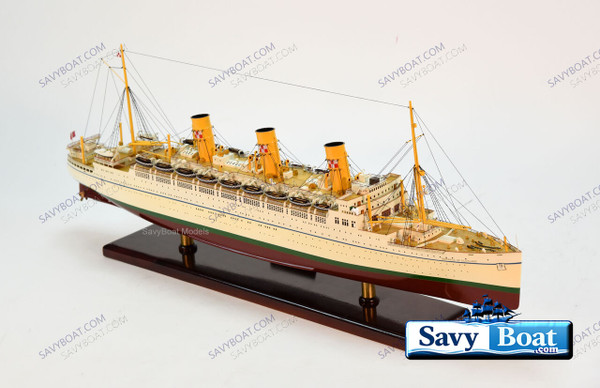
RMS EMPRESS of SCOTLAND
SAVY DIRECT PRICE $1,199.96MSRP: $1,299.99RMS EMPRESS OF SCOTLAND, CANADIAN PACIFIC LINE FULLY BUILT AND READY TO DISPLAY MUSEUM QUALITY SHIP MODEL Dimension approx.: 36″ L x 5.5″W x 13″ H Scale 1:200 The model is already...
Description

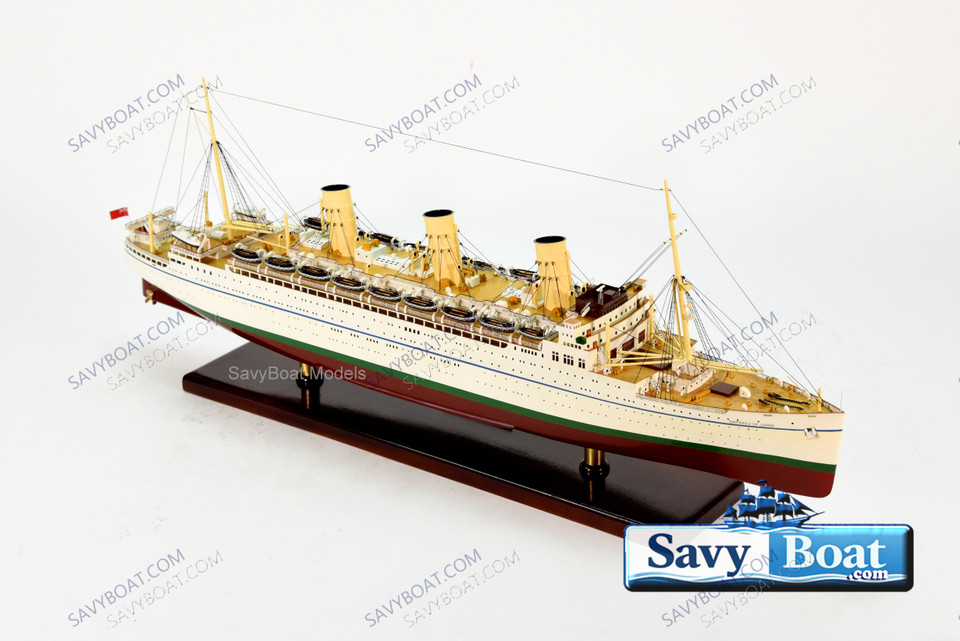
RMS EMPRESS OF JAPAN, CANADIAN PACIFIC LINE
FULLY BUILT AND READY TO DISPLAY MUSEUM QUALITY SHIP MODEL
- Dimension approx.: 36″ L x 5.5″W x 13″ H Scale 1:200
- The model is already built, NOT a model ship kit
- Handcrafted from scratch using finest woods & metal fittings
- This beautiful model is already built, NOT a kit.
- Handcrafted from finest wood and metal fittings.
- Open die cut side hull windows, NOT painted like those built by most other companies.
- The model is 100% hand built by artisans from scratch
- Hand-painted to match the actual ship.
The Empress of Japan entered the world in the last bright years before the Depression, sliding down the ways at Govan in 1929 with the confidence of a ship built for speed and distance. She was Canadian Pacific’s new greyhound of the Pacific, meant to knit together a world that still believed in the romance of long routes: Britain to Canada by sea, Canada to Vancouver by rail, and then—aboard her sleek decks—across the vast Pacific to Asia. When she began service in 1930, she proved herself immediately, racing across the ocean in nine days and earning a reputation as the fastest liner on the Pacific. Celebrities drifted through her staterooms, including Babe Ruth on his famous 1934 goodwill tour to Japan, but most passengers remembered her for the sense of purposeful motion she carried, as if she were always leaning slightly toward the horizon.
War changed her story. After 1941, the name Empress of Japan became untenable, and she was reborn as the Empress of Scotland, a ship pressed into the urgent, unglamorous work of wartime transport. She carried troops, evacuees, and the displaced, and in early 1942 she made her most dramatic escape—slipping out of Singapore just before the city fell, her decks crowded with civilians fleeing the collapse of the British Empire in Asia. She survived the war scarred but intact, and in the late 1940s she returned to her builders to be reshaped for a new life on the colder, stormier Atlantic. Her three funnels were still her signature, but inside she was transformed, her old four-class layout replaced with a simpler, more modern arrangement. In 1951 she carried Princess Elizabeth and Prince Philip home from Canada, a moment of peacetime prestige near the end of her Canadian Pacific career.
Her final incarnation came in 1958, when the Hamburg Atlantic Line purchased her and remade her once again—this time as the TS Hanseatic. The rebuild was radical: funnels removed or reshaped, superstructure modernized, accommodations expanded for a booming postwar travel market. She emerged almost unrecognizable, a 30,000‑ton transatlantic liner meant to carry more than a thousand passengers between Hamburg and New York. For a few years she thrived, a symbol of West Germany’s return to the world’s oceans.
But in 1966, fire found her in New York Harbor. Flames tore through her engine room and climbed upward, gutting decks that had once carried baseball stars, evacuees, royalty, and tourists. She was towed back to Hamburg for inspection, but the verdict was swift: the damage was too great, the cost too high. After a career that spanned three names, three identities, and three eras of ocean travel, the ship that began as the Empress of Japan was quietly scrapped, her long wake fading into memory.