




-

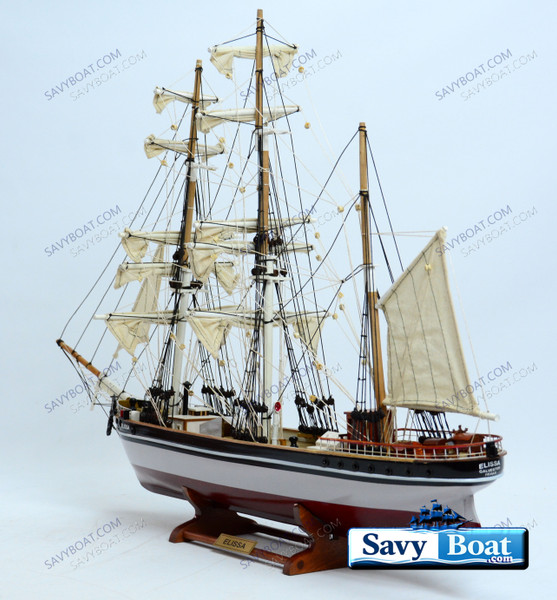
ELISSA TALL SHIP
SAVY DIRECT PRICE $739.96MSRP: $789.99ELISSA TALL SHIP FULLY BUILT AND READY TO DISPLAY QUALITY SHIP MODEL Dimension approx.: 31″ (long) x 9″ (wide) x 19″ (high) The model is already built. THIS IS NOT A MODEL SHIP... -


COSCO CONTAINER SHIP
SAVY DIRECT PRICE $899.96MSRP: $999.99COSCO CONTAINER SHIP FULLY BUILT AND READY TO DISPLAY MUSEUM QUALITY SHIP MODEL Dimension approx.: 40″ (long) x 7″ (wide) x 11″ (high) The model is already built. THIS IS NOT A... -


AIDAvita CRUISE SHIP
SAVY DIRECT PRICE $799.96MSRP: $899.99AIDAVITA (BLUE DREAM MELODY) PASSENGER SHIP FULLY BUILT AND READY TO DISPLAY, QUALITY SHIP MODEL Dimension approx.: 33″ L x 7″ W x 16″ H The model is already built. THIS IS NOT A...
Description

ENDURANCE TALL SHIP
FULLY BUILT AND READY TO DISPLAY MUSEUM QUALITY SHIP MODEL
- Dimension approx.: 34″ L x 9″W x 25.5″H
- The model is already built. THIS IS NOT A MODEL SHIP KIT
- Rosewood, mahogany, teak and other exotic woods are carefully selected to build the model
- Hull handmade from wood, hollow inside
- Handcrafted from scratch using finest woods & metal fittings
- The model is 100% hand built by artisans from scratch
- Hand-painted to match the actual ship.
She was born in a place where ships were carved with the same seriousness as monuments. At the Framnæs shipyard in Sandefjord, Norway, Polaris — the ship that would become Endurance — took shape under the uncompromising eye of master builder Christian Jacobsen. Jacobsen insisted that every man who worked on her be both a shipwright and a seafarer, someone who understood not just wood and tools, but the moods of ice and the violence of polar seas. The result was a vessel built with almost obsessive strength: “every joint and fitting was cross‑braced for maximum strength,” and her keel was a stack of four massive oak timbers totaling 85 inches thick. Her sides were layered with oak and Norwegian fir up to 30 inches deep, sheathed in greenheart — a wood so dense it seemed forged rather than grown.
Yet for all this ruggedness, she was originally intended to be a luxurious Arctic yacht. She carried ten passenger cabins, a dining saloon, a smoking room, a galley with space for two cooks, electric lighting, and even a darkroom for developing photographs. She was a strange hybrid: a fortress disguised as a pleasure craft.
Financial trouble changed her fate. Her commissioner, Adrien de Gerlache, went bankrupt, and the ship sat unwanted. She was too specialized for whaling, too large and slow for private leisure. For more than a year she lingered, unsold — until Ernest Shackleton appeared in 1914.
Shackleton bought her for £14,000, rechristened her Endurance, and transformed her into the flagship of his Imperial Trans‑Antarctic Expedition. Her white hull was repainted black. Passenger spaces were gutted and turned into storage. The crew moved into cramped quarters in the forecastle. Three boats were added: two secondhand cutters and a specially designed whaleboat drawn up by Captain Frank Worsley. The ship’s elegant interior became a working machine.
On 8 August 1914, Endurance sailed from Plymouth on her maiden voyage, bound for Buenos Aires. Shackleton joined her later, and from there she continued to South Georgia, arriving at the whaling station of Grytviken on 5 November. The whalers warned him that the Weddell Sea was “the worst they had ever known.” Shackleton listened — and sailed anyway.
Two days after leaving South Georgia, Endurance met the pack ice. At first it was scattered floes, then thicker fields, then a solid white world stretching to the horizon. Progress slowed to “less than 30 nautical miles per day.” By mid‑January 1915, they were within 200 miles of Vahsel Bay — close enough to taste success — when a gale blew in and the ice closed around them.
On 24 January, the entire Weddell Sea compressed against the Antarctic coast. The ship was suddenly “icebound as far as the eye could see in every direction.” The men waited for a southerly wind to loosen the pack, but temperatures plunged to –19°C, and the ice held firm.
In February, a brief hope appeared. A pool of young ice formed around the ship, and the crew hacked a 150‑yard channel toward open water. They hauled 20‑ton slabs of ice with ropes, rammed the ship forward under full steam and full sail, and worked until their hands bled. But the pool was too small; the channel froze again. Shackleton ordered the boilers extinguished. The ship would now drift with the ice.
As the Antarctic summer ended, the sun dipped below the horizon at midnight on 17 February. Winter tightened its grip. The ship drifted west‑northwest, carried by the massive, grinding pack. The men lived aboard as if on land, their world reduced to a wooden island trapped in a frozen desert.
July brought violence. A gale with 70‑mph winds and –36°C temperatures shattered the pack into moving floes. Pressure waves rippled through the ice, lifting the 400‑ton ship into the air before dropping her into pools of water. The floes slammed her from all sides. Yet she survived — her hull so strong that the ice itself cracked against her.
But the strain accumulated. By late September, the oak beams supporting the upper deck bent “like a piece of cane.” The masts whipped back and forth as the keel distorted. Still, Worsley wrote admiringly that “just as it appears she can stand no more, the huge floe… yields to our little ship by cracking across.”
October brought warmer temperatures and signs of the ice loosening. On 14 October, Endurance floated free in a pool of water for the first time in nine months. Shackleton ordered steam raised, but a leak delayed the effort. When a lead of open water appeared, the sails were set — but the ship could not break through.
Then, on 18 October, the ice closed again. In five seconds the ship was thrown onto her port side at a 30‑degree angle. She righted herself hours later, but the message was clear: the ice was tightening its grip.
On 24 October, the final assault began. Pressure waves crushed the stern, tearing the sternpost from the hull. The bow planking stove in. Water flooded the engine room and forward hold. Pumps froze. McNish built a cofferdam to slow the flooding, but after 28 hours of nonstop pumping, Shackleton gave the order: abandon ship.
The men moved stores, boats, and equipment onto the ice. The ship sagged visibly each day. On 13 November, the forward masts collapsed, captured on film by Frank Hurley. On 21 November, a final pressure wave lifted the stern clear — then the entire ship dropped into the sea and vanished as the floes closed over her.
The crew drifted on the ice for months before rowing to Elephant Island. Shackleton and five others sailed the James Caird to South Georgia, and after several failed attempts, he rescued the remaining men on 30 August 1916. All survived.